
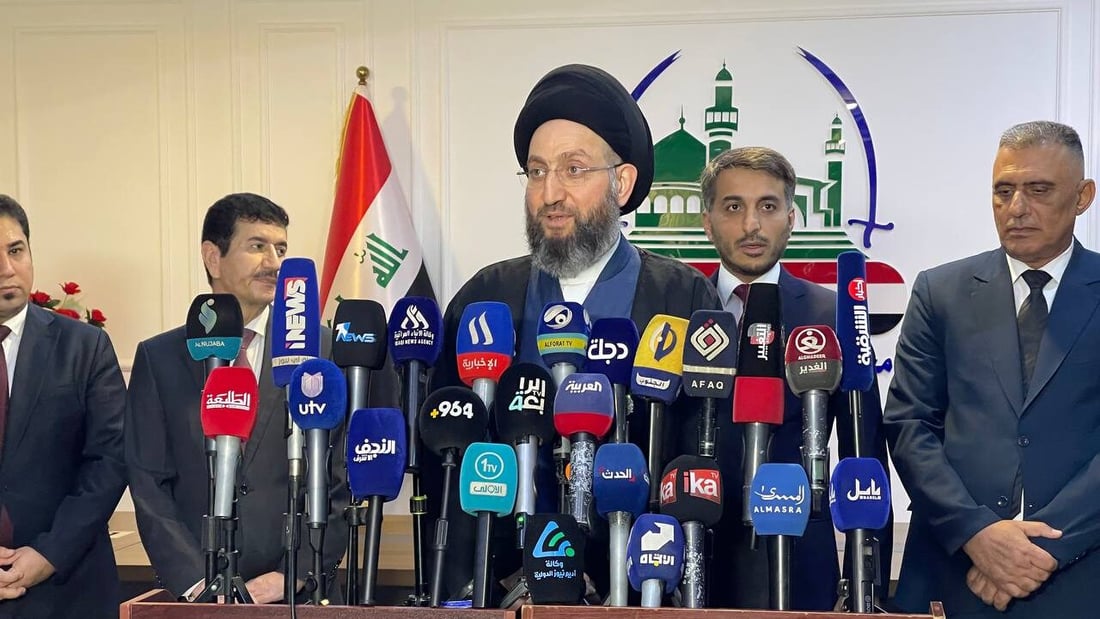
The head of the Al-Hikma Movement, Ammar Al-Hakim
Al-Zaidi, Al-Hakim urge respect for constitutional deadlines amid political deadlock
BAGHDAD — Services Alliance leader Shibl al-Zaidi and head of the Hikma Movement Ammar al-Hakim stressed the need to respect constitutional deadlines for electing a president and appointing a prime minister, according to a statement released Saturday.
The statement, issued by the Services Alliance, said al-Zaidi received al-Hakim to discuss political developments and ways to move forward in completing constitutional entitlements, foremost among them the election of the president as a step toward tasking a prime minister with forming the next government.
The two leaders “affirmed the necessity of adhering to constitutional timeframes,” the statement said, emphasizing “the importance of unifying positions within the Coordination Framework in a way that serves the public interest.”
They also noted that the current phase requires “a high level of national responsibility” to ensure political stability and enhance public confidence in “the democratic process”.
Iraq’s government formation has stalled since the November 2025 parliamentary elections. Under Article 72 of the constitution, parliament must elect a president within 30 days of its first session — a deadline that has long passed. The president then nominates a prime minister candidate to form a government.
Speaker Haibat al-Halbousi has formally requested the Federal Supreme Court to interpret a constitutional provision on the continuation of the president’s duties, following parliament’s failure to elect a new president within the required timeframe.
The position has been at the center of a dispute between the Kurdistan Democratic Party and the Patriotic Union of Kurdistan. On Feb. 11, PUK spokesperson Karwan Gaznay said a meeting between KDP leader Masoud Barzani and PUK President Bafel Jalal Talabani took place “in an atmosphere characterized by complete calm,” but denied any agreement had been reached.
At the same time, the Shiite Coordination Framework nominated Nouri al-Maliki, who served from 2006 to 2014, prompting debate among Iraqi political forces. He stepped down in 2014 under pressure following security failures, including the fall of Mosul to the Islamic State group.
The nomination also drew reactions abroad. President Donald Trump said in a social media post that the United States would not continue its support for Iraq if Maliki returned to office.