
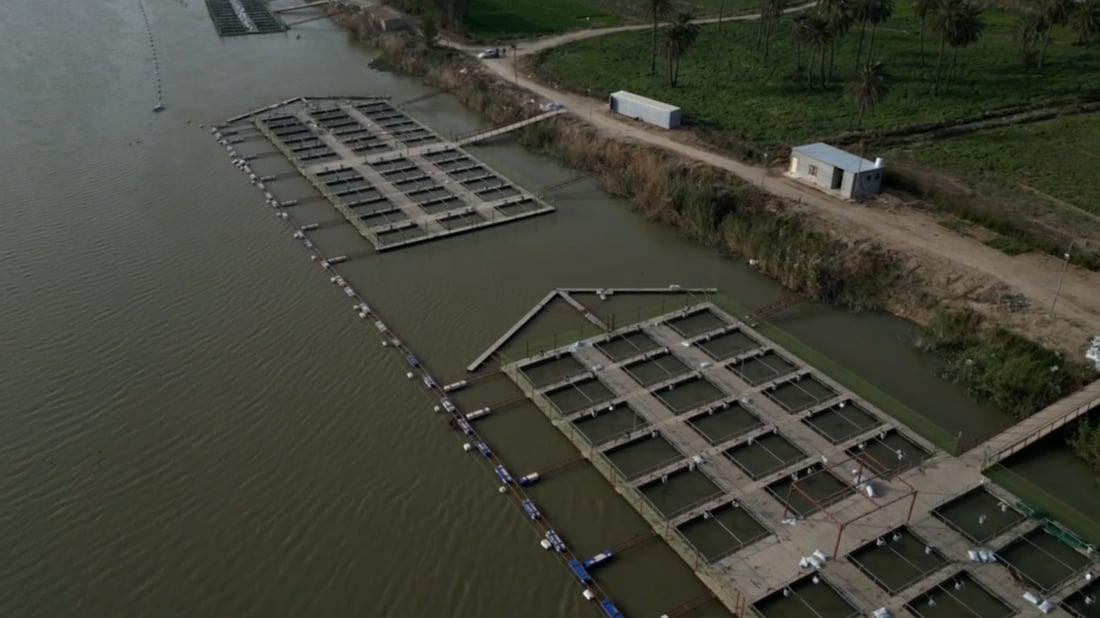
Aerial view of floating fish cages installed along the Tigris River northwest of Kut in Wasit governorate, where farmers raise fish in flowing river water. Photo by 964media.
Producers cite losses
Wasit fish farmers seek feed support for floating cage projects
KUT — Fish farmers in Wasit governorate say floating cage aquaculture on the Tigris River offers an environmentally sound alternative to pond farming but warn that rising feed costs and market pressures are pushing many operations toward losses.
Producers say raising fish in cages on flowing river water does not consume additional water resources and produces higher-quality fish compared with those raised in stagnant, muddy ponds. They note that pond fish can carry an earthy taste due to sediment and crowded conditions, while river fish are darker in color and considered cleaner.
Aerial footage documented by 964media shows rows of floating cages on the Tigris northwest of Kut, near the old Al-Ahrar Bridge and the Al-Alkaya area. Farmers say the method benefits water reserves and public health, yet their financial calculations are increasingly unfavorable due to cheap imports and the continued presence of unlicensed ponds that sell lower-quality fish at reduced prices.
Lake-raised fish can sell for as little as 3,000 Iraqi dinars (about $2) per kilogram, while river fish require higher production costs. Farmers say licensing alone can cost up to 7 million dinars (about $4,667), a detail many consumers may not realize.
Authorities have previously launched campaigns against unlicensed fish ponds, which were often filled by diverting river water into artificial basins dug in orchards. Officials say the spread of such projects contributed to water shortages downstream, particularly in Basra governorate.
Hisham Mahdi, a floating cage farmer, said the process begins with an application to the Water Resources Department to lease a suitable site and conduct an inspection. “The license is granted after approval and costs can reach 7 million dinars (about $4,667),” he said.
Farmers purchase fingerlings from producers in Hilla, initially raising them in earthen ponds. Once the fish reach a pre-maturity stage known locally as “kafiyat,” they are transferred to floating cages, where they are raised for about eight months.
Each fish consumes about 4 kilograms of feed at a cost of 5,000 dinars (about $3.33), while the market price is about 3,500 dinars (about $2.33) per kilogram, a gap farmers say does not cover expenses.
Hakim Karim, another floating cage owner, said the government should not halt imports but instead provide support and study the market. He noted that a ton of imported feed costs about 1.25 million dinars (about $833).
Karim praised cooperation from government departments but pointed to “large losses,” predicting that many cage farmers may halt production after selling their current stock. He said each fish currently results in a loss of about 1,000 dinars (about $0.67) due to high feed prices, mortality rates and disease.
A single cage measuring 6 meters by 4 meters can hold about 3,000 pre-maturity fish, “but we do not harvest more than 1,250 fish weighing one and a half kilograms at marketing due to losses,” he said.
Farmers are requesting about four dunams of land to establish earthen ponds for raising fingerlings before transferring them to floating cages, a process that takes about four months. With limited local production capacity — except for one producer in Suwayrah — Wasit relies on fish supplies from Hilla.