
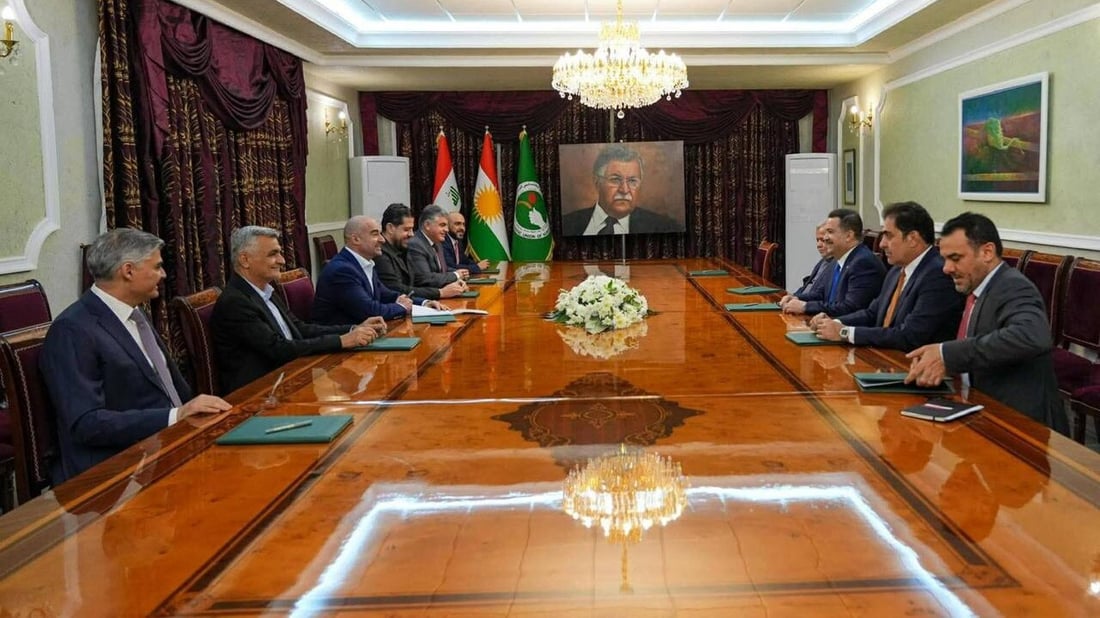
(Photo: Al-Sudani's media office)
Sudani meets PUK leader in Sulaymaniyah over presidency, next government
SULAYMANIYAH — Prime Minister Mohammed Shia al-Sudani met Monday in Sulaymaniyah with Patriotic Union of Kurdistan President Bafel Talabani, following his meeting with Kurdistan Democratic Party leader Masoud Barzani and senior KDP figures in Erbil, according to a statement from the prime minister’s media office.
Al-Sudani was accompanied by a delegation from the Coordination Framework that included Badr Organization Secretary General Hadi al-Amiri, Al Asas Coalition head Mohsen al-Mandalawi, and Coordination Framework Secretary General Abbas Radhi.
According to the media office, the meeting reviewed “the overall situation and latest developments at the national and regional levels,” and stressed “the importance of resolving the position of President of the Republic and moving forward with completing the constitutional entitlements.”
The statement said the discussions focused on forming a government “that reflects the aspirations of all Iraqis and continues the path of reform, reconstruction, and development witnessed by Iraq in recent years.”
Iraq is in the midst of government formation process following the 2025 parliamentary elections, with key constitutional steps yet to be completed. Under Iraq’s constitution, the Council of Representatives must first elect a president. The president is then tasked with nominating a candidate to form a government and appoint a prime minister. Until those steps are concluded, the current political process remains stalled.
That process has faced repeated delays. Parliament on Sunday postponed a scheduled session to elect the president without announcing a new date, prolonging the political deadlock and delaying the transition to a new government. Similar postponements have occurred in recent weeks as political blocs continue negotiations over key positions.
Since 2003, Iraq has operated under an informal power-sharing arrangement designed to balance representation among the country’s main political and sectarian groups. Under this system, the presidency is customarily held by a Kurdish politician, the prime ministership by a Shiite Arab, and the speakership of parliament by a Sunni Arab.
Despite this convention, Kurdish parties have not yet agreed on a unified presidential candidate. The Kurdistan Democratic Party and the Patriotic Union of Kurdistan, the two largest Kurdish political parties, have each put forward or supported different figures and have so far failed to reach a consensus.
Alongside the dispute over the presidency, divisions have also emerged over the selection of a prime minister. The Shiite Coordination Framework has nominated former prime minister Nouri al-Maliki as its candidate for the post, a move that has generated debate within Iraq’s political scene.
The nomination has also prompted reactions outside the country. U.S. President Donald Trump said in a social media post that the United States would not continue its support for Iraq if al-Maliki were to return to office, citing his previous term as prime minister.
Iraqi political actors have not publicly linked the stalled formation process to foreign positions, but the statement added an external dimension to an already complex political landscape.