
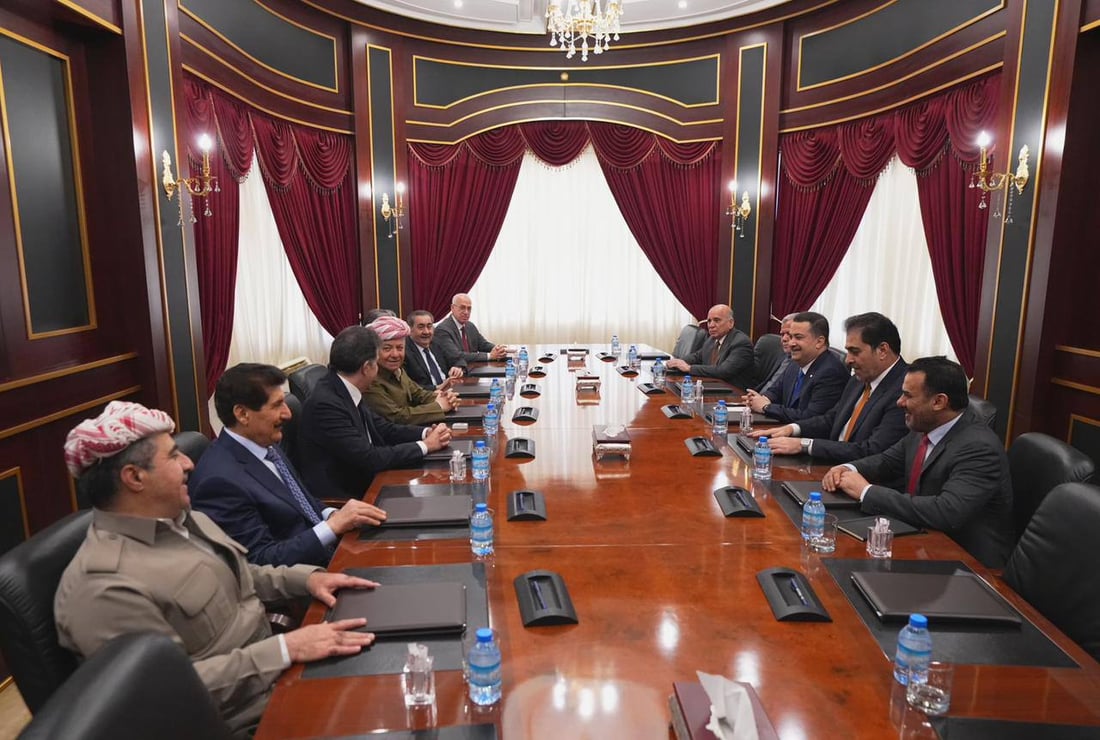
(Photo: Al-Sudani's media office)
Al-Sudani meets Barzani in Erbil as Iraq’s government talks stall
ERBIL — Prime Minister Mohammed Shia al-Sudani met Monday in Erbil with Kurdistan Democratic Party leader Masoud Barzani and senior KDP figures as Iraq’s government formation process remains stalled by repeated delays in electing a president and mounting controversy over the nomination of a prime minister, including public opposition from U.S. President Donald Trump to the return of former prime minister Nouri al-Maliki.
The meeting included a delegation from the Shiite Coordination Framework, including Badr Organization Secretary-General Hadi al-Amiri, Al Asas Coalition head Mohsen al-Mandalawi and Coordination Framework Secretary-General Abbas Radhi.
According to al-Sudani’s media office, the talks reviewed “the forthcoming constitutional entitlements, foremost among them the election of the President of the Republic,” with the aim of completing the formation of the next government “in accordance with the results of the parliamentary elections.”
Iraq is navigating the next steps in government formation after the 2025 parliamentary elections. Under the constitution, parliament elects a president, who then tasks a nominee with forming a cabinet and appointing a prime minister. That process remains incomplete, and parliament on Sunday postponed a scheduled session to elect the president without setting a new date, extending the political impasse.
Under Iraq’s post-2003 power-sharing arrangement, the presidency is customarily held by a Kurdish politician, while the post of prime minister goes to a Shiite Arab and the speakership of parliament to a Sunni Arab. Kurdish parties, however, have not agreed on a single presidential candidate. The Kurdistan Democratic Party and the Patriotic Union of Kurdistan, the two main Kurdish political forces, have yet to reach consensus on a nominee, contributing to repeated delays in holding a session to elect the president.
At the same time, the Coordination Framework has nominated al-Maliki as its candidate for prime minister. The move has drawn reactions beyond Iraq, including opposition from Trump, who said in a social media post that the United States would not continue its support for Iraq if al-Maliki returned to office, citing his previous term in power.
The discussions in Erbil also addressed “current regional developments and the situation in Syria,” al-Sudani’s media office said, stressing “the importance of unifying the Iraqi national political discourse in addressing these developments and events.” The statement said the talks emphasized handling regional issues “in a manner that strengthens Iraq’s position and safeguards its supreme national interests.”
Syria’s government and the Kurdish-led Syrian Democratic Forces reached a broad agreement Friday to gradually integrate Kurdish military and civil institutions into the state after weeks of clashes that ended in a ceasefire.