
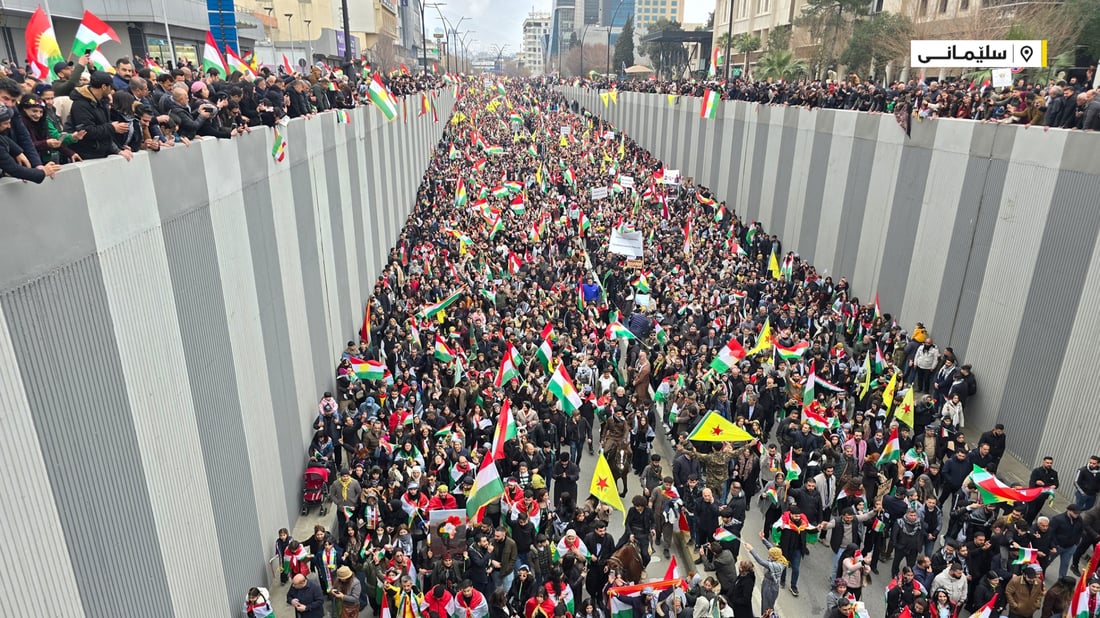
Demonstrators wave Kurdistan flags during a large rally in Sulaymaniyah on Friday in support of Kurds in Rojava, northeastern Syria. Photo by 964media.
Unity rallies
Thousands rally across Kurdistan Region for Rojava
KURDISTAN REGION — Thousands of people across Erbil, Sulaymaniyah and other cities and towns in the Kurdistan Region demonstrated Friday in support of Kurds in Rojava, northeastern Syria, waving Kurdistan flags and chanting calls for unity as fighting and displacement there continue to drive protests and aid campaigns.
In Erbil, large crowds gathered in front of the historic Erbil Citadel, chanting, “One, one, one… the Kurdish people are one.” Awara Asaad, a resident of the Hirana subdistrict, told 964media he left on foot at 7:17 a.m. and walked for six hours to reach Koya on his way to Erbil. “I still need three more hours to reach central Erbil,” he said during the protest. Asaad added, “We want to deliver our message to the world that the oppression committed against Kurds in the past must not continue. Kurds must not be oppressed anymore.” Another protester, Kameran Kakakhan, told 964media, “Our dignity is one with our brothers and sisters in Rojava, and we must protect it in every possible way.”
Organizers in Erbil displayed a large symbolic braid made from traditional Kurdish women’s clothing at the citadel gate. Tara Khalil, an organizer with the Chalabi humanitarian organization, told 964media, “Only our girls and women cut their hair,” saying the braid, designed in the colors of the Kurdistan flag, was 11 meters long and took nine days to complete. She said the display reflected the cultural meaning of braided hair in Kurdish society, where it symbolizes dignity, strength and identity. “We want to show the world that the Kurdish people will not surrender, and even through cutting their hair, they will not give up and resistance will continue,” she said. The display follows the circulation of a video showing a Syrian pro-government militant holding the braid of a slain Kurdish woman and mocking her death, an act widely condemned by Kurds as a cultural and human rights violation.
In Sulaymaniyah, the demonstration began at 2:30 p.m. in front of the Public Park, then marched along Salim Street. Thousands filled the street chanting, “Bijî Berxwedana Rojava,” or “Long live the Rojava resistance,” while raising Kurdistan flags and flags associated with the People’s Protection Units, or YPG. Protesters also chanted, “We are this — we are Kurds.” Two demonstrators carried a large banner in English reading, “World, turning back on the Kurds is immoral,” while another banner read, “Hair can be cut, freedom cannot!”
Artist Dashti Murad, who joined the Sulaymaniyah protest, told 964media, “I’ve been participating in protests in Erbil for two weeks, and today I wanted to take part in Sulaymaniyah. Kurdish unity is extremely important. For me, it’s a very positive and meaningful feeling. As five million we cannot stand against genocide and oppression, but as 40 million we can.” He added, “Because Kurds from all areas raised their voices, we were able to deliver our message to the world. Kurdish unity must continue.”
Similar demonstrations were held Friday in other cities and towns across the Kurdistan Region, including Rania, Halabja and Kalar. In Kalar, one protester told 964media, “It is the duty of all of us to support the Kurds of Rojava with our homes and our blood, because our destiny is one. All Kurds must stand united. No part of Kurdistan is separate from another.” A young woman participating in the protests said, “Today, like previous days, we are protesting with even greater determination to support our brothers and sisters in Rojava.”
The rallies followed weeks of demonstrations across the Kurdistan Region after attacks by Syrian government forces and allied Islamist militias on Kurdish-led areas in northeastern Syria displaced large numbers of civilians and prompted widespread humanitarian aid campaigns. They also came after a new agreement between the Syrian government and the Syrian Democratic Forces to halt hostilities and begin integrating military and civil institutions, a deal welcomed by Kurdistan Region leaders, as demonstrators said continued public pressure remains essential to protect Kurdish rights in Syria.