
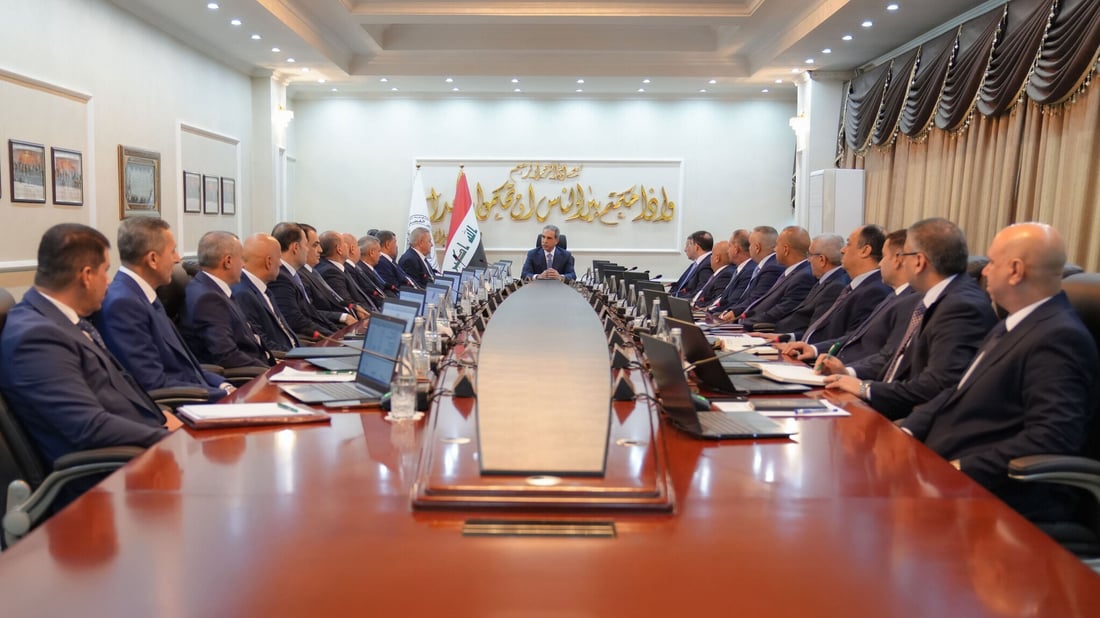
Members of Iraq’s Supreme Judicial Council meet in Baghdad on Jan. 29 to discuss constitutional timelines for forming the next government and warn against foreign interference.
Iraq judiciary warns against foreign interference in political process
BAGHDAD — Iraq’s Supreme Judicial Council on Thursday warned against foreign interference in the country’s political process, stressing adherence to constitutional timelines for appointing the president and prime minister, according to a statement issued after its first session of the year.
The council said it “affirmed the importance of adhering to constitutional timelines in completing the procedures for appointing the president of the republic and the prime minister,” and called on “all parties and political forces to commit to and respect these timelines and not violate them,” in order to protect political stability and ensure the democratic process proceeds “within constitutional and legal frameworks and to prevent any external interference.”
The session was held Thursday morning, Jan. 29, under the chairmanship of Faiq Zaidan, head of the Federal Court of Cassation, the statement said. The council also paid tribute to Deputy Public Prosecutor Mohammed Abdul Aziz Hassan, who died on Jan. 13 while serving at the Salahuddin public prosecution office.
The council’s warning comes against the backdrop of escalating political reactions to comments by U.S. President Donald Trump regarding the potential return of former Prime Minister Nouri al-Maliki. Writing on Truth Social, Trump warned that the United States would “no longer help” Iraq if Maliki were to return to office, saying the country would have “ZERO chance of Success, Prosperity, or Freedom” without U.S. support and citing what he called Maliki’s “insane policies and ideologies.”
Maliki rejected the remarks, describing them as interference in Iraq’s internal affairs. “We categorically reject blatant American interference in Iraq’s internal affairs, and consider it a violation of its sovereignty and contrary to the democratic system in Iraq after 2003,” he said in a statement. He added that such comments were “an infringement on the decision of the Coordination Framework to choose its nominee for the post of prime minister,” and said relations between states should rely on “the language of dialogue … not … dictates and threats.”
Shia political groups aligned with the Coordination Framework also condemned Trump’s comments. Asaib Ahl al-Haq said it rejected “attempts to interfere in our internal affairs and influence the peaceful transfer of power,” adding, “We do not accept external dictates and affirm that Iraqis are capable of identifying their interests, choosing their options, and nominating whomever they see as capable of managing the Iraqi state.”
Abu Turab al-Tamimi, a leader in the Popular Mobilization Forces and the Badr Organization, said, “No honorable politician or Iraqi can accept American interference,” adding that “Iraq needs a strong prime minister like Maliki.”
The Coordination Framework has nominated Maliki, who served two terms from 2006 to 2014, for another term as prime minister. His second term was marked by political tensions and protests in several Sunni-majority governorates, followed by security crackdowns, before he stepped down in 2014 after the collapse of Iraqi army positions and the fall of Mosul to the Islamic State group.
The Supreme Judicial Council said it also discussed “procedures related to the investigation and trial of detainees transferred from detention centers in Syria to reform departments in Iraq,” and approved promotions and judicial appointments during the session.