
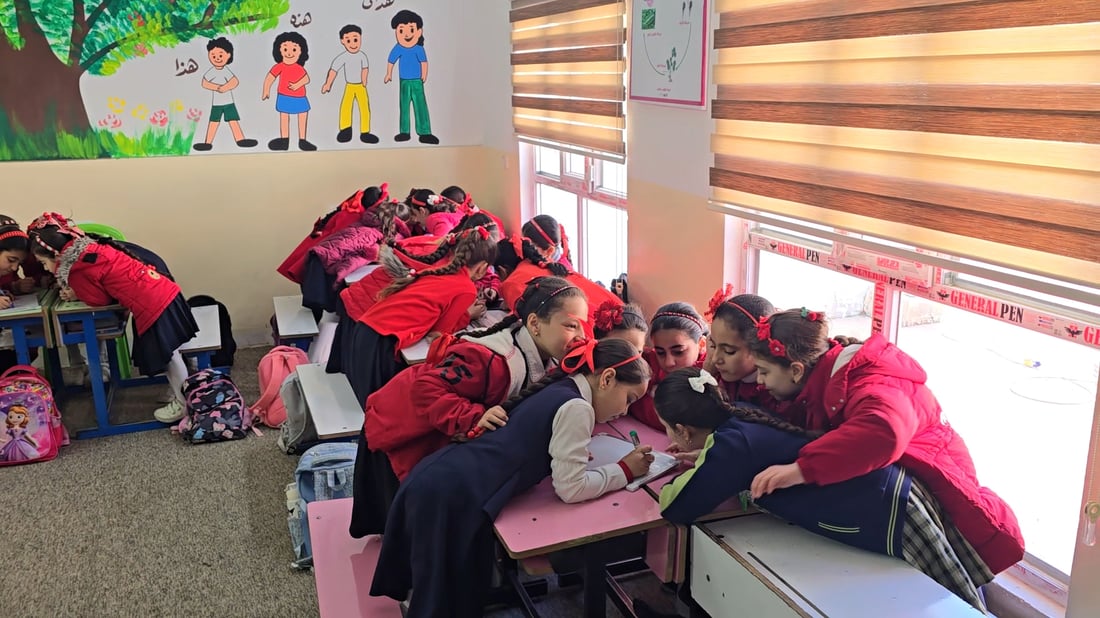
Students at Al-Kawakib Primary School for Girls in Mosul work together in small groups as part of an active learning approach that replaces traditional row seating. Photo by 964media.
Mosul girls’ school replaces rows with group circles in active learning experiment
MOSUL — A primary school for girls in western Mosul has replaced traditional row seating with group circles in classrooms, part of an active learning approach introduced by Nineveh’s education authorities.
Since 2018, Al-Kawakib Primary School for Girls in the Al-Thawra neighborhood has arranged students in small groups rather than seated one behind another, a method implemented under an active education project in several schools across the governorate.
Principal Mithal al-Dulaimi said the experiment began nine years ago in a single class and gradually expanded to include all grade levels. Each group includes five students of varying academic abilities. When questions are posed, a student considered academically weaker may be encouraged to respond to build her confidence.
She said the method has raised academic performance and strengthened friendships among students.
Under the system, each group has a leader who rotates periodically and is responsible for presenting answers to the teacher after discussion among members. Every two days, half of each group moves to another group to ensure interaction among different academic levels, allowing each student to rotate between groups over the course of a month.
Each group is assigned a name such as “Lawyers,” “Achievers,” “Princesses,” “Engineers,” “Nurses” and “Queens.”
Three years ago, the school adopted red as a distinctive uniform color. Four years ago, it introduced digital learning tools, including a smart board provided by the Nineveh Education Department’s curriculum division. Through the parents’ council, a company donated two screens, and the school administration purchased two additional screens.
Dulaimi said students have shown greater engagement with the colors and movement displayed on the screens, motivating them to participate.
University lecturer Zaid Waadallah said the group system offers broader opportunities for participation and fosters cooperation in solving questions. He added that the approach helps students overcome passivity and shyness, particularly with brainstorming techniques.