
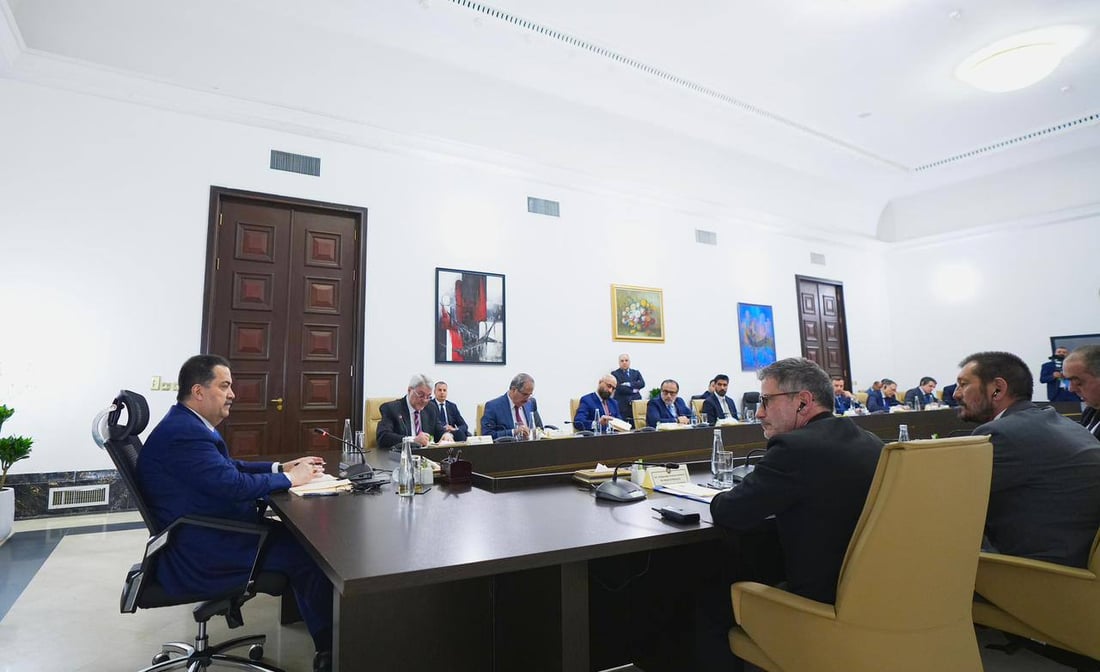
Prime Minister Mohammed S. al-Sudani chairs a meeting with ambassadors of the European Union to Iraq in Baghdad on Tuesday, where discussions focused on security, regional stability and confining weapons to state authority.
Monitor
Sudani says state control of weapons gains broad national backing
BAGHDAD — Prime Minister Mohammed Shia al-Sudani said Tuesday that the principle of confining weapons exclusively to the authority of the state has gained “national consensus”, describing it as a positive development in Iraq’s security policy, during a meeting with ambassadors of the European Union to Iraq.
“The principle of confining weapons exclusively to the authority of the state has gained national consensus and is now broadly accepted,” al-Sudani said, according to a statement from the Media Office of the Prime Minister. He added that current discussions are focused on “timing and implementation mechanisms,” calling this “a clear and positive development.”
Al-Sudani said Iraq’s security forces remain capable of enforcing stability, stating that “Iraqi society remains cohesive, Iraq’s security forces possess readiness and the capability to enforce security, and the country’s borders are secure.” He said border-security measures have been in place for the past two years, based on assessments of developments in neighboring Syria.
During the meeting, al-Sudani linked internal security to broader regional stability, warning that “the return of the logic of force, wars, and the imposition of one party’s will on others is extremely dangerous.” He said Iraq’s current challenges require “a strong government capable of making decisions independently, without internal or external dictates,” while stressing the need to prevent institutional setbacks.
The talks come as debate continues in Iraq over confining weapons to state authority and the future of armed factions operating outside government control, with some groups openly rejecting disarmament.
Earlier this month, the Iraqi Resistance Coordination Committee said it opposes any discussion of limiting weapons “even with the government” until what it described as “full sovereignty for the country” is achieved, adding that “the weapon of the resistance is a sacred weapon.”
Prime Minister Sudani said on Jan. 4 that restricting weapons to state authority is “an Iraqi decision and an Iraqi vision” and part of the government program, linking it to ending the international coalition’s mission and concluding the United Nations Assistance Mission for Iraq.
International pressure has also intensified, with U.S. Special Envoy to Iraq Mark Savaya saying on Nov. 30 that Iraq has a “historic opportunity” to disarm non-state actors, and the U.S. Embassy in Baghdad stating after a Jan. 8 meeting between Charge d’Affaires Joshua Harris and Justice Minister Khalid Shwani that Washington “will continue to speak clearly to the urgency in dismantling Iran-backed militias that undermine Iraq’s sovereignty, threaten Americans and Iraqis, and pilfer Iraqi resources.”
Full statement:
Prime Minister Mohammed S. Al-Sudani met, today Tuesday, the ambassadors of the European Union to Iraq.
The Prime Minister stated that the 2025 elections represented a pivotal milestone in the history of Iraq’s political process, given the integrity and smooth conduct of the elections and the level of broad public participation, which indicated the restoration of part of the people’s confidence in the political process and in the democratic system based on the peaceful transfer of power.
Prime Minister Al-Sudani explained that, over the past three years, the government has carried out significant structural reforms across various sectors and has succeeded in attracting Arab and foreign investments, while providing an enabling and attractive environment for the operation of both domestic and foreign private sectors.
Prime Minister Al-Sudani noted that the principle of confining weapons exclusively to the authority of the state has gained national consensus and is now broadly accepted, with current discussions focusing on timing and implementation mechanisms, which represents a clear and positive development.
Below are the key highlights from the Prime Minister’s remarks:
🔷 The world is currently experiencing widespread instability, accompanied by the weakening of the international order based on laws and rules established since the Second World War.
🔷 The return of the logic of force, wars, and the imposition of one party’s will on others is extremely dangerous, and this phenomenon is now widely evident in multiple regions.
🔷 Current domestic and regional challenges necessitate the formation of a strong government capable of making decisions independently, without internal or external dictates.
🔷 The present priority is to prevent institutional backsliding amid the complex regional and international environment.
🔷 The Reconstruction and Development Coalition will be a key player in the political landscape of the coming phase, based on the popular trust it has received.
🔷 Iraq is maintaining communication with the Islamic Republic of Iran and the United States administration to explore the establishment of a dialogue platform in Baghdad between Washington and Tehran.
🔷 Iraq has made significant progress in its relationship with the International Coalition, has fully taken over Ain al-Asad Air Base, substantially reduced the number of coalition advisers in Baghdad, and the mission at Harir Base in Erbil will conclude entirely in September 2026.
🔷 Iraq will remain an effective partner within the International Coalition Against ISIS, and coordination in counterterrorism efforts continues.
🔷 Syria is currently experiencing instability, and Iraq is concerned about the growing presence of ISIS elements and other extremist groups currently held inside prisons.
🔷 Iraq has emphasized the necessity of a transparent political process in Syria that includes all components, along with concrete steps and real measures to reassure all Syrian communities through rejecting terrorism and extremism and respecting human rights.
🔷 Iraq views Syria’s stability as a national and regional priority of utmost importance.
🔷 A stable and unified Syria, where all its components coexist peacefully, represents a fundamental guarantee for regional security.
🔷 Iraqi society remains cohesive, Iraq’s security forces possess readiness and the capability to enforce security, and the country’s borders are secure.
🔷 Border-security measures have been in place for the past two years, based on an advanced assessment of developments in Syria.
🔷 Security in Syria requires collective responsibility and genuine international cooperation.
🔷 Iraq’s position remains firm in calling for an immediate halt to bloodshed in Gaza, an end to violations in Lebanon, and the cessation of the suffering of the Palestinian people.
Media Office of the Prime Minister
January 20, 2026