
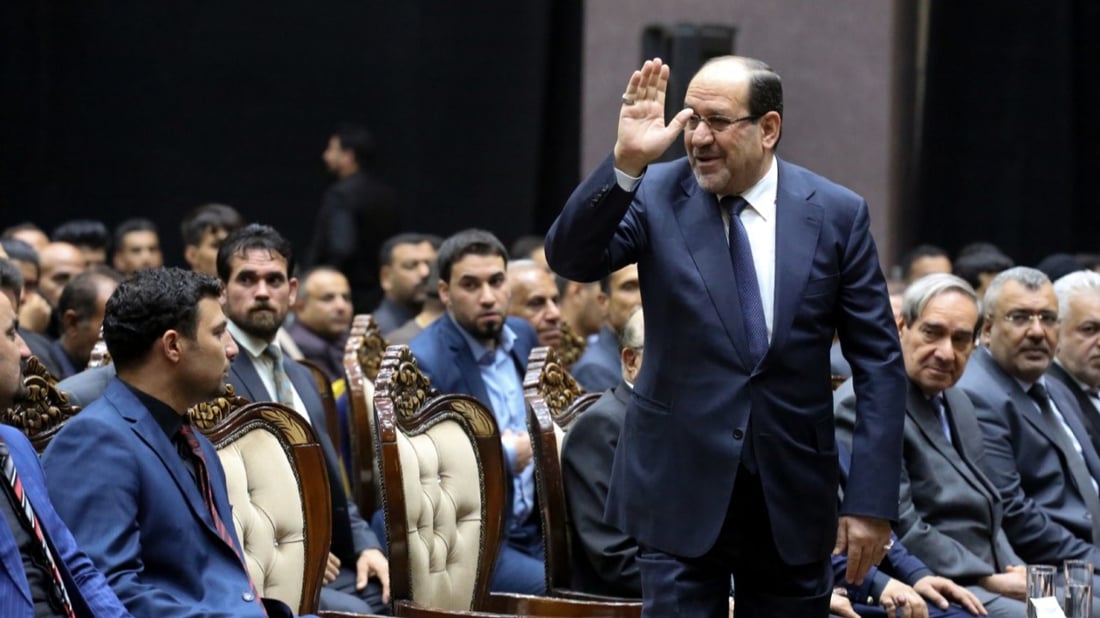
Nouri Al-Maliki, head of the State of Law Coalition, greets attendees during a political gathering in Baghdad.
Maliki ally says Sadrist-linked official would stay in post under new government
BAGHDAD — A senior adviser to Nouri al-Maliki said a future Maliki-led government would retain senior officials close to cleric Muqtada al-Sadr, signaling an effort to blunt potential resistance from rival Shiite factions as negotiations continue over naming Iraq’s next prime minister.
Abbas al-Moussawi, a senior adviser to the State of Law leader, said Hamid al-Ghazi, secretary-general of the Council of Ministers and a figure widely regarded as close to al-Sadr, would remain in his post if al-Maliki returns to office.
“Hamid al-Ghazi is our brother and friend, and he deserves to stay in his position. He is a competent person,” al-Moussawi said in an interview with UTV. “As the group close to Mr. al-Maliki, we do not want to provoke any political movement, whether participating or not. We want to form a successful government that provides services to all Iraqis.”
Al-Ghazi has served as secretary-general since 2019, spanning multiple administrations, and is seen as one of the most senior bureaucratic figures acceptable across rival Shiite camps.
Al-Moussawi’s remarks come as figures aligned with al-Maliki seek to project reassurance toward factions wary of his return, particularly the Sadrist movement, after weeks of inconclusive talks inside the Shiite Coordination Framework.
Pressed on al-Sadr’s position, al-Moussawi said the prospective government would not pursue confrontation. “Our intentions are now clear,” he said. “Our main goal is to restore balance, reset the state’s systems, and reposition the Iraqi economy.”
Relations between al-Maliki and al-Sadr have been adversarial for nearly two decades. Tensions peaked in 2008 when al-Maliki, then prime minister, launched a military campaign against the Mahdi Army, al-Sadr’s armed wing. Although al-Sadr later shifted toward political participation, rivalry between the two leaders persisted.
That rivalry resurfaced after the 2021 parliamentary elections, when al-Sadr’s bloc won the largest number of seats but failed to form a government without al-Maliki’s Coordination Framework. The deadlock ended in 2022 with al-Sadr withdrawing his lawmakers from parliament, followed by deadly unrest inside Baghdad’s Green Zone.
Al-Moussawi said the Coordination Framework has now coalesced around al-Maliki after failing to agree on alternative candidates. “There was great relief after the framework reached a deadlock over choosing a nominee,” he said. “Prime Minister Mohammed Shia al-Sudani was convinced that consensus could be achieved by nominating Mr. al-Maliki.”
He also said Hikma Movement leader Ammar al-Hakim did not oppose the move. “He did not reject Mr. al-Maliki’s nomination. He only wanted to strengthen the idea by securing broader consensus,” al-Moussawi said.
Al-Moussawi claimed al-Maliki’s candidacy has gained wider acceptance, citing messages from foreign diplomats and calls from Sunni leaders and both main Kurdish parties, the Kurdistan Democratic Party and the Patriotic Union of Kurdistan. Those claims could not be independently verified.
Al-Maliki served as prime minister from 2006 to 2014 and stepped down amid domestic and international pressure after the collapse of Iraqi army positions and the fall of Mosul to the Islamic State group.
In the Nov. 11, 2025 election, Prime Minister Mohammed Shia al-Sudani’s Reconstruction and Development Coalition won 46 seats, ahead of al-Maliki’s State of Law Coalition with 29. Despite leading the vote as a single list, al-Sudani failed to secure control within the Coordination Framework, which later declared itself the largest bloc, giving it the constitutional right to nominate the next prime minister.