
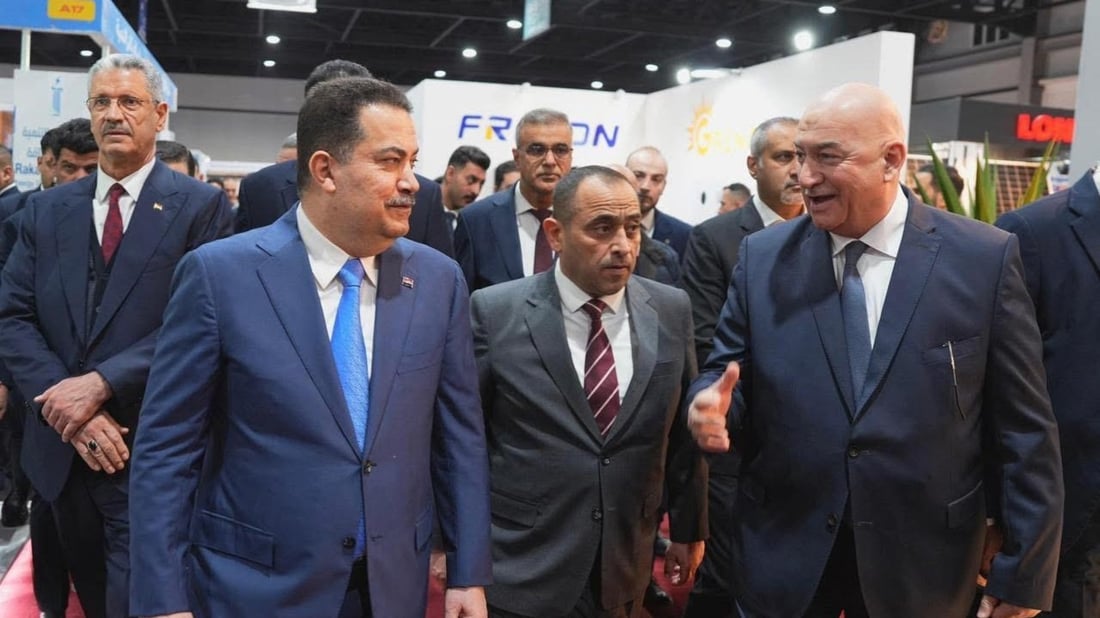
Iraqi officials tour the Iraq International Energy Exhibition and Conference at the Baghdad International Fairgrounds, as the event brings together government representatives and international companies to discuss power generation projects and energy sector development.
PM Sudani opens Iraq energy expo, touts gas cuts and power expansion
BAGHDAD – Prime Minister Mohammed Shia al-Sudani on Saturday inaugurated the 11th Iraq Energy Exhibition and Conference in Baghdad, saying the government is pushing to cut gas flaring, expand electricity generation and turn Iraq into an attractive destination for global energy investment.
The 11th edition of the Iraq Energy Exhibition and Conference, held at the Baghdad International Fairgrounds from Jan. 10 to 12, brings together more than 450 specialized companies from over 16 countries. Al-Sudani said the government wants the event to serve as “a comprehensive platform bringing together decision-makers, government institutions, and private-sector companies” to implement projects using “the latest technologies and advanced solutions with strong economic feasibility.”
He said such cooperation should “contribute to development efforts, maximizing the utilization of oil and gas resources, modernizing electricity generation and distribution networks, expanding the use of renewable energy, and safeguarding the environment.” Al-Sudani added that Iraq now enjoys stability and “an attractive investment environment” supported by laws and facilitation measures aimed at encouraging investment.
Al-Sudani said the government has made “significant progress” on oil production, citing major projects with international companies such as Total and BP, and said the Ministry of Oil is implementing infrastructure upgrades to increase export capacity and diversify outlets. He also pointed to “continuous dialogue” with ExxonMobil, Chevron and other firms on future projects.
On gas flaring, the prime minister said Iraq has “achieved major progress in investing associated gas,” with flaring reduction now “exceeding 72%,” and reiterated a target of fully eliminating flaring by the end of 2028. He said the government is moving toward “a fixed platform” to secure Iraq’s gas needs, including imports and potential future exports.
Electricity Minister Ziyad Ali Fadhil, speaking at the same exhibition, said “The government has placed the energy file at the top of its priorities over the past three years.” He said the Ministry of Electricity is pursuing “an integrated vision that included rehabilitating stations and launching new production and investment projects under implementation with a capacity of nearly 15,000 megawatts, in addition to signing strategic agreements with global companies to establish new stations with a capacity of 48,000 megawatts that rely on local fuel.”
Fadhil said the ministry has completed stalled combined-cycle projects, adding, “This will contribute to raising production efficiency and achieving additional capacity from the same fuel without increasing consumption.” He said the ministry is also working to upgrade transmission networks, advance regional interconnection projects and expand solar power plants under construction in several governorates.
Al-Sudani’s media office said the Ministry of Electricity is moving ahead with “an ambitious plan” to boost national generation capacity to more than 57,000 megawatts through projects in cooperation with Siemens, GE and other companies. A detailed plan to expand renewable energy at the district and sub-district level in Baghdad and other governorates is expected to begin implementation this summer.
The government has framed the exhibition as evidence of Iraq’s position as “a promising market with substantial opportunities in the energy field,” including large-scale projects, strategic partnerships and investment in associated and free gas across oil fields and exploration blocks. Officials say they expect the conference to help advance talks on gas capture and new power plants.
Electricity shortages remain a chronic complaint in many parts of the country, particularly during peak demand. In recent weeks residents of several cities have protested over repeated outages and limited supply hours. The Ministry of Electricity has said the complete halt of Iranian gas supplies because of what Tehran described as emergency conditions, along with seasonal demand, has added pressure on the grid even as Iraqi gas capture and local generation have increased.