
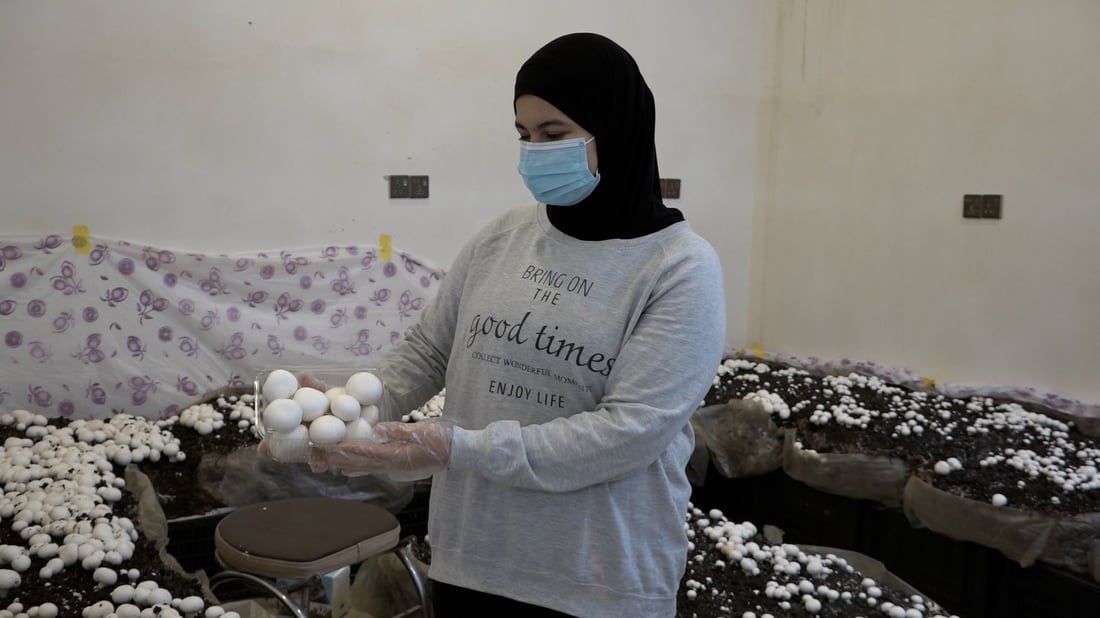
Agricultural engineer Israa Sattar holds freshly harvested white mushrooms inside the cultivation site in Al-Mudathira village south of Amarah, where a small local project produced its first commercial crop. Photo by 964media.
Local farming initiative
Maysan village produces first commercial crop of white mushrooms
AMARAH — A small agricultural project in Al-Mudathira village south of Amarah has produced its first commercial batch of white mushrooms, marking a new crop for Maysan governorate through a partnership led by two agricultural engineers and a local farmer.
Isra Sattar and Bushra Abbas, agricultural engineers from Amarah, launched the project with guidance from agricultural expert Mustafa Ali. The World Food Programme funded project costs, while the College of Agriculture at the University of Maysan provided training. The home of farmer Ali Shibl was selected as the cultivation site after being equipped to meet the crop’s requirements for controlled temperature, humidity and darkness during germination.
Project partner and agricultural engineer Sara Abbas said white mushrooms were chosen because of market demand. “The most common type is white mushroom, which we grow in Maysan because it is marketable and desirable in local markets,” she said.
Mustafa Ali said mushroom cultivation is new to the governorate and requires close monitoring. “Mushroom farming is new in Maysan. It needs special care during the germination period, with specific temperatures and humidity maintained during the first two weeks, then changed in the second stage,” he told 964media. He added that this is followed by what he described as the “shock stage,” which involves exposing the colonized substrate to a sudden drop in temperature for 12 to 24 hours.
He said preparation begins by laying a straw base, followed by compost made from animal waste fertilizer mixed with urea, before mushroom spores are spread. Germination takes about 30 days, with harvesting starting after another month.
Sattar said the project is a joint effort with Abbas and Shibl, supported by the World Food Programme and an intensive mushroom production course at the University of Maysan. “The project is shared between agricultural engineer Bushra Abbas, farmer Ali Shibl and myself, with support from the World Food Programme and specialized training at the College of Agriculture,” she told 964media.
She said an initial trial early last year produced small quantities that were distributed to family and relatives. This season, production reached about 150 kilograms since work began in November, with marketing now underway through Instagram and limited cooperation with some shops and restaurants.
The retail price is about 7,000 Iraqi dinars per kilogram, or about $4.80 at the current exchange rate, and the product is sold without preservatives, unlike some imported mushrooms.