
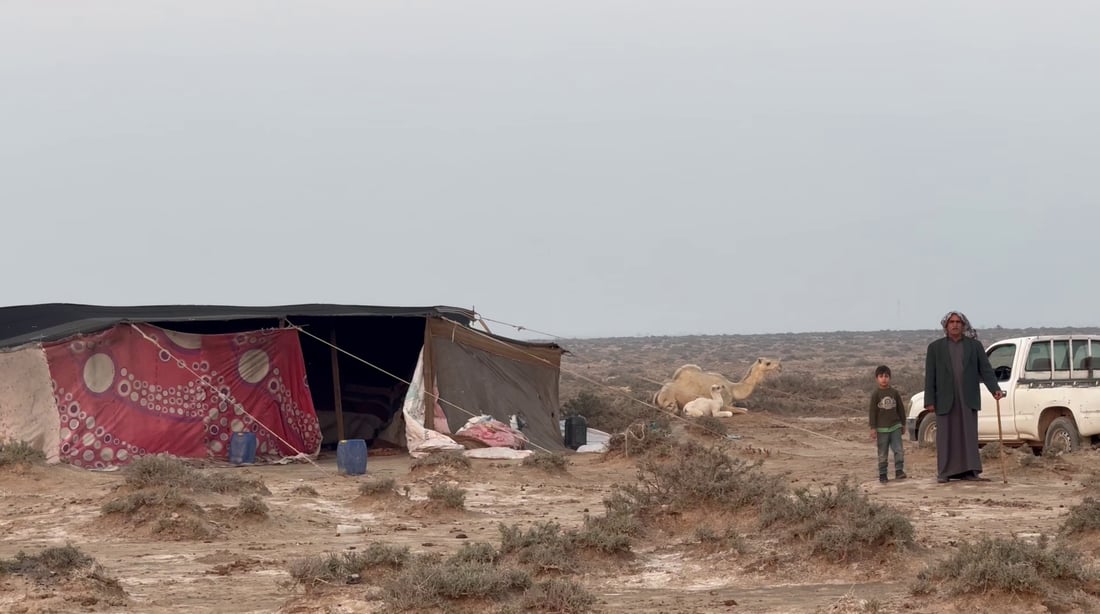
A Bedouin family stands near their tent and camel herd on higher ground outside Badra in Wasit governorate after seasonal floods cut off access to traditional grazing areas. Photo by 964media.
Seasonal migration pressures
Wasit Bedouin families move toward border highlands to escape floods
BADRA — Nomadic Bedouin families in Wasit governorate say they moved this week toward areas near the Iranian border to escape floodwaters that cut off their traditional grazing lands and threatened their camel herds, which they describe as their main source of livelihood for generations.
Members of the Masoud tribes told 964media they left areas between Diyala and Wasit governorates, including around the Kalala River and Hawr al-Shuwaija, and headed toward higher ground in Badra, Jassan and Qazaniyah after seasonal floods surrounded their autumn pastures.
They said access to grazing land has also been shrinking as investors and wealthy individuals increasingly take control of large tracts to build chalets and recreational resorts.
“They put their hands on wide areas day after day, and our camels are no longer allowed to enter the traditional pastures,” tribal members said, adding that the animals “have become thinner” as available grazing declines.
Herders said the Masoud tribe is divided into two groups. One continues a nomadic lifestyle along the border strip in Wasit, raising camels and living in tents known as “bayt al-sha’ar,” which they set up wherever they settle. Families typically remain in one location for about 20 days, until grass runs out, before moving again. The other group has settled permanently in towns and cities.
Camel breeder Adel al-Masoudi said their daily routine starts early. “My day begins at 6 a.m.,” he said, explaining that he checks on the camels before heading out to grazing areas.
Al-Masoudi said transportation has changed over time. “In the past we traveled on camels, but today we use pickup trucks,” he said. He added that many nomadic families still do not use the internet or smartphones and rely instead on basic mobile phones to communicate with relatives.
He said herders once used simple methods to determine direction. “Previously we used cigarette smoke or threw sand to know the direction of the wind and where to go,” he said, noting that roads and navigation have since developed.
Education remains uneven among nomadic families. Some leave their families in villages and cities so children can attend school while adults continue herding, while others are unable to do so and their children miss out on schooling, herders said.
Another camel breeder, Abu Abbas al-Masoudi, said climate conditions have made life harsher. “Pastures have disappeared because of drought, and camels have become thin, especially with the absence of government support,” he said. He added that the expansion of cultivated land has further narrowed grazing areas, forcing herders at times to sell camels and buy feed.