
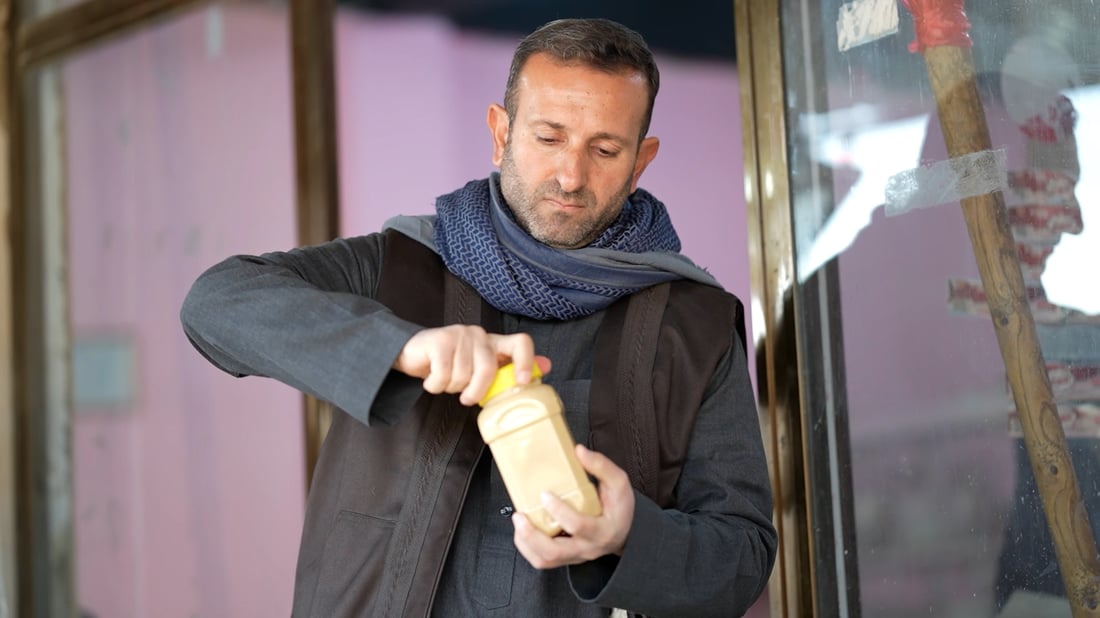
Ghassan Nouri inspects a jar of tahini produced using a traditional stone mill at his workshop in Ana, Anbar governorate. Photo by 964media.
Century-old stone mill drives tahini sales surge in Anbar’s Ana
ANBAR — A return to traditional methods has pushed tahini quality and sales to new levels in the city of Ana, with producer Ghassan Nouri saying his century-old stone mill has outperformed modern industrial equipment.
Nouri told 964media that monthly sales have risen from about 200 kilograms when he opened years ago to more than two tons today. He attributed the increase to the reputation of the stone mill, which he said is more than 100 years old.
“There are important differences between tahini produced by a stone mill and that made by modern industrial mills,” he said. “The consistency is better in the stone mill, and even the oil does not separate from the texture as happens with tahini from other mills.”
He said the differences stem from the mill’s heavy stone, which weighs about 300 kilograms and generates intense heat during grinding. “The heat almost burns the sesame, which gives the tahini a stronger taste and a clearer aroma compared with industrial presses,” Nouri said. The strong pressure as the stone rotates “mixes the tahini well and prevents oil separation.”
Nouri relies primarily on Iraqi sesame sourced from farms in Salah al-Din, Ana, al-Qaim, Hit and Hilla. The sesame is transported to Mosul for cleaning and roasting, a process he said is done more skillfully there. When domestic production falls short, he imports Sudanese sesame because “its taste is very close to the Iraqi sesame.”