
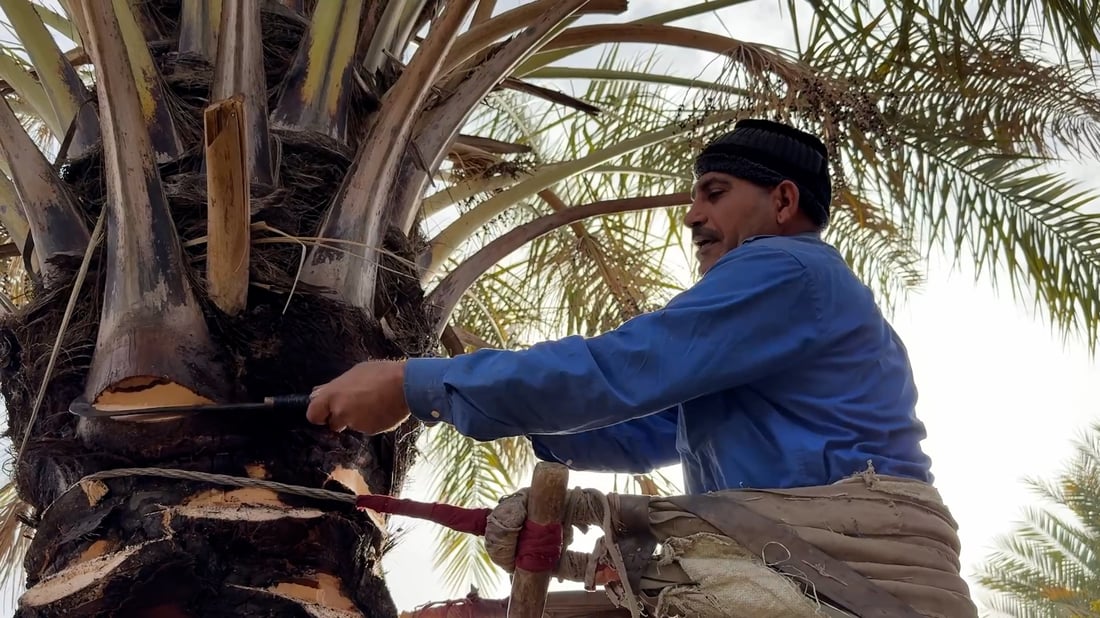
A farmer prunes a date palm in a Diyala governorate orchard during winter preparations to limit pest activity. Photo by 964media
Seasonal work resumes
Diyala farmers race to prune palms as red weevil threatens Iraq’s date trees
DIYALA — Farmers in Diyala have stepped up winter pruning of palm trees as fears persist over the red palm weevil, a pest blamed for heavy losses in recent seasons and warned to pose a long-term threat to Iraq’s date palms.
With winter dormancy ending and pollination preparations underway for March, farmers in areas such as Mansouriyat al-Shatt and al-Huwaish have begun “takreeb,” the seasonal removal of old trunk growth. The practice helps farmers climb palms for pollination and harvesting while eliminating shelters where insects lay eggs.
The urgency has been heightened by last season’s spread of the weevil in Diyala, which prompted warnings from agricultural officials that Iraq could lose up to a quarter of its palm trees within five years if the infestation is not controlled. Among the measures advised was limiting pruning to winter, when colder temperatures reduce the insect’s activity.
Farmer Shawqi Hassan said palm varieties differ in the effort required. The khastawi palm has a hard trunk that “cannot be handled with a single strike,” while zahdi palms are easier to manage and do not require annual pruning. After takreeb, farmers carry out “tasleel,” removing thorns from the fronds, before beginning “rifas,” or soil turning, around the trees.
“The preparation work for orchards begins early, sometimes in November, but by the end of January it reaches its peak as the pollination season approaches,” said Hadi Salman, an orchard owner in Mansouriya.
Farmers also inject salt and sulfur into the heart of the palm to disinfect it and prevent insects from settling. Small offshoots growing around the base are removed to clear access for climbing.
Farmer Raed Moussa from al-Huwaish said rifas removes harmful weeds, improves the orchard’s appearance and allows for fertilization. “After winter, the soil becomes compacted, which hinders root movement and water and fertilizer absorption,” he said, adding that trees “rest” after rifas as the soil loosens. The practice can continue from November through March.
The red palm weevil is an invasive pest originally from southern Asia that has spread across the Middle East and North Africa. It lays eggs inside palm trunks, and the larvae feed from within, often killing trees before visible symptoms appear.
Iraq has more than 22 million date palms, with plans to expand to 30 million through planting and tissue-culture initiatives.