
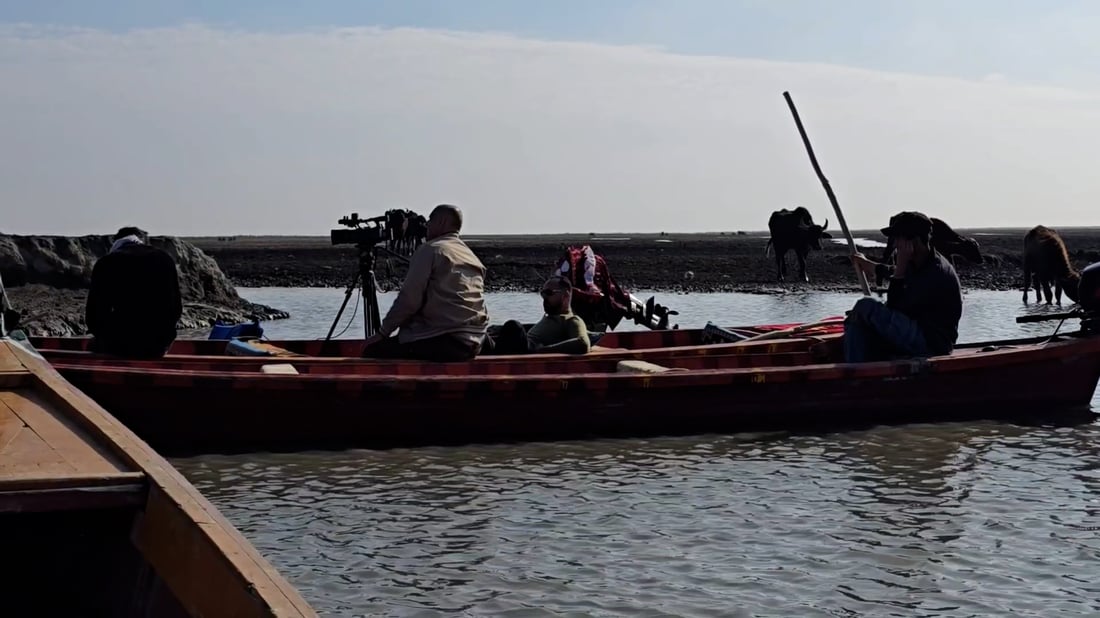
FILES: Journalists travel by wooden boat through the Al-Chibayish marshes in Dhi Qar during a UNDP-organized media tour documenting shrinking waterways and the impact of water shortages on local communities. (Photo by 964media)
Tour highlights water shortages, environmental decline in Al-Chibayish marshes
DHI QAR — The United Nations Development Programme in Iraq, working with local organizations, hosted a media tour to the Al-Chibayish marshes in southern Dhi Qar to spotlight worsening environmental conditions and water shortages that residents say are threatening their livelihoods.
A 964media correspondent joined Iraqi and Arab journalists on the visit, which organizers said aimed to present the marshes as a public issue rather than a series of individual hardships. Journalists documented shrinking wetlands, dried reeds and fragmented waterways linked to declining and irregular water supplies, leaving communities uncertain about the future.
Bassim Hatim of the Babylon Foundation said the tour is part of a broader effort to build public awareness. “We are implementing a file in cooperation with UNDP and the United Nations to create public awareness about what is happening in the marshes and the drought and local and external problems they are facing,” he told 964media. “This issue has affected people and their way of life, as well as the country’s animal and water resources.”
“The presence of international, local and regional media today is very important,” Hatim added. “The goal is to shape local and global opinion and raise awareness about the scale of the problem in the marshes.”
Hussein Ali, a correspondent for Al Jazeera Mubasher, said the field visit was essential for accurate reporting. “Our tour of the marshes is important and needed. Instead of reading from somewhere or hearing information that may be incorrect, seeing the reality on the ground is different,” he told 964media. “What is happening here is a matter of public opinion, especially given what the marshes represent. The Sumerians were here and civilizations began here.”
He added that the marshes remain a major producer of local food. “We are also talking about the role of the marshes in providing large quantities of high-quality dairy products, fish and other goods. Today, it is important for us to be here and convey the image from the ground,” he said.
Ahmed Al-Saeedi, a correspondent for UTV, said sustained media attention is a tool for protecting the marshes. “One of the important ways to introduce what the marshes are going through is media coverage, and we need such campaigns as part of advocacy for the marshes and their environment, which are facing harsh drought,” he told 964media.
“The consequences of this drought are dangerous for humans, animals, aquatic environments and even plants,” Al-Saeedi said, adding that the tour would help convey “a very important image of the very harsh scene here and the visible changes affecting both residents and the natural marsh ecosystem.”
Local resident and buffalo breeder Laila, known as Umm Salman, said water remains the central demand. “We are not asking the government for more than water so we can return to our previous life,” she told 964media. “Our life now is not good because of the absence of water, but if the water returns, we will return to our normal life.”
She said the loss of natural feed has forced families to rely on purchased fodder. “We now buy feed from the market, and the ‘grass’ here is not eaten by the buffalo because it is dried reeds,” she said.