
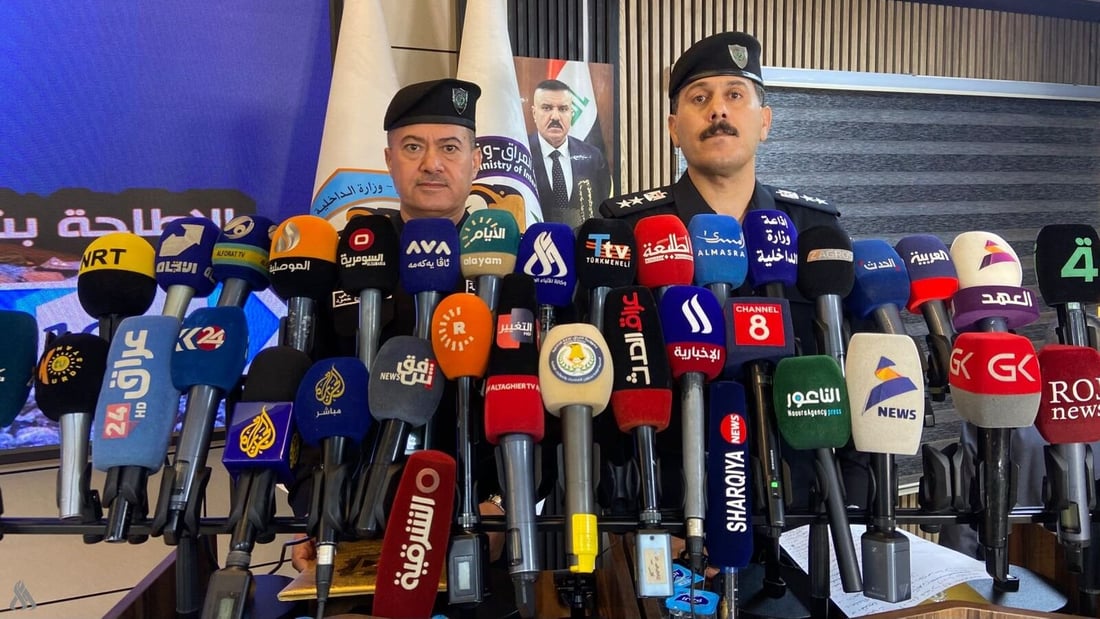
Interior Ministry spokesperson Abbas Al-Bahadli speaks to reporters during a press conference on drug enforcement efforts in Baghdad. Photo by 964media.
Interior Ministry says Iraq has dismantled more than 1200 drug networks
BAGHDAD — Iraq’s Interior Ministry said Tuesday the country dismantled more than 1,200 local and international drug-trafficking networks and seized over 14 tons of narcotics during the past three years, describing Iraq as a “leader” in regional drug enforcement.
Interior Ministry spokesperson Col. Abbas Al-Bahadli said during a press conference that the ministry’s work over those three years operated on three levels — local, international and humanitarian, through rehabilitation centers for users.
Al-Bahadli said security forces dismantled 1201 drug-trading and distribution networks, including 1030 local networks and 171 international networks, and seized 14 tons, 20 kilograms and 17 grams of narcotics. He said courts issued rulings against 23,118 defendants, including 300 death sentences and 1147 life sentences for narcotics trafficking.
He said security forces engaged in 274 armed clashes with traffickers, resulting in the deaths of seven officers from the Drug Control Directorate and 90 wounded personnel, while traffickers sustained 36 deaths and 81 injuries. A total of 3307 weapons, hand grenades and 4462 vehicles linked to trafficking operations were confiscated.
On the international level, Al-Bahadli said Iraq issued 140 international arrest warrants, carried out 40 operations outside Iraq, and maintains 33 liaison points with regional and international partners for information sharing. He said “Iraq is now called the regional leader,” adding that Iraq was the first country in the region to conduct cross-border controlled-delivery operations.
Regarding rehabilitation efforts, Al-Bahadli said Iraq has established 16 rehabilitation centers across 16 Iraqi governorates, excluding the Kurdistan Region. He said the centers have a combined capacity of 4746 patients, and that 6022 people have recovered from addiction and completed reintegration programs, with 1228 others currently receiving treatment.
He said those who completed treatment “have returned to their families and their livelihoods,” and that rehabilitation remains a central part of the ministry’s anti-drug strategy.