
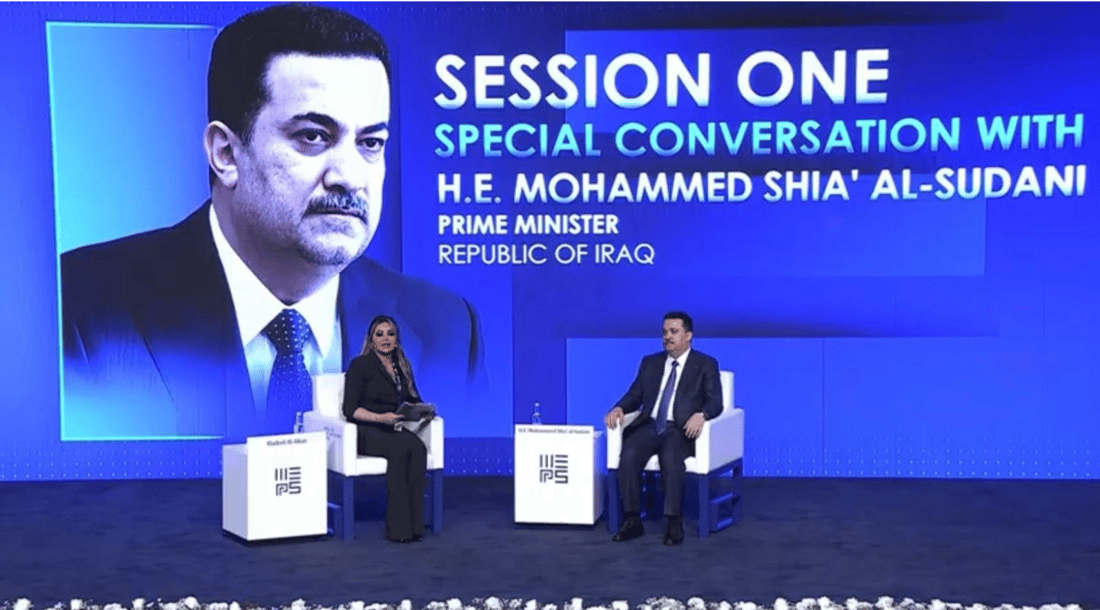
Iraqi Prime Minister Mohammed Shia al-Sudani speaks during a public conversation at the Middle East Peace and Security Forum in Duhok, where he discussed coalition-building, the next government and the election law.
PM Al-Sudani says second term ‘not a personal ambition’
BAGHDAD — Prime Minister Mohammed Shia al-Sudani said Thursday that seeking a second term “is not a personal ambition” and framed it instead as part of a commitment to continue his government’s work, confirming that the Coordination Framework will open negotiations to form Iraq’s next administration.
Speaking at the Middle East Peace and Security Forum in Duhok, Sudani said the Reconstruction and Development Coalition, which he leads, “is an essential part of the Coordination Framework.” He said the bloc met on Monday and “decided to form the largest parliamentary bloc” and will “begin dialogue with the rest of the political blocs in the national space to establish the constitutional entitlements and form the presidencies.”
Final results placed Sudani’s coalition first with 46 seats. Taqaddum followed with 36. State of Law secured 29. Sadiqoon won 27, matching the 27 won by the Kurdistan Democratic Party.
Sudani said, “The second term is not a personal ambition, but a readiness to take responsibility to complete the project we started,” describing his coalition’s result as “well-deserved” and tied to its “project and vision for the coming stage.” He said he expects political forces to respect constitutional timelines and pointed to the smooth conduct of the vote, noting the absence of “red complaints” and saying it creates space for “a quick agreement that leads to forming a government on time.”
Responding to comments by Kurdistan Democratic Party leader Masoud Barzani, Sudani said legal stability is important but agreed that the current election law needs review to prevent wasted votes. “It is not right that every cycle brings a new law designed by political forces based on their weight,” he said. He noted that the Reconstruction and Development Coalition “received one million three hundred and seventeen thousand votes, which does not match the number of seats,” and said parliament should consider revisions “to reach a fair system that reflects voters’ voices and prevents waste.”
Barzani, speaking at the same forum, said the election should be a starting point for “serious steps after this vote” and repeated his view that the law must be corrected. He called the current system “unfair and harmful,” saying it deprived many voters of representation while allowing “undeserving” candidates to win seats. He said he would “work seriously with all sides to fix this law, because it contains no fairness.”
Under the current electoral system, each governorate serves as its own multi-member constituency. This means parties with strong, concentrated support can win multiple seats in specific provinces even with fewer overall votes, while parties with high national vote totals spread across several governorates may gain fewer seats because they do not achieve the provincial thresholds needed to secure representation. The system has been a central point of debate this cycle as several major blocs received large vote totals that did not translate into proportional number of seats.
The Kurdistan Democratic Party, for example, received more than 1.1 million votes across the Kurdistan Region and Kirkuk but won only 27 seats because several of its high-vote areas either had limited seat numbers or were located in governorates where the party’s votes were significant but not high enough to take additional seats. The 46 seats won by Sudani’s coalition came from 1.3 million votes.
Party officials have argued that the law limited the conversion of its vote totals into representation despite dominating in Erbil and Duhok and gaining seats in Sulaymaniyah, Kirkuk and Nineveh.
Iraq has used several voting systems since the 2003 invasion, including full proportional representation under a single nationwide constituency and smaller district level multi-member constituencies.