
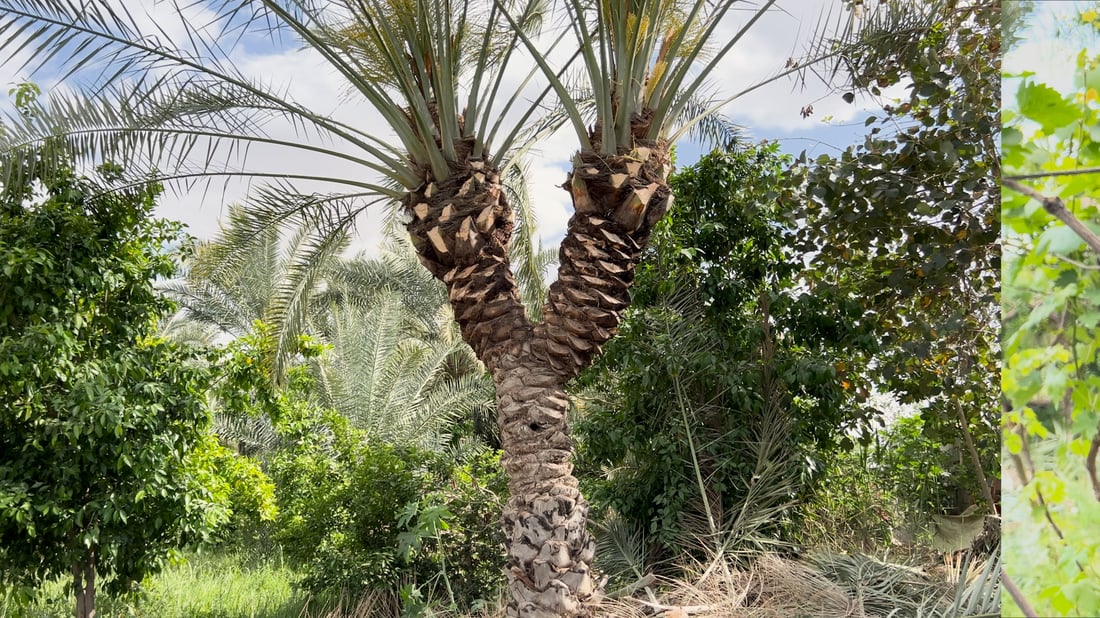
A date palm tree stands in an orchard in Jadidah al-Shatt, Diyala, where agricultural teams are combating the spread of the red palm weevil, a pest capable of destroying entire trees from within. (Photo: 964media)
Red palm weevil hollows out Diyala’s date groves as farmers fight to save dying palms
DIYALA — Agricultural officials and farmers in Diyala are scrambling to contain a fast-spreading outbreak of the red palm weevil, an invasive pest that kills palm trees from the inside out and could wipe out a quarter of the governorate’s palms within five years if left unchecked.
The insect bores small holes into the trunk, laying hundreds of eggs inside. Once hatched, larvae feed on the palm’s inner tissue, hollowing it out until the tree collapses. Within three months, the adult weevils emerge and fly to nearby palms, restarting the cycle.
Ammar Jabbar, director of the Plant Protection Department at Diyala’s Agriculture Directorate, told 964media that “the red palm weevil is dangerous because it completely kills the palm, unlike other pests that only weaken it. The insect attacks the interior of the tree and hollows it out, leading to its death within three months.”
Jabbar said the first case in Iraq was detected in Basra in 2015 and appeared in Diyala’s Muqdadiyah district in 2023. “The likely source was palm seedlings imported from Jordan and Gulf countries, such as the Medjool variety, which farmers bought at lower prices without knowing they were infected,” he said.
The pest thrives in young palms under 15 years old, while older, drier trees are more resistant. So far, more than 1,500 infected palms have been treated, though the number of dead trees remains unknown because many cases go unreported.
To fight the infestation, the Agriculture Directorate has formed rapid-response teams to carry out direct spraying and trunk injections instead of distributing pesticides to farmers. “We focused heavily on public awareness through workshops and media campaigns to prevent further infections,” Jabbar said.
Farmer Amer Majid, from the Jadidah al-Shatt area, said he has already lost dozens of palms. “The red palm weevil looks like a small red beetle. We tried every type of pesticide, even the tablets placed inside the palm trunk, but nothing worked,” he said. “When we cut into the trunk, we find tunnels everywhere — the tree becomes hollow inside.”
Majid said 50 of his palms are confirmed infected and fears the real number could be higher. “Burning doesn’t work, and even the official spraying campaigns haven’t stopped it. The weevil spreads quickly, flying from one palm to another,” he said.