
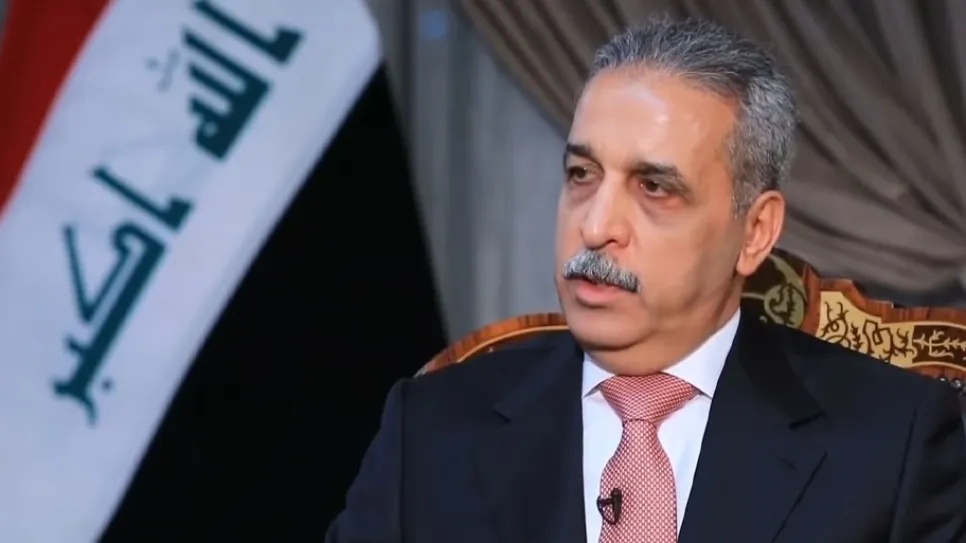
Iraq’s Supreme Judicial Council head Faiq Zaidan
Government formation
Iraq’s top judge warns political blocs over breaches of constitutional timelines
BAGHDAD — Iraq’s top judicial authority has warned that political delays in naming the country’s senior leadership after elections repeatedly breach the constitution and undermine the democratic process.
“Previous experiences have shown that naming the holders of the three presidential positions often exceeds the specified constitutional deadlines,” said Supreme Judicial Council President Judge Faiq Zaidan in a statement Sunday. “This represents a clear violation of the constitution and contradicts the spirit of democratic rotation of power.”
Zaidan said the constitution allows a total of four months from the announcement of election results to the formation of a new government, though this period could be shortened if each step began immediately. “The four-month period set by the constitution for forming the new government can be greatly reduced if each stage begins on the first day rather than waiting until the end of the maximum time limits,” he said.
He explained that Iraq’s system, defined under Article 1 of the constitution as a parliamentary republic, gives the Council of Representatives a central role, as it elects the president and confirms the cabinet.
Citing Article 56, Zaidan said parliamentary elections must take place 45 days before the end of the legislature’s four-year term, which began on Jan. 9, 2022. “Therefore, the constitutional date for the elections should be November 24, 2025,” he said. “Setting November 11, 2025, as election day represents a clear violation because it is not based on any constitutional or legal provision.”
Zaidan outlined the post-election legal sequence: the Independent High Electoral Commission receives appeals within three days of the results; it then has seven days to respond and refer them to the Judicial Authority for Elections, which must issue a ruling within ten days. The results are then sent to the Federal Supreme Court for ratification, after which the president calls the new parliament to convene within fifteen days.
The legislature, chaired by its oldest member, elects a speaker and two deputies, then elects the president within thirty days. The president designates a prime-ministerial nominee from the largest bloc within fifteen days, and the nominee has thirty days to secure parliamentary confidence.
Zaidan noted that while these steps amount to roughly four months, the frequent use of the term “within” in constitutional clauses means the deadlines are ceilings, not obligations. “This offers flexibility to shorten the timeframes whenever political will exists,” he said.
He criticized the absence of enforcement mechanisms for missed deadlines. “This continued violation stems from the absence of penalties or legal effects for exceeding these periods,” he said. “The constitution does not address this breach or specify consequences, allowing it to recur in multiple election cycles.”
Zaidan called for the issue to be addressed in any future constitutional amendments. “We hope this observation will be taken into account to ensure respect for constitutional timings and establish specific penalties for violations, in order to preserve the stability of the democratic system and reinforce the rule of law and the peaceful transfer of power,” he said.