
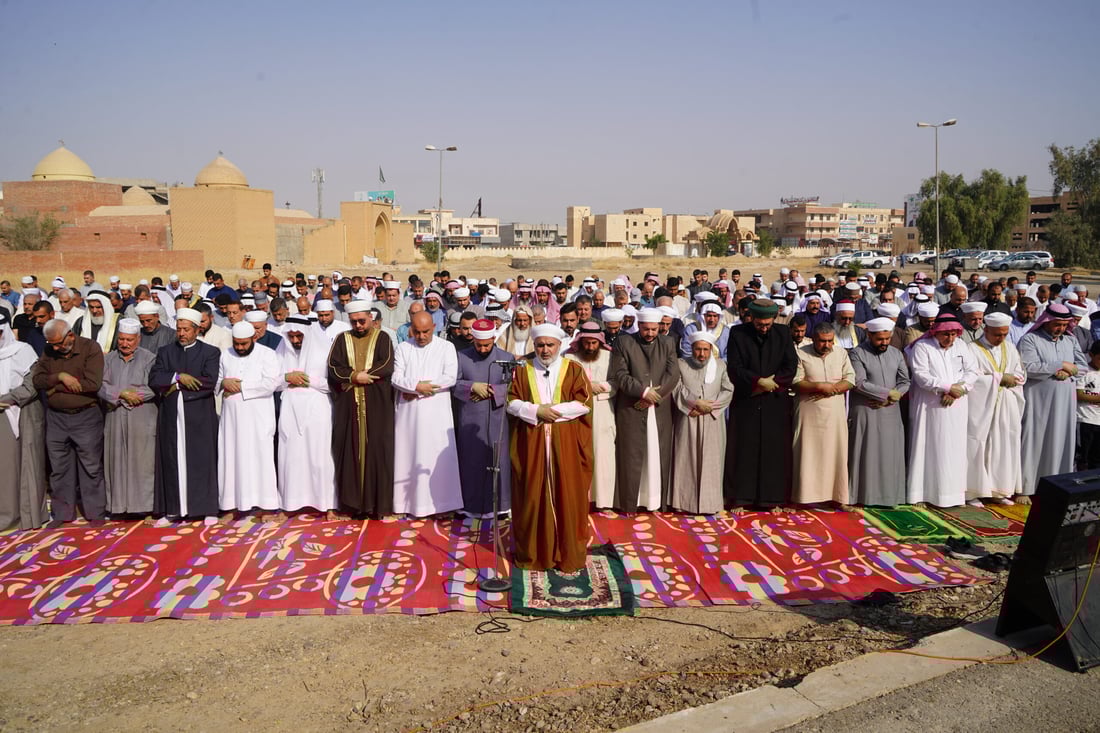
Residents in Tikrit gather to perform the rain prayer amid ongoing drought conditions, Nov. 8, 2025. (Photo: 964media).
'We raised our hands to the sky'
Iraqis turn to nationwide rain prayers amid worsening drought and plunging water reserves
NEWSROOM — Residents in several Iraqi governorates gathered Saturday morning to perform Salat al-Istisqa, or the prayer for rain, as the country faces one of its worst droughts in eight decades.
In Tikrit, Salah Al-Din, tribal and community leaders assembled at the gardens of Al-Arba’een for the prayer, following guidance from senior religious authorities. “We held the rain prayer in Tikrit. We asked God to bless us with rain and lift this hardship from our nation,” said Mohammed Al-Habbous, director of the Sunni Endowment Office in Salah Al-Din.
Local resident Haider Nazar said the prolonged drought has put farming in danger. “Salah Al-Din depends on farming, and without water, the governorate will collapse,” he said. “That’s why we turned to God, asking for mercy and rain.”
Salat al-Istisqa is a traditional Islamic prayer performed collectively during times of drought or severe water scarcity. It is typically held in open areas as a show of humility and repentance, seeking divine mercy.
In Ramadi, residents gathered near Hajji Daher Mosque for the prayer led by Sheikh Mahmoud Al-Kubaisi, who urged repentance and renewed faith. In Altun Kupri, north of Kirkuk, large crowds gathered outdoors. “We’re suffering from a lack of rainfall this season,” said Ahmad Mohammed. “We ask God to show us mercy by sending rain.”
Another resident, Salman Ali, added, “Rain is mercy for all living beings. Without it, livestock will suffer because plants and grass won’t grow. We face a water crisis and little support, so we raised our hands to the sky, asking for God’s mercy on our country.”
The Sunni Endowment Office called for coordinated istisqa prayers across all governorates at 10 a.m. Saturday in response to worsening water shortages and declining rainfall.
Iraq’s reserves are at their lowest levels in 80 years, with officials blaming climate change, drought, and upstream dam projects in Turkey and Iran. Last week, Iraq and Turkey signed an executive mechanism for their water cooperation agreement, which officials described as a step toward major joint projects to tackle Iraq’s deepening water crisis.