
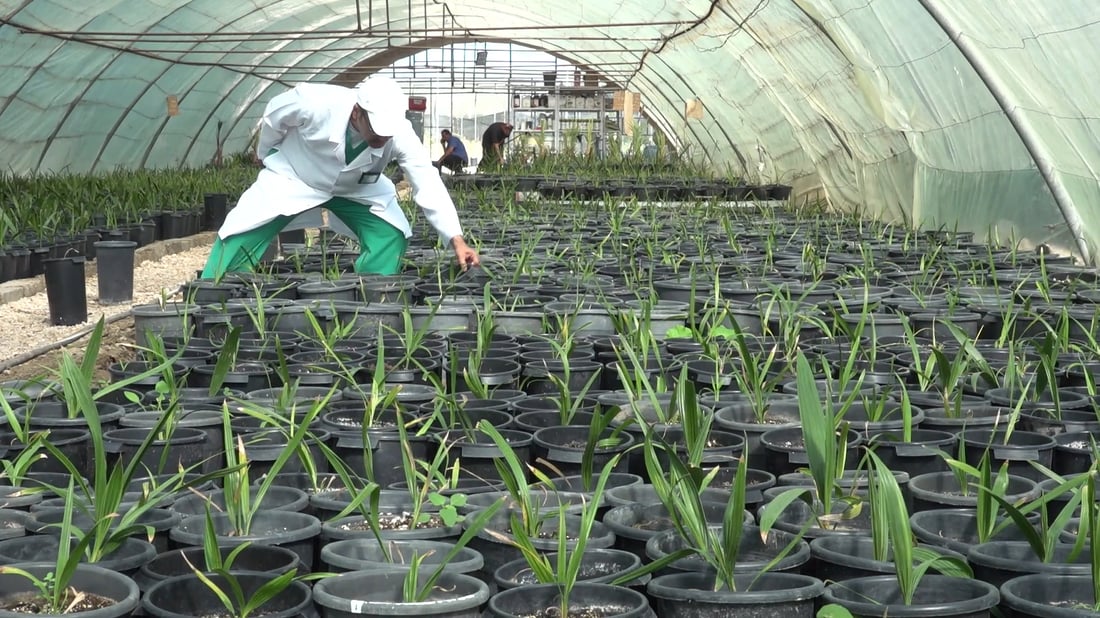
A specialist inspects young palm seedlings inside a greenhouse in Hilla, part of a Saudi-Iraqi project to expand palm cultivation through tissue culture technology. (Photo by 964media)
50,000 palm seedlings
Saudi-Iraqi partnership aims to revive date sector in Hilla
HILLA — Saudi agricultural professor and palm development expert Saleh Al-Tuwaijri is leading efforts to cultivate more than 50,000 palm seedlings in Hilla, part of a Saudi-Iraqi collaboration to revive Iraq’s once-renowned date industry and expand the country’s palm count from about 18 million to 30 million trees.
“I came to Iraq encouraged by my government, which believes the country is entering a golden decade of growth and development,” Al-Tuwaijri said. “I’ve received a warm welcome from both the Iraqi government and people.”
The initiative operates under an agreement between Saudi Arabia’s Green Palm Company and Iraq’s Durrat Al-Nakheel Company. It involves importing tissue-cultured palm plants grown in Saudi laboratories, where they begin in sterile conditions before being transferred to Iraq for acclimation.
“The main task in the lab is to help the plant adapt to local conditions by placing it in controlled environments for two weeks,” Al-Tuwaijri said. “After that, we move it to the ‘torpedo’ stage, where it remains under care for about three months before becoming ready for sale.”
He said the process includes five acclimation stages before the seedlings are transferred to greenhouses and grown in large pots until they are strong enough for distribution. “These are sensitive stages that require a specialist in acclimation technology,” he said. “Farmers cannot carry them out on their own.”
Sami Al-Zghaibi, an agricultural activist and representative of Durrat Al-Nakheel, said the partnership is already showing results. “We started importing palm ampoules from Saudi Arabia under a three-year commercial partnership,” he said. “Because we import 50,000 seedlings annually, prices stay low while maintaining high quality.”
He said each seedling costs between 60,000 and 80,000 dinars ($43–$57) depending on growth stage. “Some farmers prefer seedlings that have been cared for in our facilities for a year, as they may not have the experience or equipment to handle early growth,” he said.
Al-Zghaibi added that the Saudi side uses a hormone-free slow-growth technique that preserves genetic purity. “The seedlings are guaranteed—the Barhi remains Barhi, and the Medjool remains Medjool—without any margin for error,” he said. “We avoid growth hormones and fast breeding to prevent defects or mutations.”
Under the contract, Saudi experts will continue supervising critical stages of cultivation as 50,000 ampoules are supplied each year. Al-Tuwaijri said his team’s goal is to help Iraq restore its global standing in date production through modern technology and sustainable agriculture.
“When I first arrived in Iraq, I was uncertain since it was my first visit,” he said. “But with the cooperation of Durrat Al-Nakheel, the Cabinet, and the Ministry of Agriculture, my concerns disappeared. The government has provided all necessary support, and the environment here is safe and encouraging for work.”
He said Saudi investors view Iraq’s agricultural sector as full of potential. “The Saudi trade attaché encouraged us to invest here because Iraq is entering a transformative stage,” Al-Tuwaijri said. “We expect the next ten years to be a golden period for cooperation and agricultural growth.”