
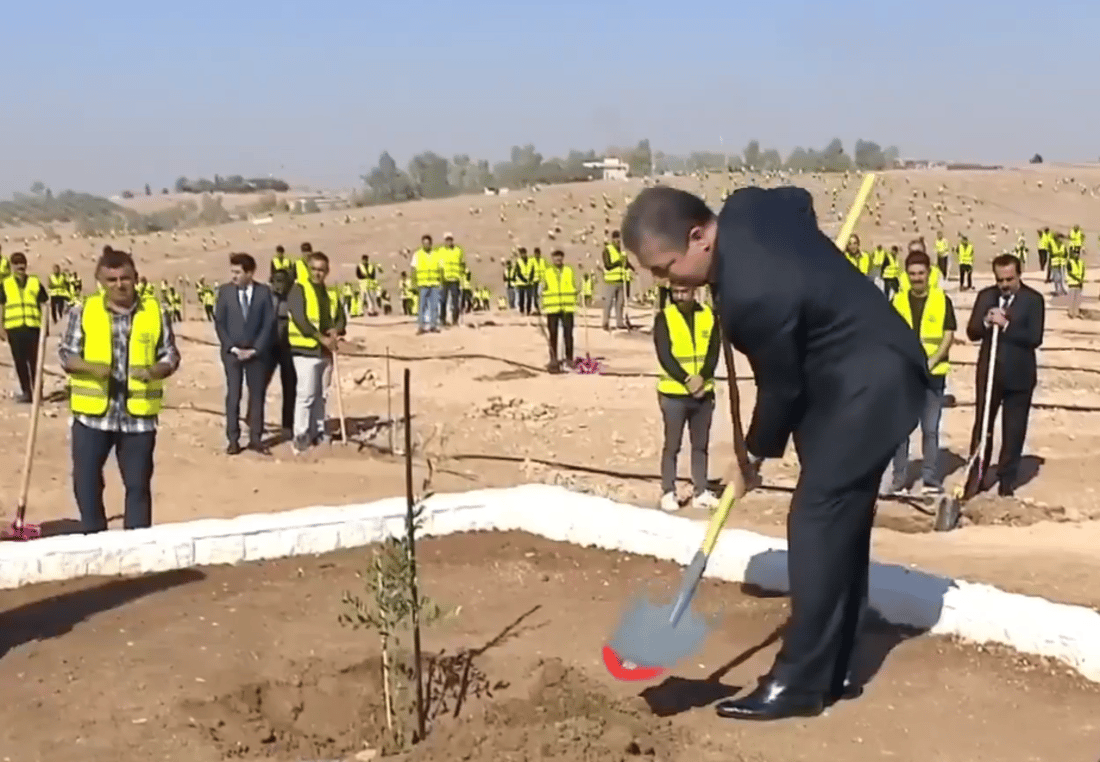
Kurdistan Region Prime Minister Masrour Barzani plants the first tree to launch the Erbil Green Belt Project on the outskirts of the capital, October 30, 2025.
Millions of trees planned
Erbil Green Belt Project launched to expand green spaces, improve air quality
ERBIL — Kurdistan Region Prime Minister Masrour Barzani on Thursday launched the first phase of the Erbil Green Belt Project by planting the first tree on the outskirts of the capital, marking the start of a major environmental initiative to expand greenery, improve air quality, and enhance urban life in the city.
“The project will have a very strong impact on Erbil’s climate,” Barzani said during the ceremony. “On one hand, it will absorb and reduce carbon dioxide, and on the other, it will return oxygen to Erbil and its surroundings. This will provide a healthier environment, cleaner air, and a better life for citizens.”
Encouraging private sector participation, he added, “The door is open for the private sector to take part in advancing the Green Belt Project. Today’s steps will continue rapidly and steadily.”
Hundreds of workers and environmental activists joined the launch, helping plant saplings as part of efforts to restore the city’s natural surroundings. The project will extend nearly 78 kilometers around Erbil, with a width of two kilometers, and include seven million olive and pistachio trees.
According to the Kurdistan Regional Government’s Media and Information Office, the green belt could reduce between 140,000 and 210,000 tons of carbon dioxide annually and “give Erbil a more beautiful and healthy appearance.”
Hemin Said Murad, head of Erbil’s agriculture directorate, previously told 964media that planting is expected to finish during the current season “if weather conditions allow; otherwise, it will be completed next year.”
The Erbil Green Belt Project, part of the city’s master plan, is considered one of the Kurdistan Region’s most significant environmental undertakings. The Erbil Governorate said the initiative “plays an important role in cleaning the city’s air and improving its environmental balance.” Officials said millions of trees will be planted around the capital, along with several water basins to mitigate the effects of climate change, dust storms, and desertification.
The green belt will encircle Erbil in a circular pattern extending outward from the 150-meter ring road, averaging two kilometers in width and including more than ten ponds for water conservation.
The first stage, launched in April, covers 13,000 dunams and uses olive and pistachio trees selected after environmental studies. Experts from Greece examined soil, water, and air samples to identify suitable species for Erbil’s climate.
According to the Erbil Governorate, “The Erbil Green Belt is a strategic project that will increase the capital’s green coverage by 25 percent.”
