
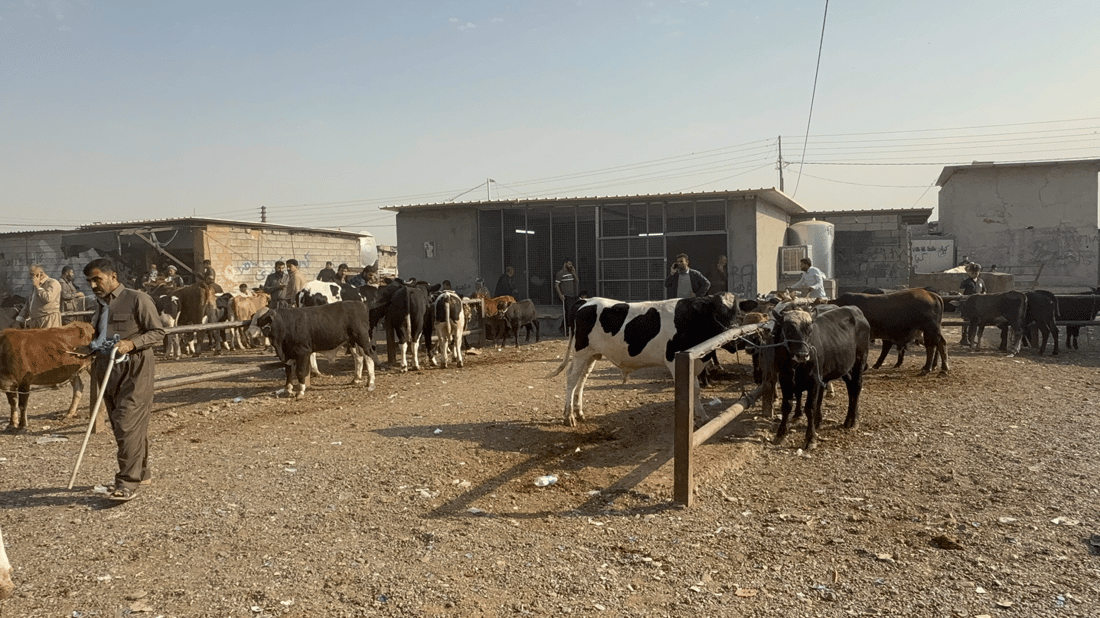
Traders at Erbil’s livestock market conduct sales using prices based on the old Iraqi dinar, a tradition that continues despite the currency no longer being in use. (Photo by 964media)
'This is our way'
Erbil livestock market keeps tradition of trading in ‘old dinar’ alive
ERBIL — In Erbil’s livestock market, a tradition older than the modern Iraqi dinar continues to shape trade. Buyers and sellers still negotiate prices using the “old dinar,” a currency that officially disappeared decades ago but remains central to the market’s culture.
Sami Mohammed Sultan, known as Mam Sami, has traded livestock for more than 30 years. “If you want to buy an animal, you have to make the deal using the old Iraqi dinar,” he told 964media. “One old dinar equals 150 of today’s dinar. This has become a cultural practice in Erbil’s livestock market, and we continue with it without changing.”
After the 1991 Gulf War, Iraq’s currency system split. The central government in Baghdad began producing lower-quality notes, locally called the “Saddam dinar”. These were printed in large quantities, leading to rapid inflation and loss of confidence in the south and center of the country.
In Kurdish areas protected by the no-fly-zone, however, the higher-quality “Swiss dinar” notes remained the de facto currency despite being officially withdrawn from circulation. Their limited supply and stable value made them the preferred currency across the Kurdistan Region and parts of Nineveh and Kirkuk throughout the 1990s. This created two concurrent economies: one in the north operating on the old Swiss dinar and another in the rest of Iraq using the increasingly devalued Saddam dinar.
Maghdid Khalid, another veteran trader known as Mam Maghdid, explained, “When we sell an animal, we first shake hands and agree on the price in old dinar. Later, we convert it into the value of the current currency — for every one old dinar, we take 150 new dinars. This is our way, and we keep it alive.”
Located about 10 kilometers from central Erbil along the Kawrgosk road, the livestock market opens on Saturdays, Mondays, and Wednesdays, drawing farmers and traders from across the governorate. Though the old dinar has long disappeared from circulation, its legacy endures in Erbil’s barns and auctions, where the past still defines the price of every deal.