
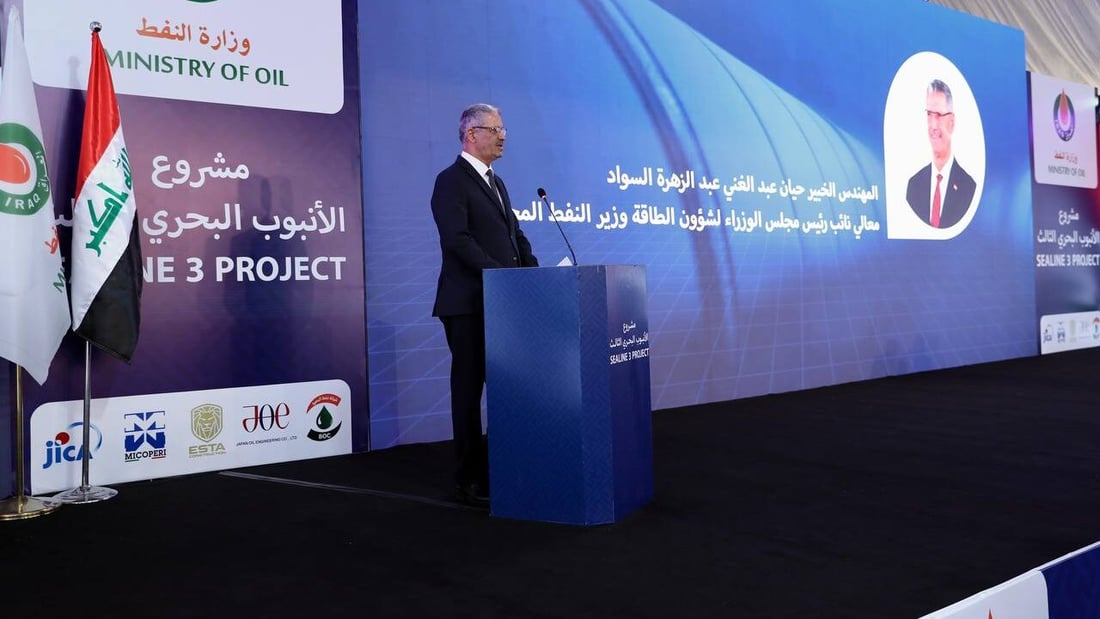
Oil Minister Hayan Abdul Ghani Al-Sawad speaks during the inauguration ceremony of Iraq’s Third Offshore Pipeline Project in Basra Governorate.
Iraq inaugurates third offshore pipeline to boost southern oil exports
BASRA — Iraq on Saturday inaugurated its third offshore pipeline, a major addition to the country’s southern export system designed to increase crude export capacity and improve operational flexibility, according to Deputy Prime Minister for Energy Affairs and Oil Minister Hayan Abdul Ghani Al-Sawad.
“The third offshore pipeline project represents a major step in Iraq’s southern crude oil export system,” Al-Sawad said at the inauguration ceremony in Basra Governorate. “It is one of the ministry’s most strategic projects, implemented through the Basra Oil Company.”
He said the project’s design capacity is 2.4 million barrels per day, with an operational capacity of about 2 million barrels per day. “This project strengthens Iraq’s export capacity and provides high flexibility in managing export operations,” he said.
The pipeline spans 70 kilometers — including 61 kilometers offshore and 9 kilometers onshore — and connects to two offshore platforms, VS-1 and VS-2, near the Basra Oil Terminal and Khor Al-Amaya Port. It also links to a single-point mooring buoy, SPM-4, and includes a 60-kilometer dual subsea cable for power and communications, along with advanced control, electrical, communication, and cathodic protection systems.
Al-Sawad said the project adds an additional export capacity of 2 million barrels per day, offering multiple routes for crude shipments through the Basra Oil Terminal, Khor Al-Amaya Port, and SPM-4.
He noted that the contract for the project was signed on April 13, 2025, between the Basra Oil Company and a consortium of ESTA and MICOPERI. The project has an implementation period of 757 days and is expected to be completed by the end of 2027.
“We look forward to continued cooperation between national institutions and international companies to achieve further progress for Iraq and its people,” Al-Sawad said.