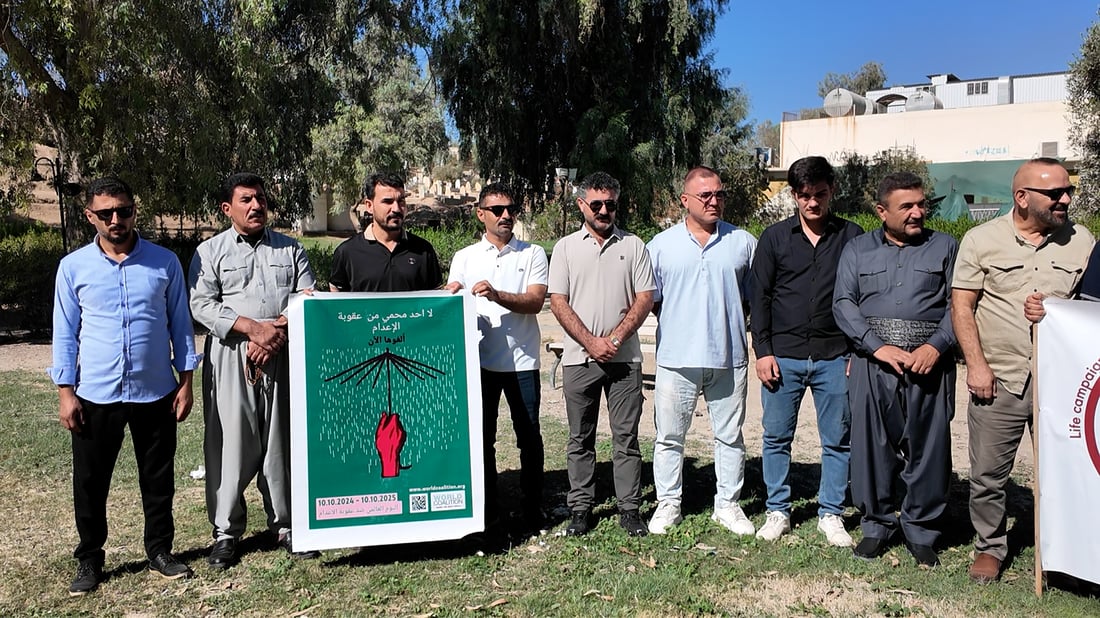
Civil society activists gather in Kirkuk’s Martyr Marf Barzinji Park to mark the World Day Against the Death Penalty, calling for an end to executions in Iraq. Photo by 964media
Kirkuk activists call for end to executions as Iraq records sharp rise in death penalty cases
KIRKUK — Civil society organizations gathered on Saturday in the Martyr Marf Barzinji Park in Kirkuk to mark the World Day Against the Death Penalty, calling on Iraqi authorities to halt executions nationwide and align with the Kurdistan Region, where the death penalty is not enforced.
Although the first global step to end executions was taken at the 1977 Stockholm Conference, 54 countries have yet to abolish the practice, and Iraq remains among them.
Activist Chenar Sirwan told 964media, “Unfortunately, in the past two years, execution rates have increased, rising by 32%. Fortunately, the death penalty is not enforced in the Kurdistan Region, but it continues in Iraq, and we demand that it stop.”
Karwan Abdulrahman, one of the event organizers, said, “As civil society organizations, we gather every year on Oct. 10 to oppose the death penalty.”
According to Amnesty International’s 2024 global report on death sentences and executions, Iraq carried out at least 63 executions in 2024, a fourfold increase from at least 16 in 2023, making it the highest number recorded since 2019.
All known executions were for people convicted of terrorism-related offenses, and Amnesty raised concerns about violations of fair trial rights and allegations of torture or ill-treatment to extract confessions. The organization also noted that some executions were carried out in secret, with families and lawyers not notified beforehand.
In 2024, the Iraqi government “dramatically increased the scale and pace of unlawful executions,” Human Rights Watch reported, documenting cases where authorities carried out executions without prior notice to lawyers or families and despite credible allegations of torture and fair trial violations.
In the Kurdistan Region, about 500 inmates are currently on death row. However, since 2008, the Kurdish authorities have maintained a de facto moratorium on executions, resulting in these sentences not being carried out. This moratorium effectively blocks the use of the death penalty, except for terror-related charges or exceptionally heinous crimes.
Globally, Amnesty International recorded 1,518 executions in 2024, a 32 percent increase from 1,153 in 2023. The report notes that these figures exclude the thousands believed to have been executed in countries like China, North Korea, and Vietnam, where data are highly restricted.