
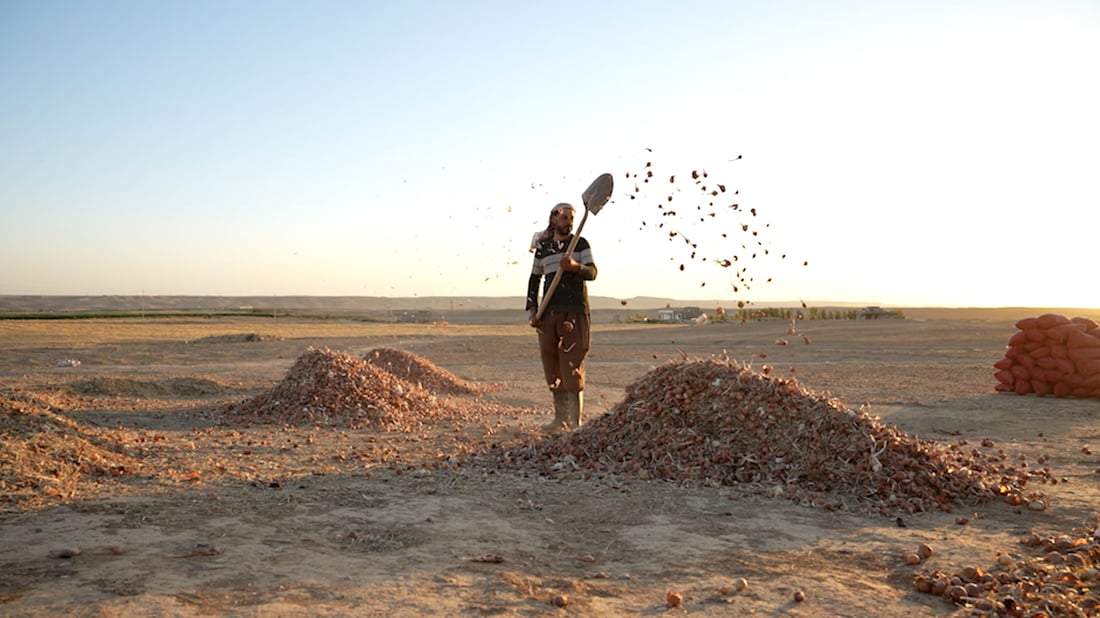
A farmer in Rawa, western Anbar, tosses freshly harvested fasaqah onions — a local variety of white onion unique to Iraq — during the cleaning process at sunset. Photo by 964media.
Anbar
Rawa farmers decry onion import decision, warn of price collapse
ANBAR — Farmers in the western town of Rawa voiced anger this week after the Ministry of Agriculture announced it would reopen onion imports, saying the decision threatens to undercut local harvests and crash prices during what they described as one of the strongest seasons in years.
Until Sunday, growers in Rawa and nearby Karmles in Nineveh were celebrating a successful onion season, with yields higher than last year and prices reaching about 500 dinars — roughly $0.35 — per kilogram. But the ministry’s move on Monday reversed an import ban imposed in April by Agriculture Minister Abbas al-Maliki, prompting frustration among farmers who had invested heavily in domestic production.
“Farmers are deeply disappointed,” said one grower, noting that onion cultivation “is more complicated than people think” and can take nearly a year from planting to sale. Rawa produces up to 500 tons of “fasaqah” onions each year — small bulbs that serve as the first stage of cultivation before being replanted to mature into full-sized onions.
Nasser Nadeem, head of Rawa’s Agriculture Division, said “fasaqah” onions are grown in tightly packed soil, preventing them from developing fully. “Farmers must replant them with wider spacing and provide months of care,” he said. “This long process can occupy the farmer all year, only for him to sell the crop at less than 400 dinars per kilo before prices collapse due to imports.”
He said Rawa produces three main onion types — white, red, and light brown — with the white variety considered the best in Iraq because of the region’s soil. Smaller quantities of the rare Baashiqi type, originally from Mosul, are also grown locally.
Farmer Heybat Jalhout said the process begins in January, with harvesting in July after the final irrigation. “It’s a labor-intensive process that faces many difficulties, especially in getting fertilizer and seeds,” he said, adding that climate fluctuations and rising input costs have made the work harder.
Another grower, Mohammed Shukri, said, “In Rawa we have three main types of fasaqah — white, red, and Baashiqi — but only the white kind grows successfully here. It starts from a black seed, becomes a small bulb, and finally grows into a full onion.”
Nadeem said about 50 to 60 percent of Rawa’s population depends directly or indirectly on agriculture, with farmland extending from Haditha in the east to Iraq’s western border with Syria. The region remains suitable for wheat in winter and hybrid corn in summer, he said, but unstable prices and import competition have forced many farmers to abandon potato and onion production.
He urged the government to provide irrigation support and compensate areas affected by the Haditha Dam, which flooded large sections of farmland. “If the state supports agriculture in Rawa, Ana, and al-Qaim, Iraq could achieve self-sufficiency in key crops like potatoes,” Nadeem said.