
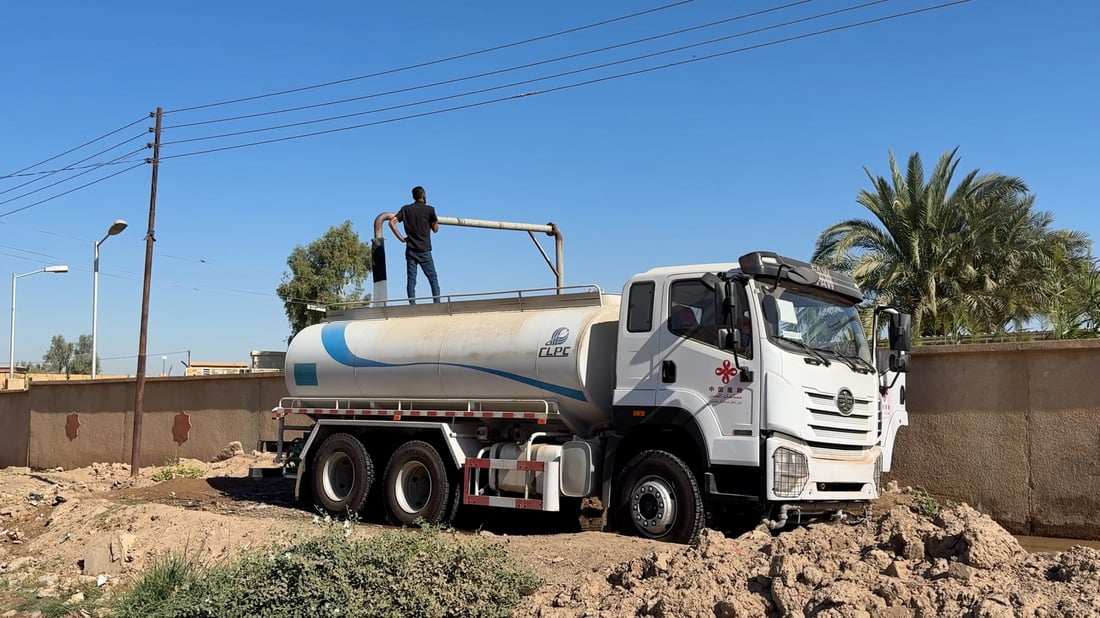
A worker fills a tanker truck with water to distribute to residents in Al-Azim, Diyala governorate, as shortages continue to affect thousands of people. Photo by 964media
Water crisis deepens in Diyala’s Al-Azim as dam dries and pollution worsens
DIYALA — Residents of Al-Azim subdistrict in Diyala Governorate say the water reaching their homes has become among the worst in Iraq, with rising salinity, foul odors, and contamination linked to declining levels at the Al-Azim Dam. The reservoir, which collects runoff from the highlands of Kirkuk and Sulaymaniyah, feeds the southern branch of the Al-Azim River for about 100 kilometers before it joins the Tigris near Al-Khalis.
Locals told 964media that the dam’s water shortage has forced authorities to ration supply and rely on tanker deliveries, while pollution from chemicals dumped by fishermen has worsened conditions. They said the contamination killed large numbers of fish and left the water blue with a strong odor of decay.
“The water crisis is suffocating,” said resident Sabah Al-Jarrah. “Water reaches us for only half an hour or an hour, and some areas get none at all. Without the tankers, the problem would be worse and more dangerous.”
He added, “The tap water reaches us with a blue color and a foul smell like rotten fish because some fishermen threw poison into the water. We used to receive a mix of fresh and salty water, but now we barely get any.”
Officials say Al-Azim, home to about 50,000 people, is suffering from both shortages behind the dam and widespread illegal connections along the supply line from the Tigris River near Al-Khalis.
Osama Saad, head of the Al-Azim Water Department, told 964media that more than 800 unauthorized pipes from nearby villages disrupted the main line. “The authorities cut all the illegal pipes but left the small household hoses until an alternative solution is found,” he said.
Saad said officials are mixing poor-quality dam water with cleaner water pumped from the Tigris, but the supply remains limited. “We applied a rotation system that provides one hour of water pumping for residents,” he said. “Twelve tanker trucks distribute water continuously to the eastern and western parts of the subdistrict, and we’ve been doing this for ten days.”
He said around 24,000 people have been affected and about 12,000 now depend entirely on tanker trucks for water. “The solutions are in the hands of the Ministry of Water Resources,” Saad added. “It’s the authority responsible for securing water for treatment plants, but it hasn’t contacted us to find solutions to the crisis.”
Saad suggested drilling wells for local supply, noting that “the main complex in the subdistrict also needs wells to provide water for household use because groundwater can be either fresh or salty depending on location.”
Resident Hazem Mohammed said the poor-quality water has caused health problems. “In Al-Azim, the water is salty, while other areas get fresh, usable water,” he said. “The smell is fishy, and it caused me skin irritation. But the water department employees are doing their best with the tankers.”