
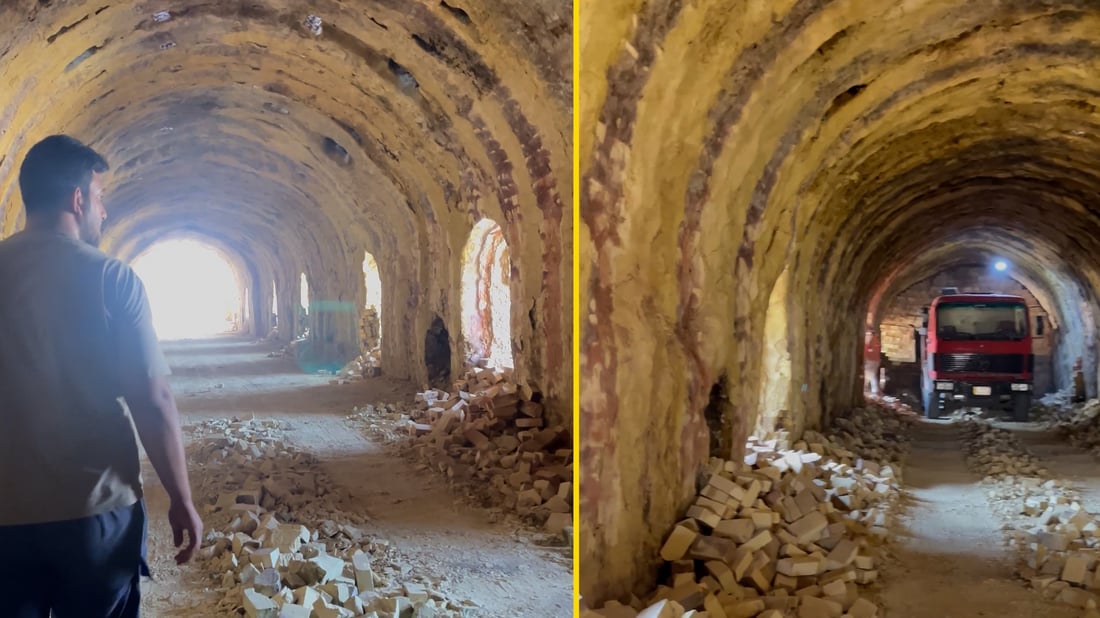
Inside a brick kiln in al-Tabar, Maysan, where workers fire traditional Iraqi bricks at over 1,000 degrees Celsius. Photo by 964media
Maysan
In al-Tabar, Iraq’s traditional brick industry endures the heat
MAYSAN — In southern Iraq, the craft of making solid Iraqi bricks has survived despite its difficulty, cost, and time demands. Unlike hollow cement blocks that are molded and left in the sun, these bricks are produced through a long and strenuous process that yields a durable product able to insulate heat and sound while supporting concrete ceilings for decades.
Not every governorate has the right soil for brickmaking. Famous quarries are located southeast of Baghdad, producing the well-known Nahrawan bricks, as well as in Dhi Qar and Wasit. Basra, whose soil is unsuitable, relies on supplies from its neighbors.
A 964media camera visited the Nahrawan brick factory in al-Tabar, south of Amara, which has been operating since 1993. About 25 workers produce bricks using red soil extracted after removing two layers of earth. The soil is mixed, pressed into molds, and dried for several days before entering kilns — large caverns big enough to fit a truck, surrounded by flames from above. The bricks remain inside for three days at temperatures exceeding 1,000 degrees Celsius.
The finished bricks are distributed across Amara and surrounding areas, reaching as far as Basra. They are smaller than Baghdad’s famous bricks, though prices are comparable at about 1 million dinars ($710) for 8,000 bricks before loading and transport costs. Production halts during the rainy season, with workers storing prepared clay to resume in summer.
Ali Mohsen, a factory representative, said: “The Nahrawan factory in al-Tabar, Maysan governorate, was established in 1993. It employs more than 25 workers and relies on red soil in production. The process begins when diggers extract layers of sabkha, sand, and red clay. After transport, the clay is mixed, pressed into molds, cut, and left to dry for two or three days depending on weather. The bricks are then fired in kilns for about three days at more than 1,000 degrees Celsius before being ready for use.”
Mustafa Mohsen, another factory representative, compared production with Baghdad: “Amara bricks differ from Baghdad bricks in size. If seven Baghdad bricks are stacked, they equal eight Amara bricks. Many in Amara prefer Baghdad bricks because they are transported in neat arrays, while Amara bricks are delivered in bulk, which leads to breakage. To account for this, we add extra bricks to cover losses.”
He added that Basra depends on Amara’s bricks, while in Dhi Qar, areas such as Qalat Sukkar have rich soil that supports brick factories. “In winter we stop working because brickmaking depends on clay and water, and weather changes affect quality. At the end of summer, we store clay in bundles covered with plastic and soil. During winter we use these reserves to keep producing bricks of the same quality.”
Prices vary between governorates. In Baghdad, bricks sell at a fixed price of 125,000 dinars ($89) per 1,000 bricks, excluding transport. In Maysan, they are sold in full “double” sets of 4,000 bricks plus 200 free to account for breakage, with a total cost of 500,000 dinars ($355) including delivery.