
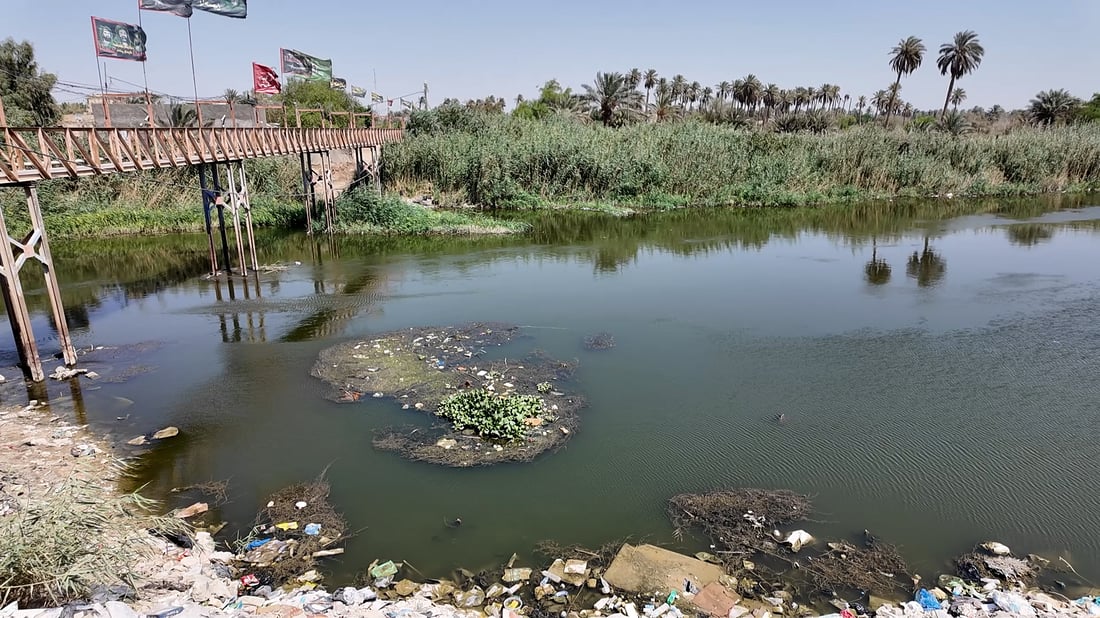
Wastewater flowing into the Euphrates near Kufa has caused foul odors, algae growth, and health risks for residents. Photo by 964media
Najaf
Sewage from Kufa overwhelms treatment plant, flows into Euphrates
NAJAF — The Barakiya wastewater treatment plant in Kufa can no longer handle the volume it receives, forcing untreated sewage into the Euphrates River, according to local officials and residents who warn of severe health and environmental consequences.
Najaf Environment Director Jamal Abdul-Zaid told 964media, “Sewage discharge points and rainwater networks in Najaf governorate continue to pose a major environmental problem for the Euphrates, especially with water scarcity and low levels, which increase pollutant concentrations and worsen their impact.”
He said discharge points along the Kufa stretch of the river, where most drinking water projects are located, have been reduced from six to three: the Buhedari drain, a point on Abu Shkheir Island, and the Barakiya plant, which he described as “the main hub of pollution.”
“These points receive inflows beyond their design capacity, releasing more than half into the Euphrates untreated, while the treated portion does not reach the acceptable environmental level,” Abdul-Zaid said.
He added that violations by residents connecting to rainwater or agricultural drains have aggravated the issue. Two discharge points on Sikka Street and at the Guest House have been closed, but the remaining outfalls continue to exceed capacity.
The Environment Directorate said it has issued warnings, imposed fines, and filed lawsuits against responsible parties but lacks authority to enforce closures. “This requires a stance from the governorate or a higher government decision to resolve the file,” Abdul-Zaid said.
Dr. Ali Kazem, a physician from Najaf, said the Suhailiya drain in Kufa has been releasing untreated sewage into the Euphrates for more than 15 years, causing widespread health issues. “This drain has caused a large number of citizens to suffer from skin diseases and other illnesses, and it has changed the taste and color of the river water, especially with reduced flows,” he told 964media.
Kazem said repeated appeals to past and current governors have not produced solutions. “We still demand urgent, effective, and sustainable measures,” he said, calling on the ministries of health, environment, and water resources, along with local water and sewage departments, to act.
Residents say the impact is already visible. Hussein Saeed, who lives in Najaf, described worsening algae growth in the stretch of the Euphrates between the Imam Ali Bridge and the Kufa Bridge leading to Abbasiya.
“The continued discharge of sewage has led to the spread of skin diseases and respiratory infections,” he said. “Movement at night has become impossible due to strong odors. In summer, the smells drawn through air coolers cause suffocation and sometimes equipment breakdowns.”
He added that fish stocks have nearly disappeared from the area. “You no longer see fishing. Only layers of algae remain, with the water’s color, smell, and taste changed until it has become like sewage water,” he said.