
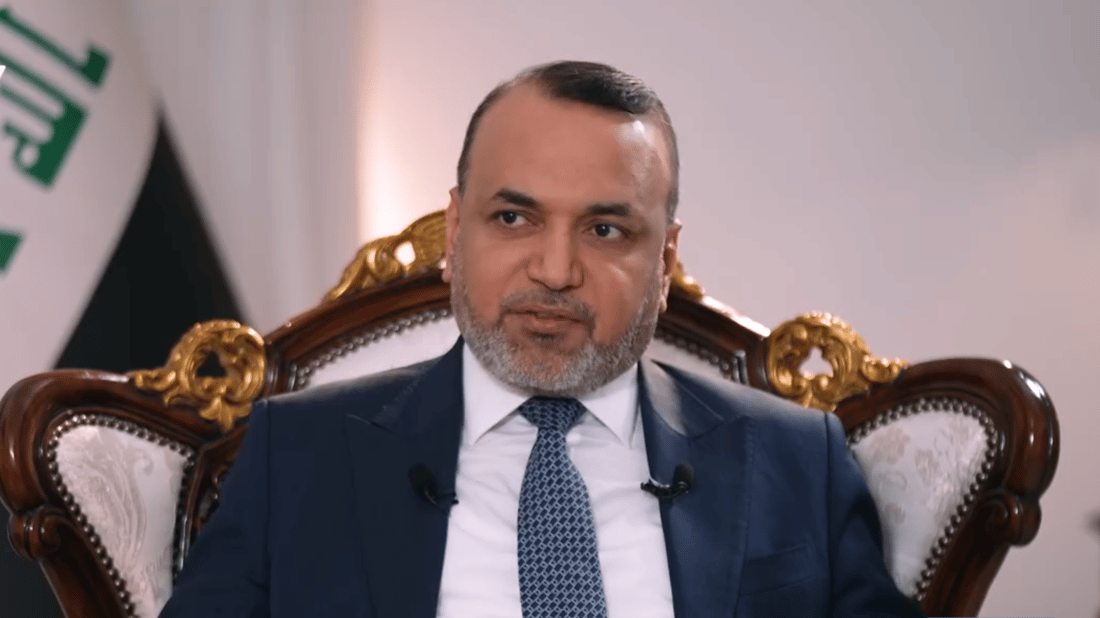
Iraq’s Minister of Labour and and Social Affairs Ahmed Al-Asadi
Media Monitor
Labor minister says PMF law stalled by divisions, external pressure
BAGHDAD — Iraq’s Minister of Labor and Social Affairs Ahmed al-Asadi said the Popular Mobilization Forces law will not advance in parliament due to political rifts and outside pressure.
“In this session of the parliament, we have become accustomed to frequent absences from all blocs; therefore, the Popular Mobilization Law will not be passed at present,” al-Asadi told Utv in an interview. He added that “the Sunnis and Kurds have conveyed to us a direct message that none of them will vote on the law.”
The government pulled the bill on Aug. 10 after warnings from rival blocs and international partners. The legislation would have formally transformed the PMF into a permanent military institution with broad operational, political, and financial powers.
Al-Asadi said internal disputes have also played a role. “There are more than 50 independent Shiite deputies not affiliated with the Coordination Framework, which is one of the reasons for the lack of quorum to vote on the Popular Mobilization Law,” he said.
The Coordination Framework is an alliance of predominantly Shia political factions and armed groups.
Al-Asadi dismissed talk of regime change as “propaganda,” saying: “The current Iraqi system is parliamentary democratic. What is the alternative to the democratic system? Either a new dictatorship or new chaos and destruction for Iraq.”
He also warned against regional escalation, stressing Iraq’s vulnerability. “Iraq is not capable of entering a war, as its results would be catastrophic,” he said. “We are working with America, Europe, Russia, and the countries of the other axis to prevent war, but if it occurs, God forbid, we will work to prevent Iraq from being dragged into it.”
Excerpts from Ahmed Al-Asadi’s interview with Utv:
In this session of the parliament, we have become accustomed to frequent absences from all blocs; therefore, the Popular Mobilization Law will not be passed at present, and the Sunnis and Kurds have conveyed to us a direct message that none of them will vote on the law.
The connection between the blocs and the deputies in this session is different from previous ones, and there are more than 50 independent Shiite deputies not affiliated with the Coordination Framework, which is one of the reasons for the lack of quorum to vote on the Popular Mobilization Law.
There was no decision or directive from the leaders of the Framework for the deputies to wear the Popular Mobilization uniforms; rather, it was a vision among the deputies themselves. This is a media matter, a gesture of loyalty to the Popular Mobilization, and the law itself was not on the agenda of that session.
One of the reasons for the lack of national consensus among Sunnis and Kurds to pass the Popular Mobilization Law is American dissatisfaction.
After 2025, the Americans changed their perspective, especially with the changes in the international and regional system and the Al-Aqsa Flood. All of these developments pushed them toward more cautious and less rational directions in dealing with files, and they had a significant influence in preventing the passage of the Popular Mobilization Law.
It is not new to hear about a coup in Iraq; this is propaganda we hear during every election and every crisis that hits the region, where talk emerges about changing the system.
The current Iraqi system is parliamentary democratic. What is the alternative to the democratic system? The alternative does not go beyond two possibilities: either a new dictatorship or new chaos and destruction for Iraq. Every rational person is keen not to return to dictatorship, as Iraqis paid heavy prices and cannot allow its return.
The weapons of the armed factions are an Iraqi issue. We bear responsibility for it and know its details—how they were established, why they remain until now, and what the future is for these formations. This issue will be resolved by Iraq with friends and partners in a way that preserves what these parties have offered in efforts and blood, and at the same time preserves the state’s prestige.
The current circumstance is not normal—international changes and heated events in the region: wars, confrontations, and possibilities are present. We are not required to assume good intentions or reassurance. If the Americans decide to withdraw, we must study why they responded and did not postpone.
Khamenei’s leadership is wise; it has been able to overcome many crises, and Iran has emerged from several crises with the Iranian people standing with its leadership. When Khamenei speaks about the necessity of preparing for war, this is natural because Israel, and Netanyahu in particular, has become obsessed with blood, war, and crime. The possibility of war exists every day, but it is not inevitable—it can be avoided. Whoever does not hear the drums of war is deaf. Preparation for war will prevent it, while lack of preparation will hasten it.
Iraq is not capable of entering a war, as its results would be catastrophic for it. All parties have realized this and have responded. We, as a state with all its representations, work through our relations with America, Europe, Russia, and the countries of the other axis to prevent war. But if it occurs, God forbid, we will work to prevent Iraq from being dragged into it.