
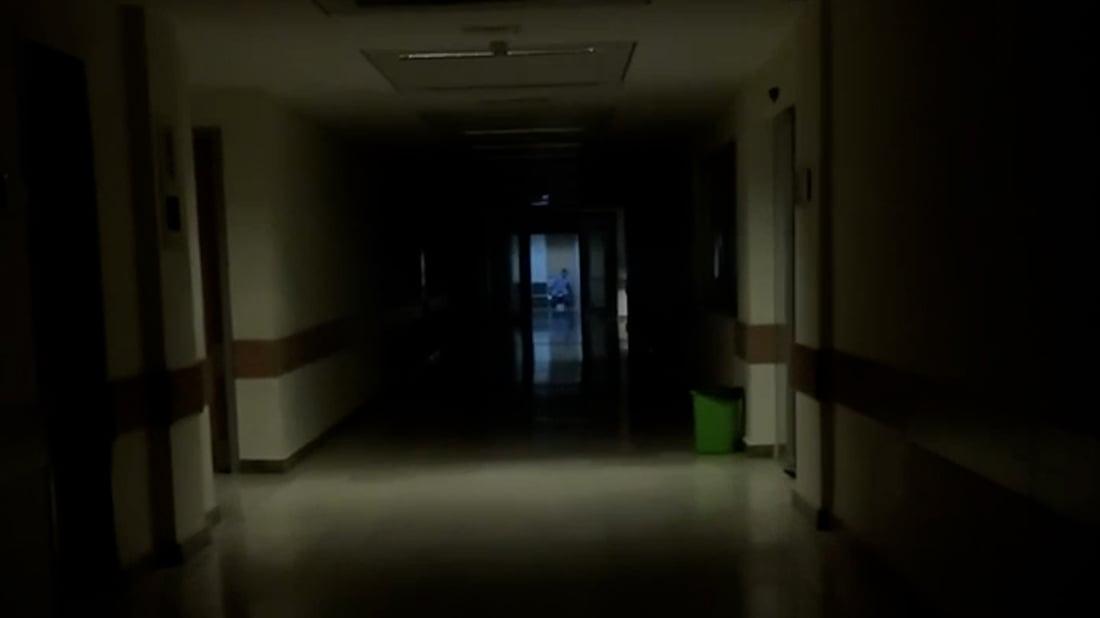
A corridor at Al-Sayyab Hospital in Basra during Monday’s nationwide power outage, which left parts of the facility in darkness.
Queues at gas stations
Iraq restores power after nationwide outage leaves residents sleeping in cars
BAGHDAD — Much of Iraq spent Monday and part of the night without electricity before power was gradually restored late in the evening, following the collapse of the national grid earlier in the day during extreme heat and the Arbaeen pilgrimage.
In Baghdad, outages began between noon and 3 p.m. across multiple districts, including Zafaraniya, New Baghdad, Al-Mashtal, Al-Jamia, Al-Amiriya, Al-Qadisiyah, Al-Mansour, Al-Yarmouk and Abu Ghraib. In Basra, where temperatures stayed high into the night, some residents slept in their cars with the air conditioning running, while others checked into hotels. Long queues formed at fuel stations despite many locals being away for the pilgrimage.
“The crowding at gas stations is because of the outage and people sleeping in their cars to use air conditioning,” said fuel station employee Ali Emad.
Citizen Jamal Sami said, “We are in the pilgrimage season and the streets are almost empty, but people had to sleep in their cars because of the power cuts and heat.”
Another resident, Wathiq Hamid, said his family planned to drive around Basra for hours before staying in a hotel. “It’s very hot and we are living without electricity now,” he said.
Basra Governor Asaad Al-Eidani called the outage an “emergency incident” caused by a frequency surge above 50 hertz, triggering automatic shutdowns at local plants. He denied claims that electricity had been diverted from Basra to Baghdad on the order of the prime minister, calling them “untrue and election propaganda.”
Basra Health Director Abbas Al-Tamimi said a “technical issue” at Al-Sayyab Hospital forced reliance on generators but did not cut off oxygen or water, contradicting widely shared videos showing parts of the facility in darkness. Witnesses said some intensive care patients were moved to other hospitals during the blackout.
The parliamentary electricity and energy committee called the outage a “serious failure” for which the Ministry of Electricity and other authorities are responsible. Committee head Mohammed Nouri al-Abd Rabbo said it “cannot be justified by technical or circumstantial excuses” and showed “poor planning and weak management.”
The committee said it has begun urgent oversight measures, summoning officials to identify the causes and referring those responsible to the judiciary. It warned that public patience “has run out” and called on the government to take immediate steps to prevent a repeat, repair the grid’s infrastructure and improve its management.
The Ministry of Electricity earlier said the collapse was caused by record heat, high demand and large crowds during the pilgrimage, which shut down two major transmission lines in Karbala and Babel governorates, removing more than 6,000 megawatts from the grid.