
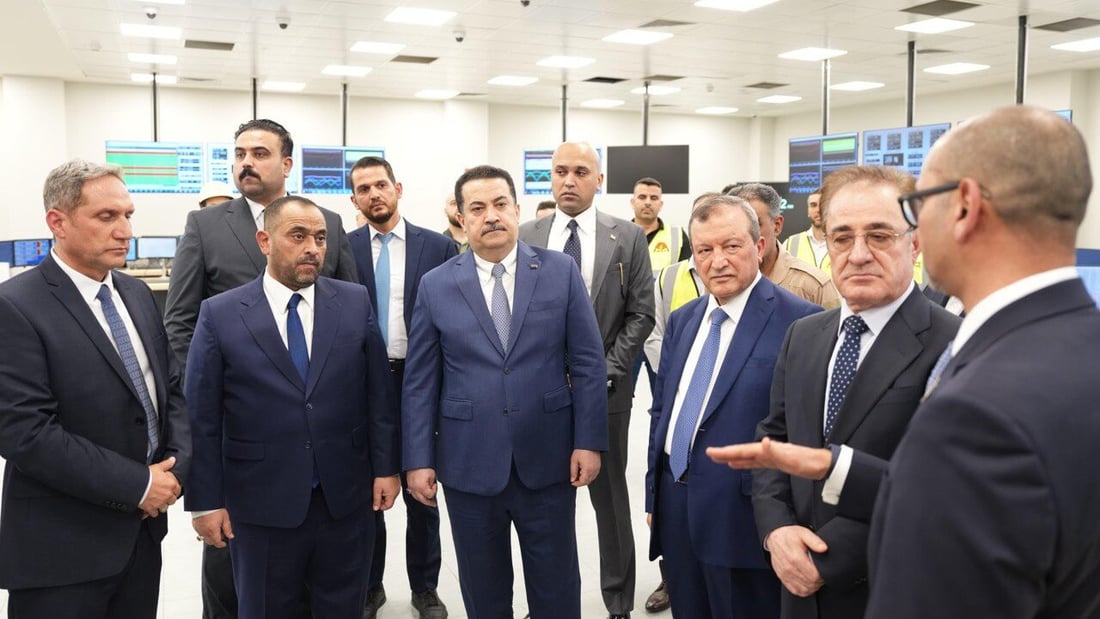
Prime Minister Mohammed Shia al-Sudani listens to a briefing during the inauguration of the gas turbine unit 13 at the Bismayah investment power station on Monday.
Monitor
Iraq to add 60,000 megawatts to power grid, says PM
BAGHDAD — Prime Minister Mohammed Shia al-Sudani said Monday that Iraq’s electricity system will see an additional 60,000 megawatts once major projects are completed, outlining a multi-track plan involving gas turbines, thermal and investment power plants, as well as solar and renewable energy projects.
Speaking at the inauguration of the gas turbine unit 13 at the Bismayah investment power station, al-Sudani said the unit will add 300 megawatts to the plant’s output, along with 210 megawatts restored through maintenance, bringing the total capacity to 5,000 megawatts. He stressed ongoing efforts to secure gas supplies for power stations and to enhance energy infrastructure.
On August 7, Electricity Minister Ziyad Ali Fadhil said Iraq’s power production reached a record 28,000 megawatts, achieved through maintenance contracts, station upgrades, advanced cooling systems, and some imported fuel.
“We commend the cooperation between the private sector and state institutions, which proves a genuine partnership to provide services,” al-Sudani said, praising Mass Company, General Electric, and the Ministry of Electricity for their role in completing the work “in record time” despite challenging conditions.
The prime minister said the government is working on a wider partnership to secure gas for stations, including the completion of a floating platform and the establishment of a fixed platform at the Grand Faw Port, expected to be operational in the summer of 2026.
He outlined key targets: 24,000 megawatts through the largest project with GE for gas turbines, 15,000 megawatts with Siemens, 10,000 megawatts from thermal power plants, 10,000 megawatts from investment plants, and up to 3,000 megawatts from solar and renewable energy.
Al-Sudani also highlighted progress in transmission and distribution projects to improve network efficiency and ensure a steady power supply, stressing the need for the Ministry of Electricity to regulate consumption through “fair, smart, and flexible collection” systems.
“It is necessary to secure production costs to provide funds for generating power and purchasing fuel,” he said, adding that the government is moving toward a comprehensive billing system using smart meters and prepaid cards.