
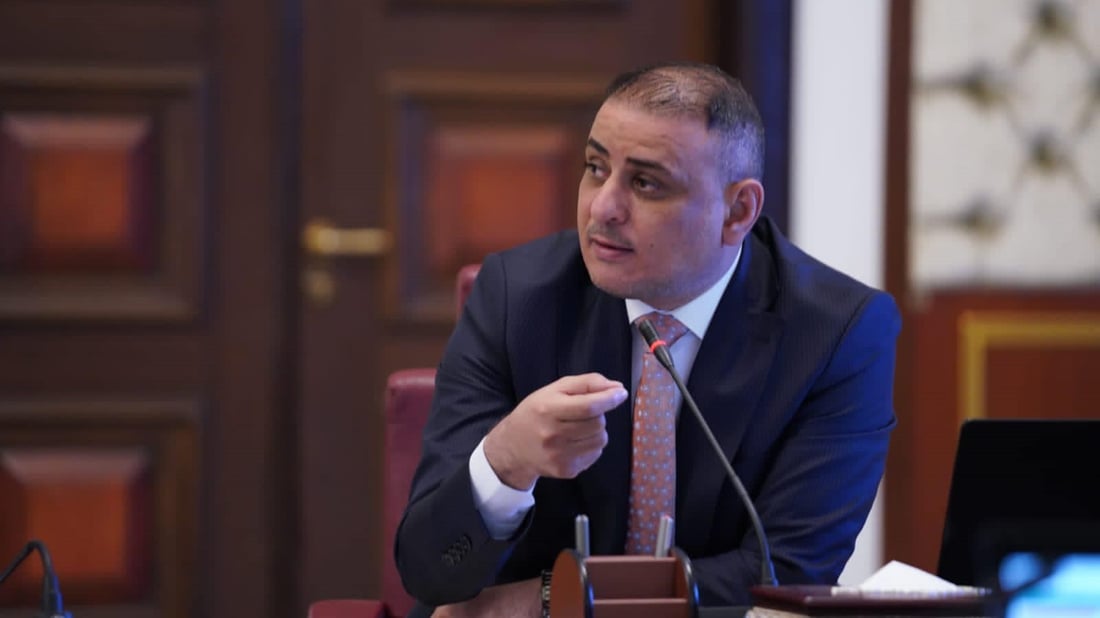
Mohammed Jameel Al-Mayahy
Media Monitor
Wasit governor blames Kut mall fire on oversight failures, accuses rivals of political exploitation
WASIT — Gov. Mohammed Jameel Al-Mayahy said the Kut shopping mall fire that killed 61 people exposed critical weaknesses in Iraq’s emergency response system and building safety enforcement, while also accusing political opponents of using the tragedy to undermine him.
In an interview with Dijlah TV, Al-Mayahy said the building had been converted into a commercial mall without municipal authorization. “There are about 20,000 commercial buildings in the city that do not meet safety requirements,” he said.
The governor, under pressure from local residents demanding his removal, criticized the Civil Defense response, claiming rescue teams concentrated only on evacuating individuals trapped on the roof while others remained inside. “At 2 a.m., I entered the fourth floor of the building and we found eight martyrs due to suffocation,” he said. “The capabilities of Civil Defense were very limited,” he added, alleging that responders were using tissues during evacuations.
He also accused the mall operator, identified as Bassam Al-Rawi or Al-Saadi, of fleeing the scene with 80 workers and contributing to the high death toll. “Some survivors said the person named Bassam prevented people from leaving, and he is the one who turned off the electricity in the building,” Al-Mayahy claimed, though he acknowledged that investigations had not confirmed whether an electrical short caused the blaze.
Al-Mayahy warned that a nationwide review of Civil Defense operations is needed and noted the scale of the problem. “If we wanted to close all buildings that do not meet safety requirements, we would have to shut down 90% of the shops in Wasit. These people would protest in the streets,” he said.
Public anger over the July 17 fire has continued to build. For more than a week, victims’ families have held nightly demonstrations outside the governorate council building in Kut. On Monday, they launched an open-ended sit-in, erecting condolence tents and demanding Al-Mayahy’s removal and prosecution.
“We, the families of the martyrs of Kut, demand the dismissal of Gov. Al-Mayahy and his referral to the judiciary,” they said in a statement.
On Tuesday, Prime Minister Mohammed Shia Al-Sudani approved the findings of the investigative committee into the fire and ordered the referral of Al-Mayahy, in his capacity as head of the governorate’s civil defense committee, along with other committee members, for further legal investigation.
Excerpts from Al-Mayahy’s interview with Dijlah TV:
The city of Kut, home to over 750,000 people, has seen both regulated and unregulated urban expansion in recent years. Approximately 40,000 unregulated structures exist in the city center alone.
The building where the fire occurred was originally developed between 2019 and 2020 as a hypermarket, during a period marked by protests and government office closures. The project’s owner circumvented legal, technical and administrative regulations to convert the land’s zoning from residential to commercial use, with the cooperation of municipal authorities. The site later became a restaurant under the Zarzoor agency and was eventually repurposed as a shopping mall without municipal approval.
However, the mall owner visited the Civil Defense Directorate and paid the fines due. All the concerned departments had previously visited the building, but none asked whether the building was licensed or not. There are about 20,000 commercial buildings in the city that do not meet safety requirements. Unfortunately, some investors spend one billion dinars on the building and do not spend 100 million on safety procedures.
The fire broke out at 9 p.m., and I was at home at the time. I inquired with the company’s leadership, and they told me the incident was under control. At that time, I sent the voice note that spread in one of the groups. But after 15 minutes, I discovered that the fire was large and that there were families trapped in the building. That’s when I went to the site of the incident.
I contacted the Joint Operations Command to request a helicopter to rescue those trapped on top of the building. They told me a helicopter could not land on a burning building. After that, I directed all the tankers belonging to the service departments to participate in extinguishing the fire. Until 10:30 p.m., Civil Defense confirmed to me that there were no human casualties.
All the teams’ focus was on rescuing those stuck on the roof of the building. No one noticed there were people stuck inside. At 1 a.m., the crisis of those trapped on the roof ended. Until that time, rescue teams confirmed to me that there were no human casualties, with several cases of suffocation. All this information is recorded via radio devices.
At 2 a.m., I entered the fourth floor of the building and we found eight martyrs due to suffocation. Then we moved to the fifth floor and the toll increased to 20, including 18 who died from suffocation. To be honest, the capabilities of Civil Defense were very limited, and they used tissues to avoid suffocation during evacuation operations.
I am the highest authority over Civil Defense, but it is administratively and legally linked to the Ministry of Interior. My powers are to approve the reports for removing violations. I cannot move even a single Civil Defense vehicle. The Civil Defense Directorate lacks the most basic necessities.
The disaster happened on the sixth floor when we found charred bodies. Some had locked themselves in bathrooms and died of suffocation. We were not able to enter the floor until 6 a.m.
Civil Defense has very basic experience in control and rescue operations. They own only 10 specialized vehicles. We contributed to repairing and modifying some of them from our operational budget and recently spent two billion dinars for them.
The building’s owner died during the incident, but ambiguity surrounds his partner who owns 20% of the project. He is the actual operator of the project, but he disappeared along with 80 workers, except for a few who came to testify in court. The person is named Bassam Al-Rawi or Al-Saadi and lives in the Dora area of Baghdad.
Some survivors said the person named Bassam prevented people from leaving, and he is the one who turned off the electricity in the building. Investigations are still ongoing. It was denied that the cause was an electrical short. A witness said, “We heard a sound from one of the cabinets along with the fire,” so we must go deeper into the criminal investigation, as the incident may have been intentional.
There is no reduction or change in the number of victims. We lost 61 people in the incident, all of them from the people of Kut, and their families are known.
I entered the water building because the site of the incident was very crowded and I was not able to do anything there. I stayed in there for two hours, then I headed to the burned building. During the two hours, I was managing operations, making calls, and coordinating. The video that spread was sold, and I know the party that bought it. The first person who published it was former governor Mahmoud Mulla Talal. Arrest warrants were issued against those who leaked it.
I filed a lawsuit against the people who were next to me in the water building, and we will present the confessions of those involved in leaking the video to destabilize the governorate’s security. The video was sold for 500 million dinars. If the target was the governor’s head, then kill him—but why do you burn the people?
One of the political blocs opposing the Prime Minister asked me to attend parliament to hold the Prime Minister responsible, with the aim of toppling him while guaranteeing my own safe exit from the issue. They told me, “Hold Sudani responsible for not receiving funds and equipment.” This is a clear political exploitation of the incident.
The Director of Civil Defense arrived late at the site of the incident, and during the period before his arrival, he misled me, saying there were no human casualties, even though he was not at the scene.
The Civil Defense system across Iraq must be re-evaluated. The organizational link of Civil Defense should also be reconsidered, because the firefighting teams arrived late. When I inquired, they said they received the alert, then called the central command in Baghdad, after which they were ordered to head to the incident site. These are unreasonable procedures for an emergency event.
If we wanted to close all buildings that do not meet safety requirements, we would have to shut down 90% of the shops in Wasit. These people would protest in the streets.