
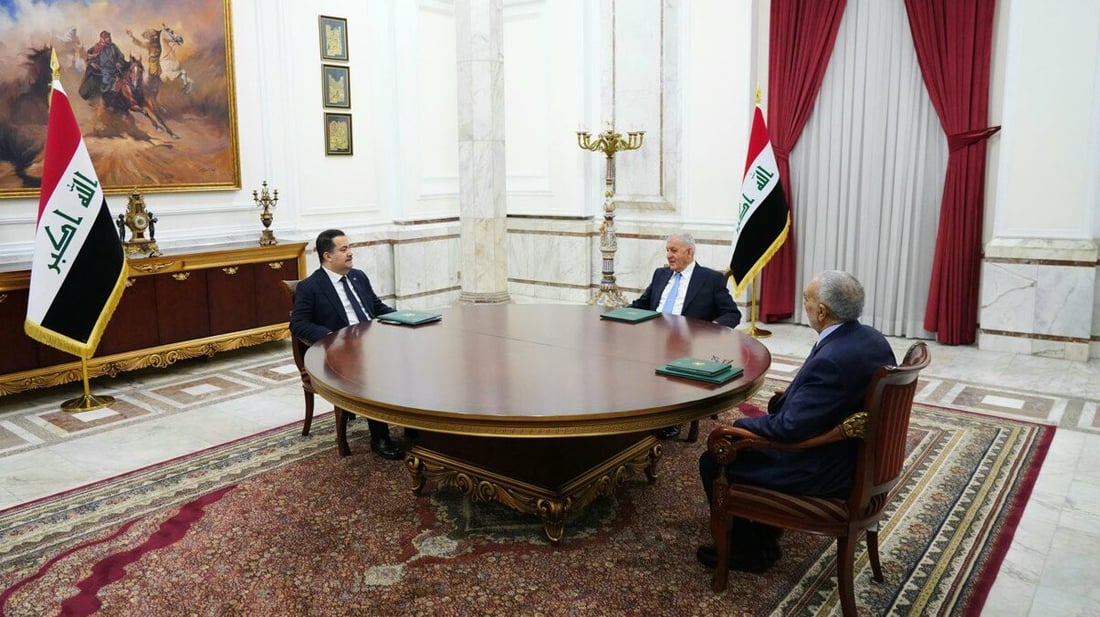
Prime Minister Mohammed Shiaa Al-Sudani, President Abdul Latif Rashid, and Parliament Speaker Mahmoud Al-Mashhadani meet at Baghdad Palace to discuss regional developments, upcoming elections, and the legal path forward on the Khor Abdullah maritime agreement.
Maritime pact under spotlight
Iraqi leaders agree to bring Khor Abdullah Agreement back to parliament following court ruling
BAGHDAD — Iraq’s top officials met Tuesday at Baghdad Palace to agree on a path forward regarding the Khor Abdullah maritime navigation agreement with Kuwait, after the country’s highest court ruled its ratification unconstitutional.
Prime Minister Mohammed Shia Al-Sudani, President Abdul Latif Rashid, and Parliament Speaker Mahmoud Al-Mashhadani discussed the next steps following the Federal Supreme Court’s 2023 decision, which found that the 2013 agreement was not properly ratified by a two-thirds parliamentary majority as required under Article 61 of the Iraqi Constitution.
In a statement issued by Al-Sudani’s office, the leaders said the agreement must be re-legislated by Parliament to comply with constitutional requirements. They also agreed to withdraw previous legal appeals submitted by the Presidency and Council of Ministers that sought to reverse the court’s decision, noting that fresh legislative action made those appeals moot.
The talks also covered upcoming parliamentary elections, scheduled for Nov. 11, 2025, as well as Iraq’s broader posture toward international treaties. The statement reaffirmed Iraq’s commitment to upholding international law and U.N. resolutions, but warned against politicizing agreements. “Such matters must be approached with care and responsibility, as they directly affect Iraq’s rights, reputation, and foreign interests,” it said.
The 2013 Khor Abdullah Agreement was signed to regulate maritime navigation in the narrow waterway linking Iraqi and Kuwaiti ports to the Persian Gulf. While supported by successive governments, the deal has faced opposition from nationalist factions in Iraq who see it as overly favorable to Kuwait.
The renewed political attention to the agreement comes amid institutional upheaval in Iraq’s judiciary. On June 29, Judge Mundhir Ibrahim Hussein was named head of the Federal Supreme Court following the resignation of Chief Justice Jassim Mohammed Abboud, who stepped down citing “health reasons”.
The appointment followed the mass resignation of nine judges in protest of internal conflicts and what they described as political interference — including in the Khor Abdullah ruling. MP Soran Omer told 964media that “the primary reason is their disputes with Chief Justice Jassim Mohammed Abboud, along with persistent political interference in the judiciary’s work, including in the Khor Abdullah case.”