
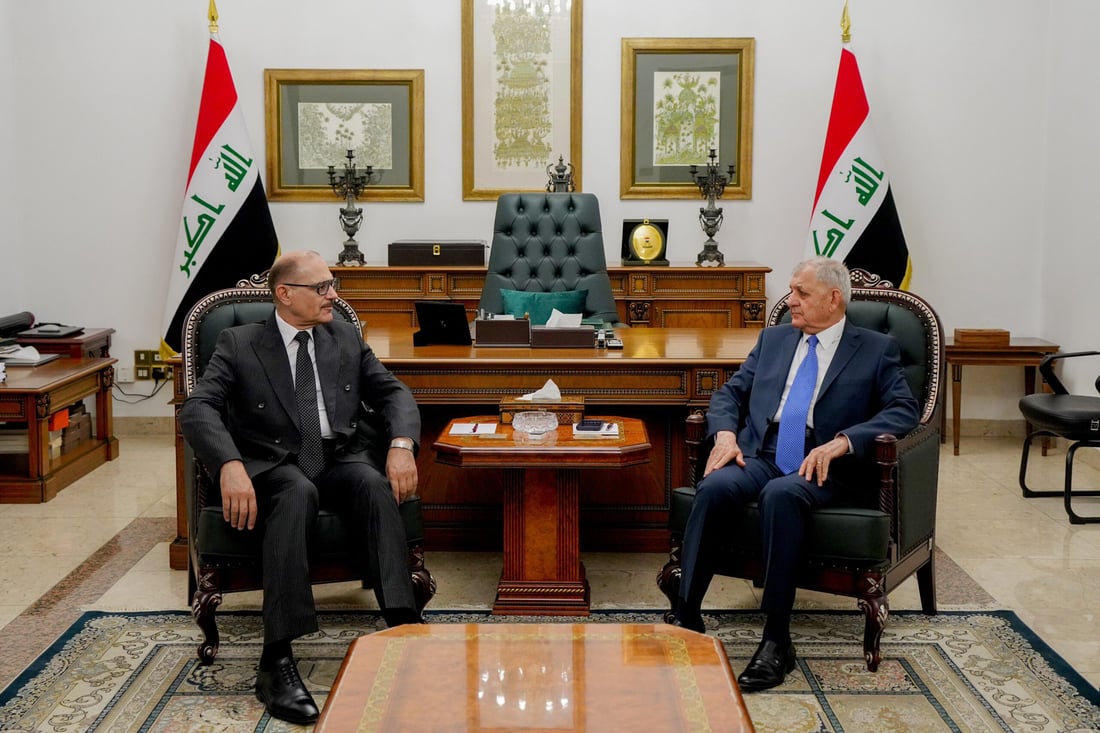
Iraqi President Abdul Latif Jamal Rashid meets with Federal Supreme Court Chief Justice Jassim Mohammed Aboud Al-Amiri in Baghdad on June 14, 2025.
'Humanitarian issue'
Iraqi president, top judge discuss stalled Kurdistan salaries amid deepening dispute
BAGHDAD — Iraqi President Abdul Latif Jamal Rashid met Saturday with Federal Supreme Court Chief Justice Jassim Mohammed Aboud Al-Amiri to discuss the prolonged delay in salary payments for public employees in the Kurdistan Region, a dispute that has sparked protests and legal action.
According to a statement from the Presidency’s media office, Rashid emphasized the urgency of resolving the matter, calling it a “humanitarian issue” that must be addressed in accordance with the constitution, the law, and Federal Court rulings.
“The Presidency is committed to applying the constitution and adhering to its provisions,” Rashid said, adding that he fully supports Iraq’s judiciary in upholding national unity and legal obligations.
Judge Al-Amiri said the court performs its duties “in accordance with the constitution and the law, in a manner that safeguards the interests and rights of the people and promotes national unity.” He backed calls to resolve the salary crisis through legal channels and thanked the president for his support.
More than 1.2 million public sector workers in the Kurdistan Region have not received their May salaries following the federal government’s suspension of monthly budget transfers to the Kurdistan Regional Government. Baghdad accuses the KRG of failing to hand over oil and non-oil revenues as required by the 2023-2025 federal budget law. Kurdish officials deny the claim and accuse Baghdad of using salaries as political leverage.
In February, the Federal Supreme Court ruled that disputes over revenue sharing must not block the payment of civil servant salaries in the Kurdistan Region. Despite that decision, the federal Ministry of Finance withheld the May payment, prompting a new lawsuit from Kurdish civil servants seeking enforcement of the ruling. A final decision is expected soon.
The salary crisis reflects long-running disagreements over budget allocations, oil revenue sharing, and constitutional authority between Baghdad and the KRG. Years of financial standoffs have led to recurring salary delays, sparking protests and widespread frustration among civil servants and their families. While temporary deals have occasionally eased tensions, a permanent resolution has remained elusive.