
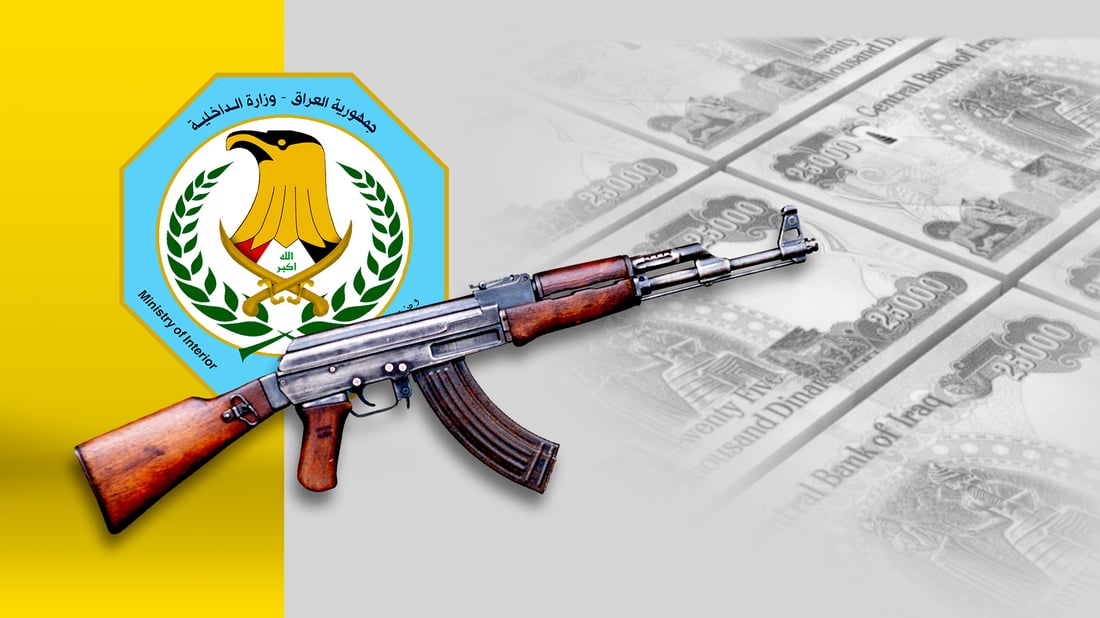
An AK-47 rifle is shown alongside stacks of Iraqi dinar and the Ministry of Interior’s emblem, reflecting Iraq’s new national initiative to track lost and stolen weapons under a broader plan to control arms possession.
Interior Ministry Initiative
Iraq Develops National Database to Track Lost and Illegal Weapons
BAGHDAD — Iraq’s Ministry of Interior has launched a national initiative to register and track stolen and lost weapons as part of its broader plan to limit arms possession to state institutions. The effort aligns with Iraq’s obligations under the United Nations Convention against Transnational Organized Crime.
Maj. Gen. Mansour Sultan, secretary and rapporteur of the Permanent National Committee for Arms Regulation, said Iraq was among the first countries in the region to begin withdrawing weapons from unauthorized individuals and non-security civilian institutions. He also noted increased efforts to combat illegal arms sales.
“One of the major organizational steps is to register citizens’ firearms for possession under a set of specific regulations and instructions issued by the committee,” Sultan told the state-run newspaper. The registration deadline is December 31 of this year.
He added that a new centralized database is being developed to monitor weapons that are lost, stolen, or smuggled both inside and outside Iraq, in coordination with international organizations. “This step marks a fundamental shift in national security policy,” he said.
In January 2024, Iraq’s Interior Ministry launched a nationwide initiative to regulate firearm ownership and reduce the number of unlicensed weapons held by civilians. The program includes the registration of personal firearms through the “Ur” digital platform, the seizure of illegal weapons, and a buyback scheme offering one billion Iraqi dinars per governorate for medium-sized arms.
The database will involve not only the Ministry of Interior but also other security bodies, including the Ministry of Defense, the National Security Service, and the Criminal Labs Directorate. It will also cover civilian-owned weapons reported missing or stolen.
Sultan said the move is supported by Iraq’s adoption of Resolution No. 16 of 1923, issued by the National Security Council — the first formal directive to create an integrated weapons tracking system nationwide.
These efforts were recognized during a conference in Geneva in April, where the Iraqi delegation presented reports and procedures demonstrating the country’s commitment to disarmament and arms control. As a result, Iraq was reclassified from a “high-conflict state” to a “moderate-risk” category by the relevant international body.
Sultan concluded that these measures are part of the government’s broader program to enforce the rule of law and control weapons outside state authority, aiming to improve Iraq’s standing in international forums and reflect real progress in national security.