
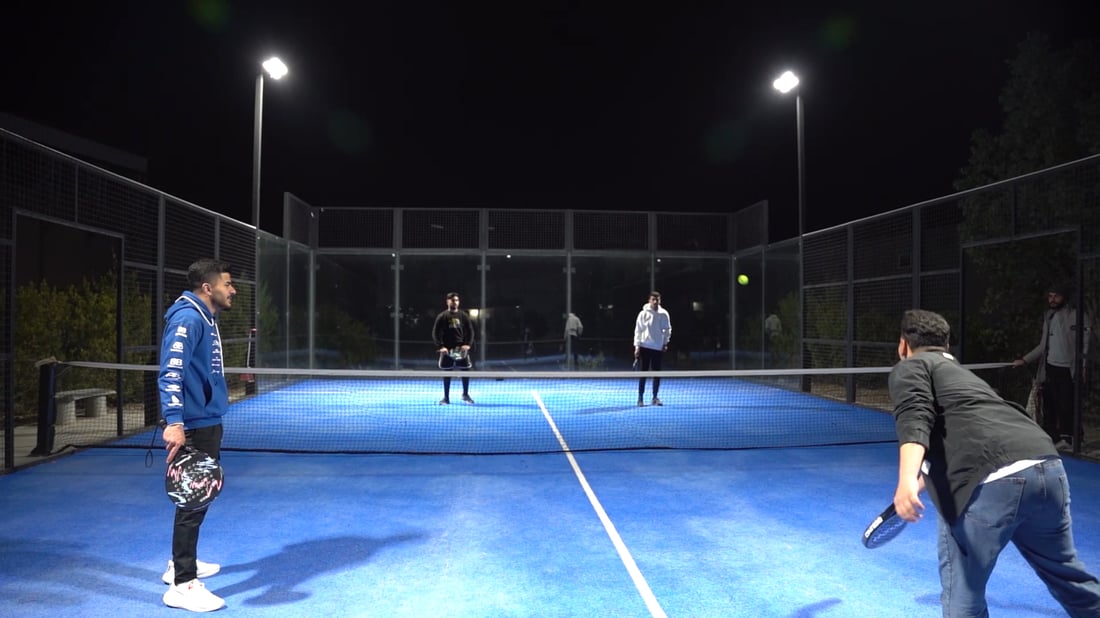
Young players enjoy a game of padel at Fallujah’s first court, as the sport gains popularity in Anbar. Once limited to Baghdad, padel is now attracting a growing number of enthusiasts in the region.
'Exciting and competitive'
Padel gains popularity among Fallujah youth as new courts open in Anbar
ANBAR — Young adults in Fallujah are increasingly embracing padel, a fast-paced racket sport blending tennis and squash, following the opening of the city’s first dedicated court.
The court, located at Al-Sumoud Club on 60th Street, introduced padel to Anbar governorate for the first time, quickly drawing attention among local sports enthusiasts. A second facility recently opened in Ramadi, further boosting access to the growing sport.
Other cities, like Kurdistan Region capital Erbil also have padel facilities. Courts are also under construction in Duhok.
Thamer Abdulwahid, owner of Fallujah’s padel court, described the game as a dynamic alternative to soccer, which has long dominated local sports culture.
“Padel is a new sport here. It combines tennis and squash and is very similar to tennis,” he told 964media. “Many celebrities, including Messi, Cristiano Ronaldo, and Zidane, have played it.”
Padel originated in Mexico but has rapidly expanded internationally, reaching Arab countries such as Lebanon, the UAE, and Jordan before arriving in Iraq. Baghdad was the first Iraqi city to adopt the sport, after which it began spreading to other governorates.
Played exclusively in doubles on a court roughly 25% smaller than a tennis court, padel incorporates surrounding walls as a key element of gameplay.
“What makes padel unique is that the walls are part of the game, making it more dynamic and easier for beginners,” Abdulwahid explained. “The ball must bounce on the ground before being struck, which adds to the challenge.”
Initially viewed as a sport reserved for the wealthy, padel is now accessible to a broader segment of society due to reduced fees.
“At first, it was limited to the upper class, but now we offer affordable booking prices so that everyone can play, regardless of their background,” Abdulwahid said.
Currently, padel attracts mainly university students and young adults over 18, but Abdulwahid aims to expand participation further by launching a dedicated training academy.
“We want to introduce padel to a wider audience. In the future, we aim to offer training for kids as well as adults,” he said.
Local padel enthusiast Taha Mohammed said the sport quickly became a favorite among young people who grew up primarily playing soccer.
“Most of us grew up playing soccer, but we wanted to try something new,” Mohammed said. “My friends and I started playing padel, and we found it to be exciting and competitive.”
Mohammed believes padel can become as addictive as soccer, highlighting its growing appeal in Fallujah.
“If you play it once or twice, you’ll get hooked,” he said.
Before Fallujah’s court opened, padel players like Mohammed had to make frequent trips to Baghdad to practice.
“We used to go to Baghdad for padel, but now we have a court here, which makes things much easier,” Mohammed said.