
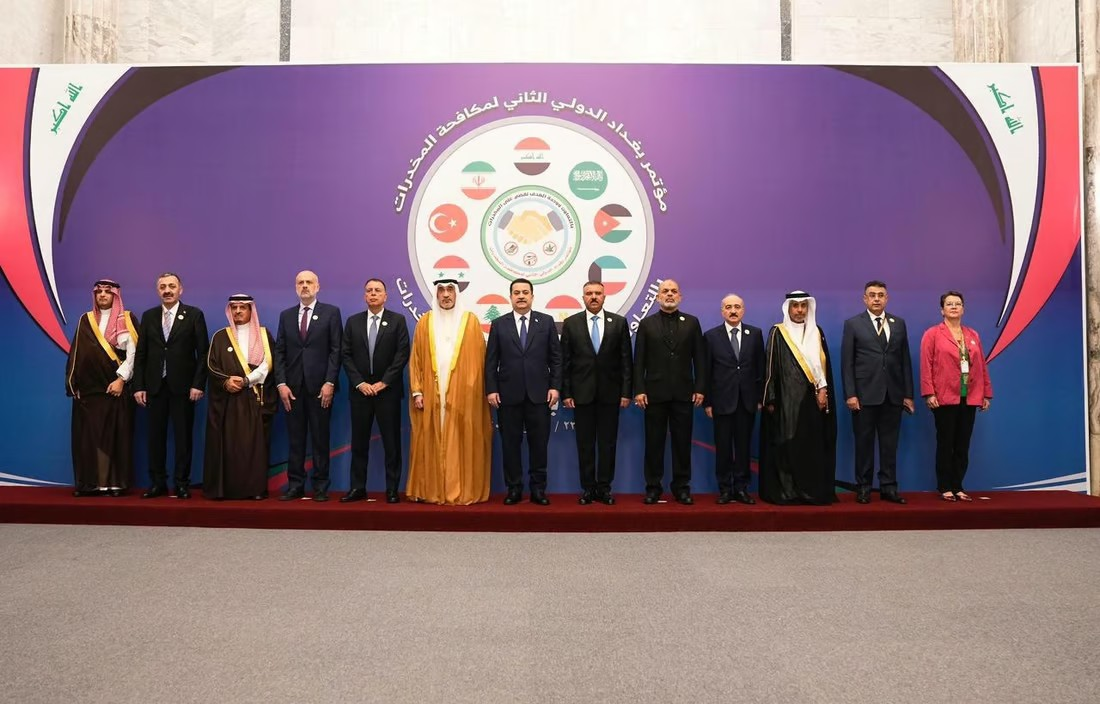
International conference in Baghdad
Interior ministry spox on drug trafficking: Methods resemble ‘what happens in movies’
BAGHDAD — The Second Baghdad International Conference on Combating Drugs concluded on Monday with several key recommendations. The conference featured participation from Saudi Arabia, Jordan, Kuwait, Iran, Turkey, Syria, Lebanon, and Egypt, alongside officials from the Arab Interior Ministers Council and the UN Office on Drugs and Crime.
Participants discussed the “serious situation” caused by increasing rates of drug abuse and addiction both regionally and internationally. They acknowledged that this surge is a consequence of rising drug trafficking operations and emphasized “the need for unified regional and international efforts to enhance regional and global security,” according to a statement from Iraq’s Prime Minister Media Office.
Iraq, historically a transit country for drugs from Iran and Pakistan en route to Gulf states, has recently become a destination. This shift has led to a more complex and dangerous drug trafficking environment, posing increased challenges for Iraqi authorities.
Key recommendations from the conference included enhancing joint efforts to disrupt drug trafficking routes, updating and protecting “criminal databases,” and adopting modern technologies for detection and tracking. The conference also stressed the importance of monitoring websites and social media promoting drugs, intensifying preventive measures by “promoting awareness,” addressing legal loopholes, imposing stronger penalties, and expanding rehabilitation centers.
Khaled Al-Mahna, Director of Communications and Media at Iraq’s Ministry of Interior, announced that crystal meth is being smuggled into Iraq from Afghanistan and Iran via “unconventional routes,” while Captagon pills primarily enter through Syria. Last year, Iraqi authorities seized record quantities of Captagon, valued at up to $144 million.
Reports indicate that crystal meth, once smuggled from Iran, is now produced domestically, especially in the southern governorates of Basra and Maysan. This production is allegedly managed by networks linked to influential political and tribal groups, as well as militias.
In an interview with local media, Al-Mahna described drugs as “a cross-border crime” and noted that Iraq has initiated a regional cooperation project to exchange expertise. “We defeated terrorism, and drugs are not stronger than terrorism. A national strategy has been developed, one aspect of which is to activate international cooperation,” he stated.
The United Nations has praised Iraq’s anti-drug efforts, which are evaluated based on the volume of seizures, the type of gangs apprehended, and international trade indicators. “The price of crystal meth has increased dramatically, from 15,000 IQD ($11) per gram to 90,000 IQD ($69), reflecting the scarcity of the drug in many areas due to the efforts of security forces. The increased price is also expected to deter many from getting involved in drug-related activities,” Al-Mahna added.
The Ministry of Interior reported a 98% success rate in preventing border infiltration. However, drug traffickers continue to devise new methods to smuggle drugs, often hiding them inside other goods or living animals. “One of the objectives of international cooperation is to share information on these new smuggling techniques,” Al-Mahna concluded.
A recent report from the United Nations Office on Drugs and Crime highlighted a dramatic surge in drug trafficking and consumption in Iraq over the past five years. In 2023, authorities seized 24 million Captagon tablets, equating to over 4.1 tonnes, with a retail value estimated between $84 million and $144 million. The report noted that Iraq is becoming a “nexus of regional trafficking routes” for methamphetamine and Captagon, with Captagon seizures tripling between 2022 and 2023 and increasing 34-fold since 2019.
In the first half of 2024, Iraqi authorities seized nearly two tons of various narcotics, including crystal meth, Captagon, heroin, tramadol, hashish, opium, and cocaine. Approximately 8,000 individuals involved in narcotics trafficking were arrested during this period, reflecting a slight decrease compared to the same period in 2023. Last year, over 15 tons of psychotropic substances were confiscated, and more than 19,000 people were arrested on drug-related charges.
Iraqi law imposes severe penalties for drug trafficking, including death in extreme cases. Recently, the Central Criminal Court in Baghdad sentenced seven people, including a foreign national, to death for drug trafficking. Additionally, the Babil Criminal Court sentenced a dealer to life in prison for possessing and intending to sell crystal meth and other narcotics.