
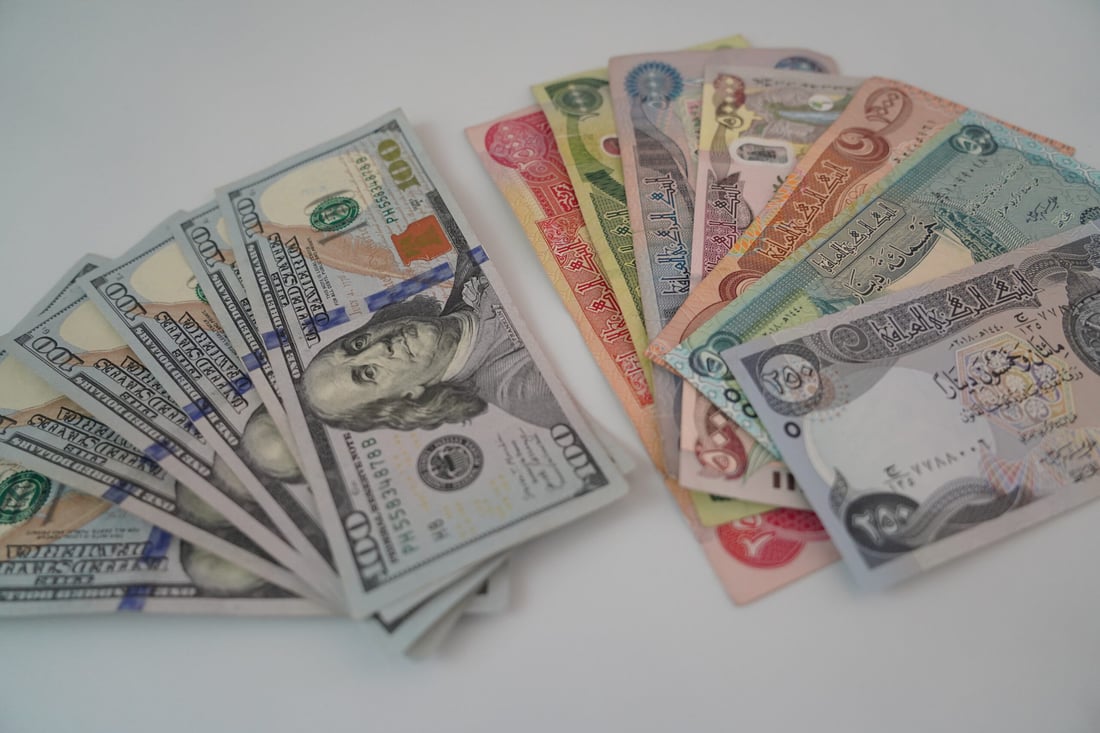
Iraqi dinar banknotes and U.S. $100 bills.
'I don't have change'
Baghdad shops hand out celery and candy as small banknotes run short
BAGHDAD — Shopkeepers across Baghdad say 250- and 500-dinar banknotes have grown so scarce that they are handing customers celery or candy instead of change, or waiving the difference.
The two notes are worth about 15 and 30 cents at the street rate. Merchants on both sides of the city, in Karkh and Rusafa, told 964media that many of the notes still in circulation are torn or damaged, and customers refuse them.
Some shopkeepers give customers small goods in place of cash. Others ask them to come back later for their change.
Yousif Muayad, who owns a pharmacy in Adhamiya, said the shortage has hurt his business for about a year. “If I sell a patient medicine worth 4,500 dinars and don’t have small change to return the balance, I waive the 500 dinars and take only 4,000 because I don’t have change,” he told 964media.
Some medicines cost 250 or 500 dinars, including paracetamol made in Samarra, Muayad said, so customers sometimes buy two strips and pay 1,000 dinars to avoid the problem of change.
Thaer Farhan, a shop owner in the Shawaka area, said his shop has been short of small notes for two to three months. Some customers pay with a 10,000-dinar note for an item that costs 250 dinars, he said.
“If someone buys something from me and I don’t have small denominations to return the change, I ask them to buy something else worth the remaining amount or come back later to collect it,” Thaer Farhan said. “Some accept this, while others refuse.”
Hamza Muzaffar, who works at a grocery in Adhamiya, said shopkeepers often hand over small items instead of change so customers are not kept waiting. “Many times, we have to give customers items worth 250 or 500 dinars because small-denomination notes are unavailable,” he said.
It happens every day, Muzaffar said. A customer may get a bunch or two of celery, and children who come with shoppers may be given a banana.
“The 1,000-dinar note is available, but the 250- and 500-dinar notes are not available in the market, and this often causes problems for us,” he said.
Ahmed Shakir, who runs a kiosk in Baghdad’s Jamia district, said some customers walk away when a shop cannot give the right change. “Sometimes the customer refuses to take an additional item and leaves without buying what they wanted, simply because there is no small change,” he said.
In Abu Ghraib, on Baghdad’s western edge, shop owner Omar al-Mafraji said small sums are now the hardest part of any change. “We are suffering severely from the shortage of small denominations. If a customer buys something worth 1,500 dinars and pays 25,000, we struggle to return the remaining 500 dinars because 1,000-dinar notes are available, but smaller denominations are disappearing,” he said.
“We call on the Central Bank to intervene and print these denominations because our profits depend on their availability,” Mafraji said.
Haider Farhan, a shop owner on Rashid Street, said the shortage also affects dealings between merchants. “The entire market is suffering from a shortage of small denominations,” he said.
“Sometimes I owe other shopkeepers 250 or 500 dinars after a purchase, and when I tell them I don’t have change, they understand because they face the same problem,” Haider Farhan said. He has plenty of small notes, he added, but they are torn and hard to use.
Abu Hassan al-Jubouri, a shop owner in Yarmouk, said the change vanished suddenly. “Small change suddenly disappeared from the markets, and we struggle with this every day. We have to give customers sweets worth 250 or 500 dinars because these denominations are unavailable in our shops,” he told 964media.
“Even when customers want to pay these amounts, we find that the notes are torn and almost unusable,” Jubouri said. “We don’t know why these denominations have disappeared from the markets.”
The Central Bank of Iraq has not publicly explained the shortage. Merchants point to notes worn out by constant use in small daily transactions, too few replacement notes and the low purchasing power of the small denominations.
Iraqis can now apply online to replace damaged banknotes, the Central Bank said in October, in a system meant to cut paperwork and expand digital banking. Iraq remains heavily reliant on cash: about 92% of the currency the bank has issued was held outside banks at the end of June, according to its data.
The Coalition Provisional Authority, the U.S.-led administration that governed Iraq after the fall of Saddam Hussein’s government, began issuing the current dinar on Oct. 15, 2003, in notes from 50 to 25,000 dinars. A 500-dinar note followed in 2004.
The Central Bank withdrew the 50-dinar note in 2015, leaving the 250 as the smallest denomination, and issued a 50,000-dinar note, still the largest, the same year. Notes from the 2003, 2013 and 2018 editions all remain in circulation, the bank says.