
Media monitor
Time to replace quota system with majority government, Sudani says
ERBIL — Former Prime Minister Mohammed Shia al-Sudani called Monday for Iraq to move from its quota-based political system to a government formed by a parliamentary majority, with the rest of parliament in opposition.
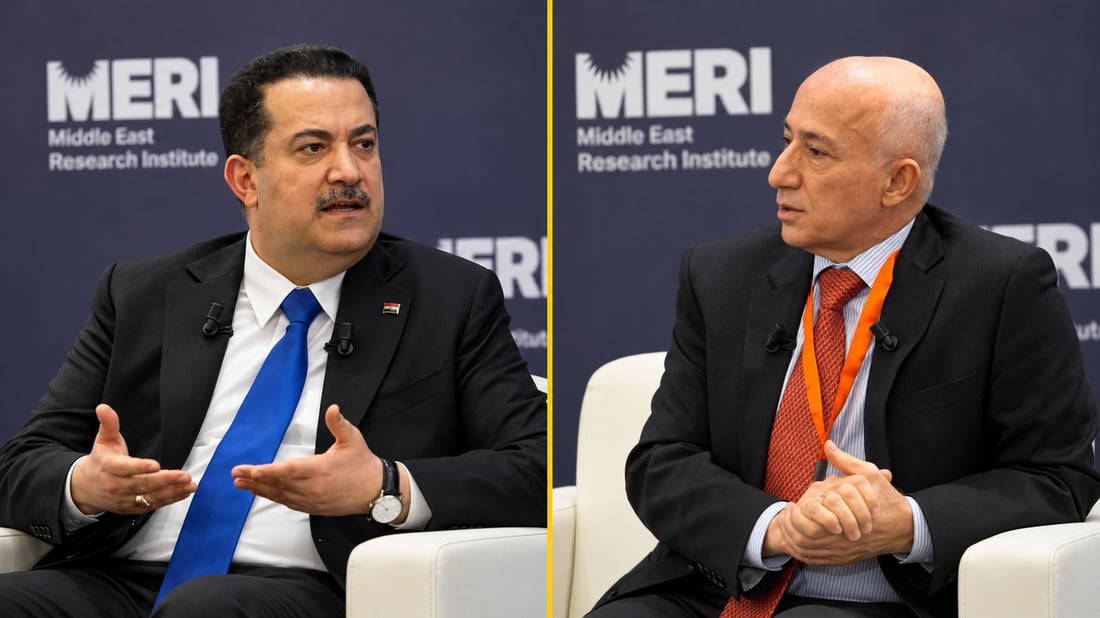
“After two decades of the political process, I believe it is time to move toward a political majority that takes into account the balance among communities and moves beyond the quota system,” Sudani, who leads the Reconstruction and Development Coalition, told the Middle East Research Institute Forum in Erbil, in a discussion moderated by MERI President Dlawer Ala’Aldeen. “There is nothing wrong with a coalition government. This principle is adopted in many established democracies. But dividing positions and state institutions according to quotas creates many problems, and this is the root of corruption.”
“Let us move toward a majority and an opposition,” he said. “I believe only 5% to 10% of political forces are outside the government, meaning 90% of the political forces in parliament participate in governing.” Such broad participation should make decisions easier, he said, yet the current government still faces criticism and obstruction over its policies.
Iraq has about 1 million personnel across its security agencies and can keep internal order after the end of the U.S.-led coalition’s mission on Sept. 30, Sudani said. “Iraq in 2024 was not Iraq in 2014, and there was no justification for the presence of 86 countries on our territory,” he said, adding that the end of the mission meant a shift to bilateral ties, not a break. Iraq still needs Washington, he said. “We need them for armament because most of our weapons are American. We need them for intelligence sharing and training courses. But operationally, on Iraqi territory, our own forces control the ground.”
Iraq has acquired French Thales radar that detects aircraft at high and low altitude, he said, but gaps remain. “We have shortages in some air defense capabilities, and we have addressed some of them through contracts.” KDP official Hoshyar Zebari said in a TV interview this week that Iraqi forces track about 200 military flights a day but have no means of dealing with them.
“ISIS today does not represent a threat to the Iraqi state. Drugs and their trafficking represent the number one threat,” Sudani said. Two Iraqi soldiers were killed on Oct. 4 when an explosive device left by ISIS went off during a search operation north of the Anbar town of Rawa.
Political forces had agreed with the government on a constitutional framework and timetable to bring weapons under state control, Sudani said, and any attack launched from Iraqi territory, at home or against neighboring countries, was unacceptable; his own government had stopped several such attempts. Zaidi’s timetable sets a 90-day halt to attacks from Sept. 30, followed by a six-month weapons handover ending June 30, 2027. Kataib Hezbollah and other factions said on Sept. 30 that they were not bound by any timetable.
Relations between Baghdad and Erbil need “an institutional framework away from temporary settlements,” Sudani said, noting that past agreements had brought short periods of cooperation before disputes returned.
Zaidi’s spokesperson, Haider al-Aboudi, said on Sunday that Sudani’s 2023 decision to strengthen the dinar had cost the treasury nearly 36 trillion dinars.