
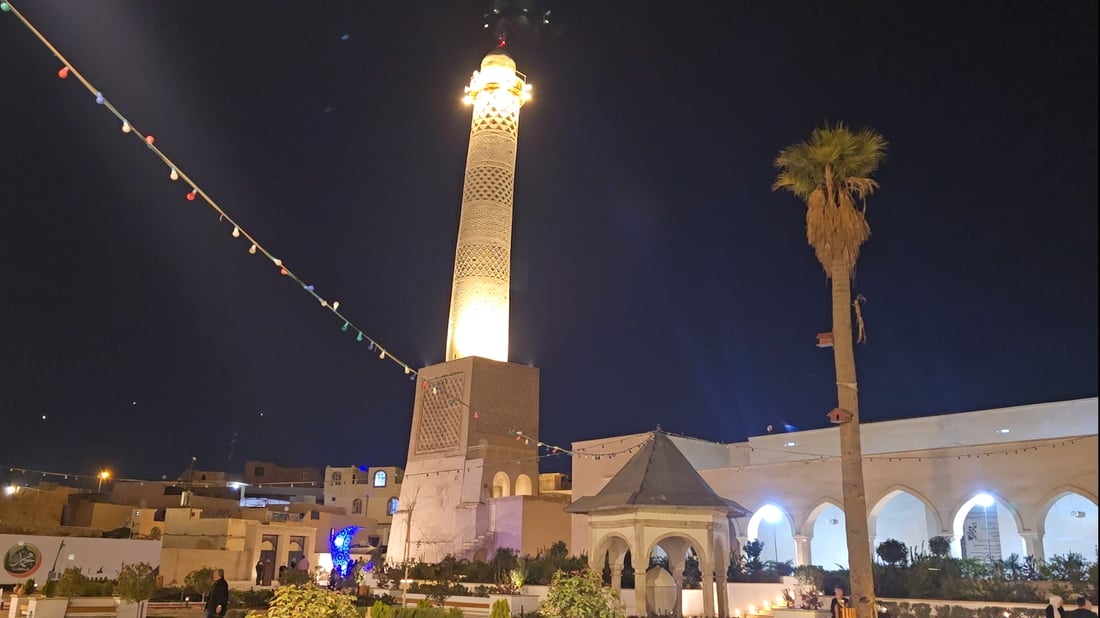
The illuminated minaret of the Pasha Mosque rises over the courtyard in Mosul’s Old City at night, as festive lights hang across the grounds. Photo by 964media.
Mosul clerics work to preserve Iraq’s tradition of melodic prayer calls
MOSUL — In the old city of Mosul, clerics and muezzins are working to keep alive a tradition that once defined the soundscape of Iraqi minarets: assigning specific melodic maqams to each of the five daily calls to prayer.
At the Pasha Mosque in the Bab al-Saray market, imam and muezzin Sheikh Mohammed Salem told 964media that neither Quran recitations nor the adhan were ever delivered arbitrarily. “Nothing is issued by chance or randomly from the voices of Iraq’s minarets,” he said. “Just as every maqam has its context, every context has its maqam in the melodic sense.”
The system assigned distinct melodic modes to each prayer time to reflect the character of different parts of the day. The saba maqam is used for the dawn prayer, hijaz for noon, rast for afternoon, and sikah for sunset, while several maqams may be used for the night prayer. Salem said the dawn call would begin softly and rise gradually, while the night call could carry greater intensity. Beyond atmosphere, the system once served a practical purpose — helping visually impaired people living alone identify the time of day by sound alone.
The practice has declined in many Iraqi mosques, where the adhan is now often delivered “at random,” Salem said, noting it remains more widely observed in Turkish mosques.
Some traditions persist, particularly for Friday prayers. The first adhan is delivered in the same maqam used by the Quran reciter to conclude his reading, while muezzins perform short melodic invocations before the second call, usually in the sikah maqam. At the Pasha Mosque, Salem incorporates phrases from the zangaran and nakriz melodic modes — styles not historically common in Mosul but introduced over time to enrich the performance.
Salem also noted regional differences in style, with Baghdad muezzins tending to emphasize certain letters more strongly while Mosul’s tradition is generally softer.