
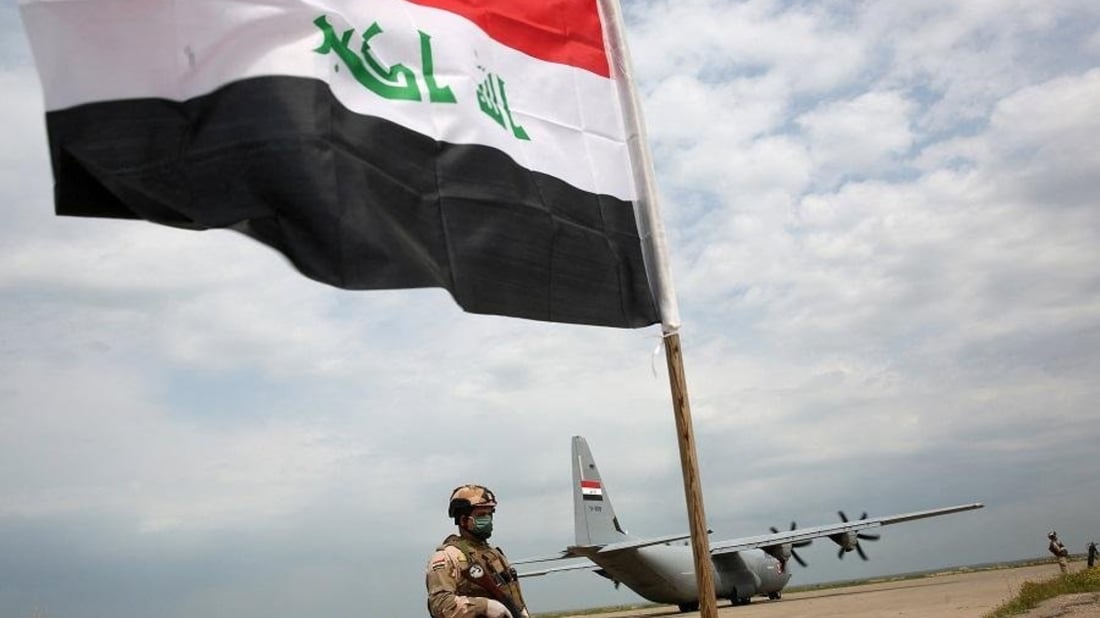
An Iraqi flag flies near a member of the Iraqi security forces at a military air base
Iraq says coalition advisers have withdrawn from federal bases, ending first phase of mission
BAGHDAD — Iraq’s Higher Military Committee for Ending the International Coalition Mission said Sunday that all coalition advisers have withdrawn from military bases and command headquarters in federal areas of the country, marking the completion of the first phase of the drawdown agreed with Washington.
In a statement, the committee said the move implements the Iraqi government announcement of Sept. 27, 2024, which set a timetable for ending the coalition’s military mission in Iraq, and follows the joint Iraqi-U.S. statement of Nov. 6, 2025, on the future of bilateral security relations.
The committee said the process concluded with the departure of the remaining advisers from Ain al-Asad Air Base and the Joint Operations Command headquarters, adding that “these sites are now under the full administration of the Iraqi security forces.”
“This achievement would not have been possible without the firm political will of the Iraqi government, precise planning, and the national and professional efforts exerted by the Higher Military Committee to complete the first phase of the international coalition’s mission to fight ISIS in Iraq in the federal areas,” the statement said.
The committee said Iraqi forces are ready to assume full responsibility for security nationwide. “Our armed forces, in all their branches and formations, now possess the full will and capabilities to impose security across all parts of the country,” it said, adding that “ISIS no longer constitutes a strategic threat and our forces are fully capable of preventing its reemergence in Iraq or its infiltration across the borders.”
With the first phase complete in federal areas, the statement said Iraq is transitioning to a bilateral security relationship with the United States focused on implementing memorandums of understanding on military cooperation and developing Iraqi capabilities in “equipment, armament, training, exercises, maneuvers and joint operations to ensure sustained readiness and counter ISIS.”
On regional coordination, the committee said the second phase of the coalition’s mission against ISIS in Syria has begun. It said coordination will continue to prevent spillover into Iraq, including cross-border logistical support for Syria through the coalition’s presence at an air base in Erbil. The statement added that Iraqi forces may conduct joint counter-ISIS operations with the United States from Ain al-Asad when necessary.
The committee said Iraq remains committed to protecting its sovereignty and building balanced security partnerships that respect independent national decision-making and contribute to international peace and security.
Iraq and the United States agreed earlier in 2024 on a phased transition plan for the U.S.-led coalition, which has operated in Iraq since 2014 to combat the Islamic State group. Under the plan, coalition personnel are to withdraw from Baghdad and other sites by September 2025, with the remainder leaving by the end of 2026, after which cooperation will continue through bilateral advisory and capacity-building arrangements, including coordination linked to Erbil and northeast Syria.