
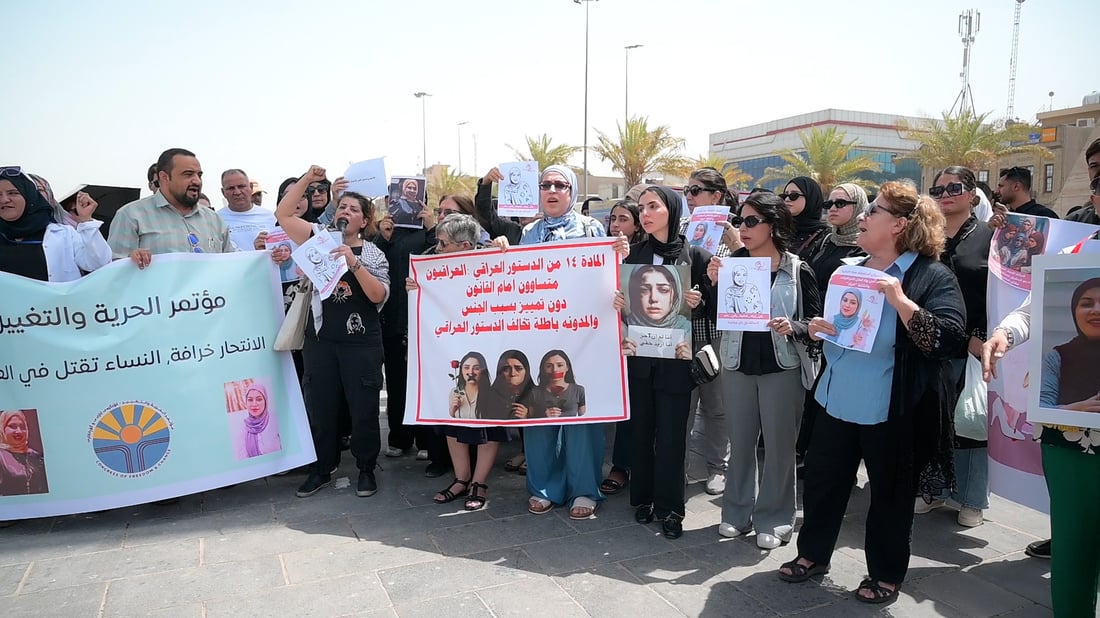
Women gather in Baghdad’s Tahrir Square holding photos of Dr. Ban Ziyad and banners demanding justice in her case. Photo by 964media.
Ban Ziyad Tariq
Women rally in Baghdad for transparency in death of Basra psychiatrist
BAGHDAD — Dozens of women gathered Saturday in Baghdad’s Tahrir Square to call for transparency and accountability in the death of psychiatrist Ban Ziyad Tariq, a case that has drawn national attention and renewed debate over women’s safety and how sensitive investigations are handled in Iraq.
Protesters carried banners and photos of Tariq, urging the judiciary to pursue the case thoroughly. One sign read, “Article 14 of the Iraqi constitution: Iraqis are equal before the law without discrimination. Silence about the crime is a violation of the Iraqi constitution.”
“This is the least we can do for the case of the martyred Dr. Ban,” said Ayat Adham, a health adviser in Iraq’s parliament. “The people have become more aware of this crime than the government, and everyone knows the details of what happened in this heinous crime. We demand that the perpetrators be punished to prove that Iraqi blood is not cheap.”
Tahira Dakhel, a university professor, said all aspects of the case should be examined. “All hidden facts related to this crime must be revealed, as there may be parties with political interests in keeping silent about it,” she said. “Claims by some politicians that Dr. Ban was taking psychiatric medication are untrue and have nothing to do with her death.”
Activist Bidaya Abdul Karim said the issue reflected broader risks for women. “We are not safe even in our homes,” she said. “Yesterday the victim was Dr. Ban, and tomorrow it could be someone else. All the reports that spoke of her suicide are false. She was aware, rational, and could not have done such a thing. We demand the judiciary investigate urgently and reveal the truth to the public.”
Tariq, who was in her thirties, was found dead in her home in central Basra on Aug. 4. Police initially reported the case as a suicide, saying she had cut her wrists with a sharp object. She worked at a government-run medical facility, had recently been promoted, and was described by the Basra Medical Association as “a painful loss to the medical community.”
Lawmakers and colleagues later questioned the initial account. Lawmaker Uday al-Awadi cited preliminary forensic findings he said raised suspicion, including signs of strangulation, bruises, deep wounds on both hands, and disabled surveillance cameras. Basra Governor Asaad al-Eidani said existing evidence still suggested suicide but noted the investigation could change direction if new information emerged.
The Basra Third Investigative Court has since said it is taking “expanded legal measures” under a specialized judge, recording statements from the family’s representatives and witnesses, and detaining one suspect pending further inquiry. A forensic report is still awaited. Basra Security Committee head Aqeel al-Furaiji told 964 that intelligence services have been directed to broaden the investigation, including reviewing cameras and the victim’s workplace environment.
Prime Minister Mohammed Shia al-Sudani has ordered “close and rapid follow-up” of the case and stressed that results must be made public with “full transparency,” according to a government source. The parliamentary Human Rights Committee has also called for a professional investigation involving all relevant institutions and warned of wider issues affecting women and health workers.
Saturday’s demonstrators in Baghdad linked their demands to broader concerns about women’s rights and safety in Iraq. “We demand justice not only for Dr. Ban but for all Iraqi women,” one participant said.