
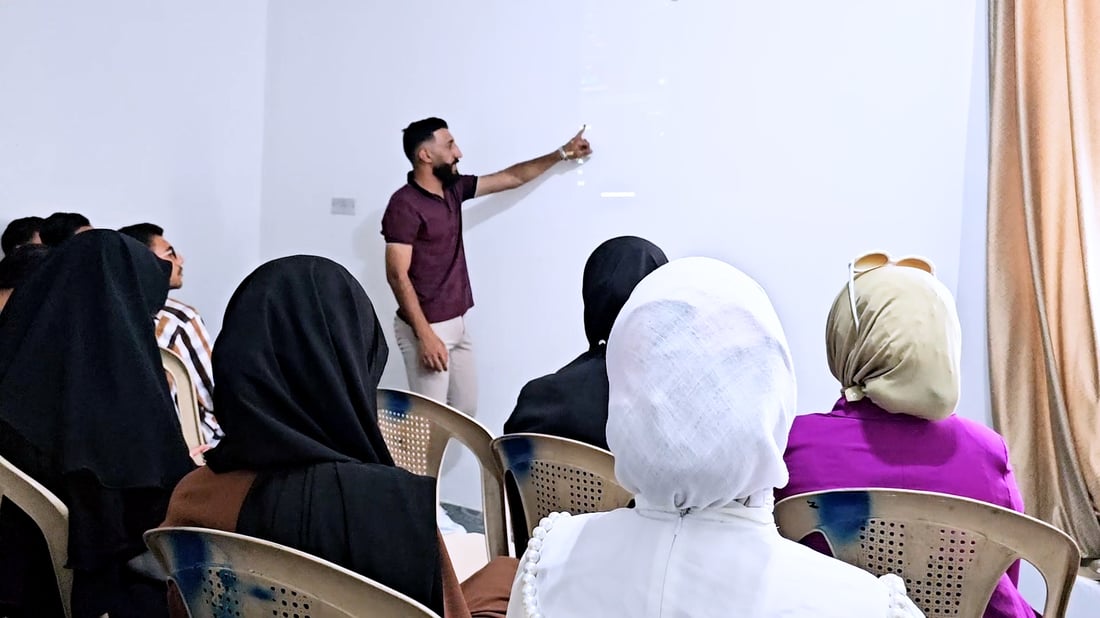
A photography instructor leads a training session for young men and women in Al-Qaim, part of a free course aimed at teaching basic skills in visual media and editing. The course attracted more than 100 participants. Photo by 964media
Outsized demand
Free photography workshop in Al-Qaim draws unexpected turnout
ANBAR — A free photography and editing course launched in Al-Qaim has attracted more than 100 participants, far surpassing expectations and highlighting growing interest in visual media skills in Iraq’s westernmost districts.
Trainer Hossam Al-Salmani told 964media he and co-trainer Abdullah Al-Salmani initially anticipated no more than 20 registrants. “We were surprised when 103 people signed up in just 25 days,” he said. “We had to divide them into groups of 25 to ensure everyone benefits.”
The course, held on Fridays and Saturdays for three hours, covers basic photography concepts including lighting, framing, and lens types. It is the first of its kind in Al-Qaim, a traditionally conservative area where photography is still viewed with some hesitation. Despite this, enthusiasm has been strong, with participants traveling from nearby towns such as Rawa, Anah, and Al-Rummana.
“We got the idea after receiving many messages asking for training opportunities,” Hossam said. “The course is especially useful for those without steady jobs—it creates income potential and helps present a positive image of Al-Qaim.”
He added that he and Abdullah personally covered all costs, including renting chairs and using their own cameras and equipment. “We even canceled some of our photography work to make this possible.”
Participant Ahmed Jawad, who registered through an online form, said the training was long awaited. “I’ve been wanting to learn photography and editing for a while, whether free or paid, but there was no support in this field. This course taught us how to use the camera and understand editing and framing techniques. Despite transport issues, especially for those coming from Al-Rummana, Anah, and Rawa, it was a great opportunity.”
He added, “I hope to open my own studio one day to represent Al-Qaim and Anbar in the best way, and to have a source of income.”
Hossam and Abdullah say they’re ready to launch similar workshops in nearby areas if modest support—particularly for transport—becomes available.