
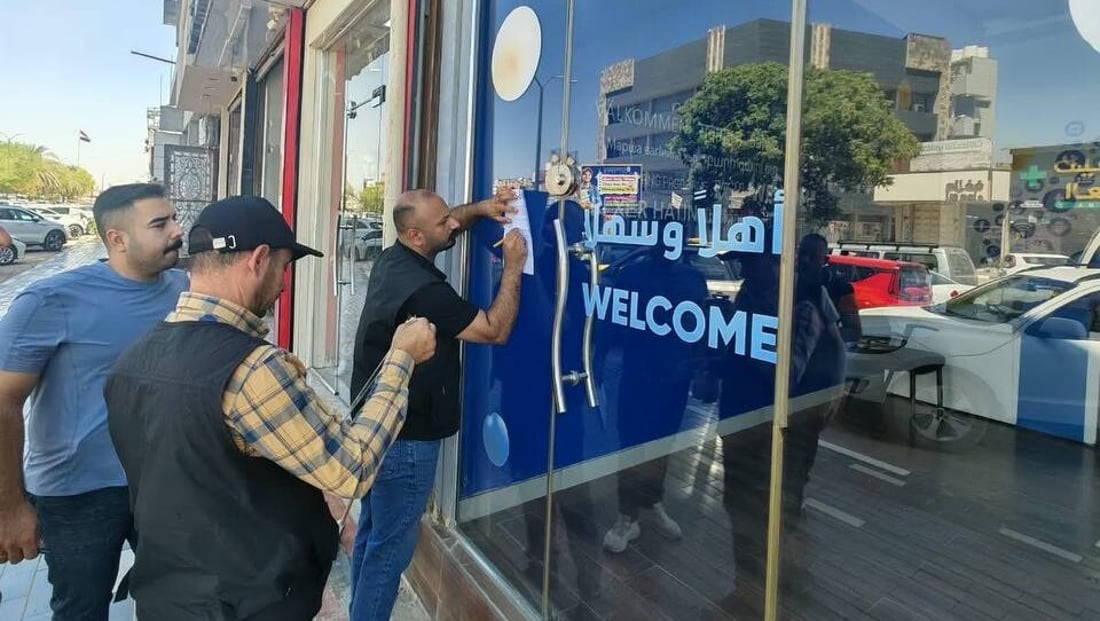
Officials seal a Korek Telecom service center as part of regulatory enforcement measures against the company.
Korek closures extended to three more governorates
BAGHDAD — The Communications and Media Commission has closed Korek Telecom offices and service centres in Najaf, Diwaniyah and Babil, including the company’s centre at Najaf International Airport, extending enforcement against the operator beyond Baghdad.
Its Middle Euphrates offices carried out the closures on Wednesday with the National Security Service, the commission said, and its governorate offices will continue monitoring enforcement with security agencies.
The court order that briefly protected Korek has gone. The regulator and the National Security Service closed the company’s Jadriya headquarters and three Baghdad sales centres on Aug. 20; the Rusafa Court of First Instance issued an urgent order three days later suspending the commission’s decisions; and the commission said the same court cancelled that order on Aug. 24 after an appeal by executive chairman Baligh Abu Galal, leaving its decision to halt dealings with Korek in force.
The commission announced on Aug. 9 that it was moving to shut down Korek’s network and equipment and place liens on its assets after cancelling a settlement agreement. It warned subscribers not to recharge balances, renew subscriptions or buy services in case the network is shut, told customers to keep their SIM cards, and told owners of sites hosting Korek towers not to let equipment be removed without approval.
Underneath is a dispute dating to the 2007 mobile licence auction. The commission says Korek still owes $375 million from it; Korek says payment was conditional on the regulator transferring the subscriber base of the former Iraqna network, which it says never happened. The regulator said in April that Korek owed about 1.4 trillion dinars, roughly $1.06 billion at the official rate, under a settlement signed in September 2025, with liabilities still accruing. It cancelled that settlement in June, saying Korek had not met its obligations. Korek disputes the cancellation, saying the agreement came from a committee set up by the prime minister’s office in May 2025 and that implementation depended partly on obtaining a 4G licence comparable to those held by Zain Iraq and Asiacell, and has called on Prime Minister Ali al-Zaidi to intervene.