
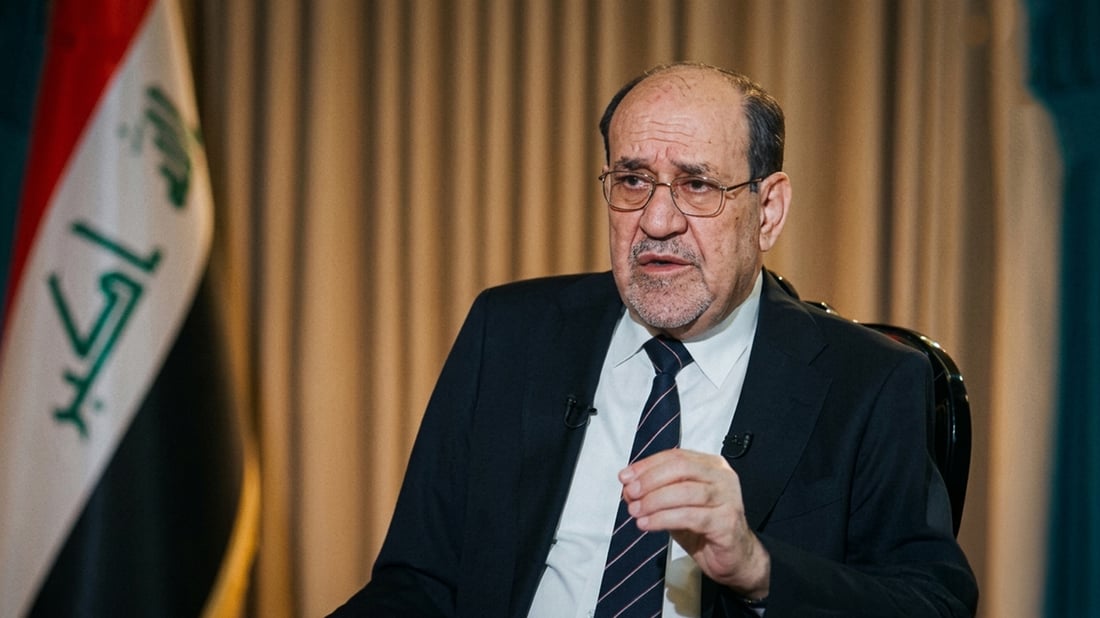
Maliki warns disarmament push must not trigger clash with armed factions
BAGHDAD — State of Law Coalition leader Nouri al-Maliki warned Wednesday that Iraq’s effort to bring weapons under state control must not turn into a confrontation between the government and armed factions, days after Prime Minister Ali al-Zaidi publicly ruled out such a conflict and said political forces had agreed to pursue the process peacefully.
Maliki made the comments during a meeting with political analysts and specialists, according to a statement from his office, as debate intensifies over how Iraq will deal with groups carrying weapons outside state authority after the U.S.-led coalition mission ends Sept. 30.
He said Iraq was passing through a sensitive period requiring “a high degree of wisdom and responsibility” and called for the weapons issue to be addressed without escalation.
Maliki warned that a confrontation between state institutions and armed factions would be extremely dangerous and could threaten Iraq’s stability. He rejected suggestions that such a conflict could remain a “Shiite-Shiite” confrontation, saying its consequences would affect the state, society and all Iraqi communities.
His remarks follow Zaidi’s assurance at the eighth Baghdad Dialogue Conference on Friday that the government would not pursue the weapons issue through military confrontation.
“There are no intentions or possibilities of any military confrontation, and we will not allow Iraq’s enemies to exploit any opportunity,” Zaidi said. “All political forces are in complete agreement on proceeding with restricting weapons to the state, and work is underway on mechanisms for handing over weapons and completely ending this situation.”
Maliki said the government and the Coordination Framework, the main alliance of Shiite political forces, would not allow the country to slide into internal fighting. He called for a clear national and regional approach to prevent Iraq from becoming an arena for competing regional and international interests.
The debate centers on armed factions that expanded during the war against the Islamic State group, many of which operate within the Popular Mobilization Forces. The PMF was formally incorporated into Iraq’s security establishment, but some factions maintain separate political and military structures. Iraqi authorities have said the policy of restricting weapons to state control targets arms and commands operating outside formal state institutions rather than the PMF as a state security body.
The issue has become closely tied to Sept. 30, when the current phase of the U.S.-led coalition mission in Iraq is scheduled to end. During a July visit to Washington, Zaidi said there would be “no justification” for armed factions after that date, arguing that the departure of coalition forces would remove the principal rationale cited by groups that describe themselves as resistance factions.
The State Administration Coalition, which brings together Iraq’s main governing political forces, subsequently said armed activity outside state authority after Sept. 30 would be dealt with under the Anti-Terrorism Law. Prime Minister’s security adviser Qasim al-Araji has since clarified that Sept. 30 is the coalition withdrawal date rather than an immediate deadline for factions to surrender their weapons, and said it would mark the beginning of understandings on the process.
Several factions, including Saraya al-Salam, Asaib Ahl al-Haq and the Imam Ali Battalions, have moved toward compliance with the government process, while Kataib Hezbollah, Harakat al-Nujaba and Kataib Sayyid al-Shuhada have refused to disarm while U.S. forces remain in Iraq.
The Coordination Framework has formed a committee involving Maliki, Badr Organization leader Hadi al-Amiri and former Prime Minister Mohammed Shia al-Sudani to pursue negotiations over the weapons issue. Sudani also met a Harakat al-Nujaba delegation, with both sides calling for dialogue and de-escalation in resolving disputes.