
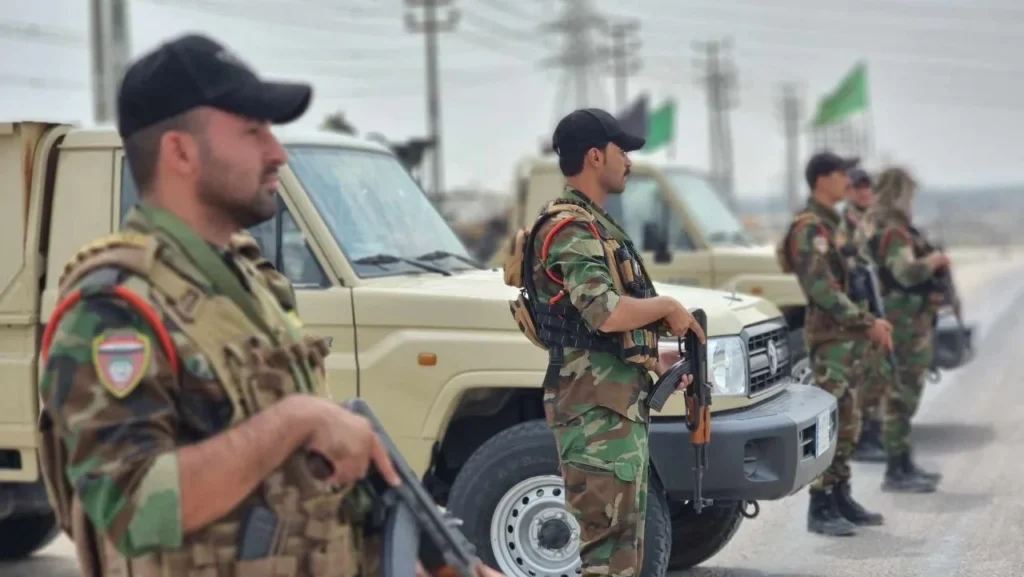
Popular Mobilization Forces members stand guard beside military vehicles
Authorities close 71 ‘fake’ offices that claimed to be PMF headquarters
BAGHDAD — Iraqi authorities have closed 71 offices whose operators claimed affiliation with the Popular Mobilization Forces, the Interior Ministry said Monday, and the PMF said none of them had any connection to the organization.
“The fake headquarters announced by the Interior Ministry, whose operators claimed affiliation with the Popular Mobilization Forces, have no connection whatsoever to the authority,” the PMF said. Its General Directorate of Security and Discipline took part in closing and investigating the offices under the Committee for Weapons Control, established by order of the commander-in-chief, and it said it would keep investigating similar cases and pursue legal and administrative measures against anyone using its name without authorization.
Miqdad Miri, the Interior Ministry’s director of media and public relations, announced the closures at a news conference. Neither body said where the offices were, what they had been doing, how long they had operated or whether anyone was arrested.
Prime Minister Ali al-Zaidi’s government set up the weapons-control committee in June to draw up binding procedures for withdrawing weapons and ending political affiliations within the security forces, with representatives from the army, the interior and defense ministries and the PMF. Saraya al-Salam, Asaib Ahl al-Haq and the Imam Ali Battalions have moved to comply; Kataib Hezbollah and Harakat al-Nujaba have refused.
The closures come as the committee weighs proposals that would break up PMF units formed around individual factions, redistributing fighters between brigades, putting army officers into the command structure and retiring the generation of commanders who took charge in 2014, sources told 964media.
The PMF was formed in 2014 after Grand Ayatollah Ali al-Sistani called for volunteers to fight the Islamic State group after it seized Mosul, and parliament recognized it in 2016 as part of Iraq’s security apparatus under the commander-in-chief. It grew into an umbrella of dozens of brigades, some closely tied to Iran and the Revolutionary Guard, and its place in the state has been contested ever since.