
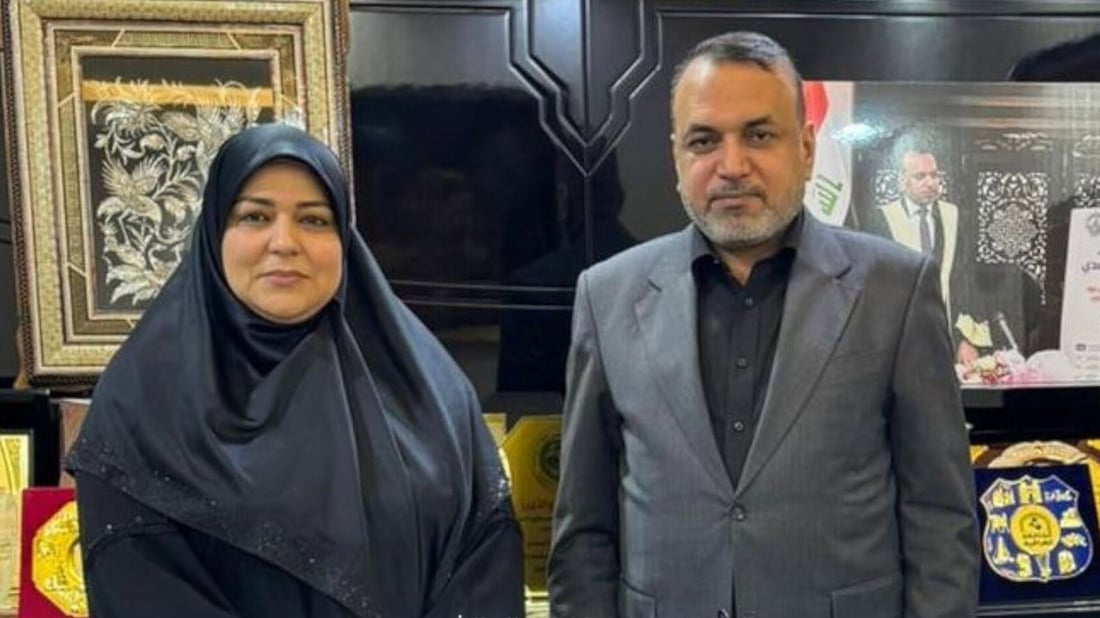
Karbala MP Ghufran Iqbal Al-Shammari, left, with former Labor and Social Affairs Minister and Sumeriyoun Alliance leader Ahmed Al-Asadi.
Karbala MP quits Sumeriyoun bloc after arrest warrants issued for Al-Asadi
BAGHDAD — Karbala lawmaker Ghufran Iqbal Al-Shammari announced her withdrawal from the Sumeriyoun parliamentary bloc, led by former Labor and Social Affairs Minister Ahmed Al-Asadi, saying she will continue her work in Iraq’s parliament as an independent.
Al-Shammari announced the decision after the Baghdad Karkh Court of Appeal issued two arrest warrants for Al-Asadi, the head of the Sumeriyoun Alliance and a former labor minister. The warrants accuse Al-Asadi of failing to establish the legitimate source of an increase in his wealth and of directly benefiting from contracts and projects that he was involved in preparing in his capacity as minister, according to the court documents.
“I announce, with complete clarity and responsibility, my withdrawal from the Sumeriyoun bloc and the continuation of my parliamentary career independently in my position, decisions and performance within the Iraqi parliament,” Al-Shammari wrote in a Facebook post.
Al-Shammari said her decision stemmed from what she described as her “national responsibilities.” She also distanced herself from anyone found by the courts to have been involved in corruption.
“My position on corruption is firm and clear, and I declare my political and moral disavowal of any person against whom corruption cases are proven in accordance with the law and judiciary,” she said. “I also reject having my name, position or parliamentary work used as cover for any suspicion affecting public funds, the dignity of the state or the rights of Iraqis.”
“There is no immunity before the law, no friendship above the interests of the nation, and no position above the trust of the people,” she added.
Asadi was labor minister under Mohammed Shia al-Sudani and is a senior figure in the Coordination Framework, the Shia alliance that backs the government. His case is the first at that level within the alliance since the campaign began.
Al-Shammari said her withdrawal did not diminish her respect for her former colleagues in the Sumeriyoun bloc and wished them “success” in their parliamentary work. She said becoming an independent would give her greater freedom in oversight and legislation.
The announcement marks a change from Al-Shammari’s public position less than a month ago, when she denounced what she described as an “organized campaign” against Al-Asadi. At the time, she urged Sumeriyoun supporters to “remain united” and called for allegations to be handled through legal proceedings rather than social media.
The arrest warrants against al-Asadi were signed on July 29, eight days after Asadi publicly denied being wanted by the judiciary. Asadi said on July 21 that he was not wanted and faced no warrant. “I am not wanted by the judiciary, and no arrest warrant has been issued against me,” he said in audio statements, which was accurate at the time. He said he had been abroad for medical treatment when “one of those close to me” took actions that raised suspicions, that he had stayed silent during a media campaign for fear of affecting the investigation, and that he had opened his offices and records to investigators. He acknowledged that money belonging to him had been seized but said it was lawful and “less than the figures that were announced.”
A day earlier, Coordination Framework figure Amer Al-Fayez said Prime Minister Ali Al-Zaidi had informed leaders of the alliance that he intended to arrest Al-Asadi upon his return from Australia over corruption suspicions. Al-Fayez said the Coordination Framework had given Al-Zaidi approval to arrest anyone accused of corruption.
Meanwhile, Baghdad’s Karkh Court of Appeal has asked parliament to lift the immunity of lawmaker Nazem al-Asadi over contracts awarded by the Labor and Social Affairs Ministry to a company the court says he founded jointly with the ministry’s former head, Ahmed al-Asadi.
Corruption investigations have widened since the arrest of former Deputy Oil Minister Adnan al-Jumaili in May, covering government contracts, money laundering and misuse of public funds, and have reached ministers, lawmakers, political figures and businesspeople.