
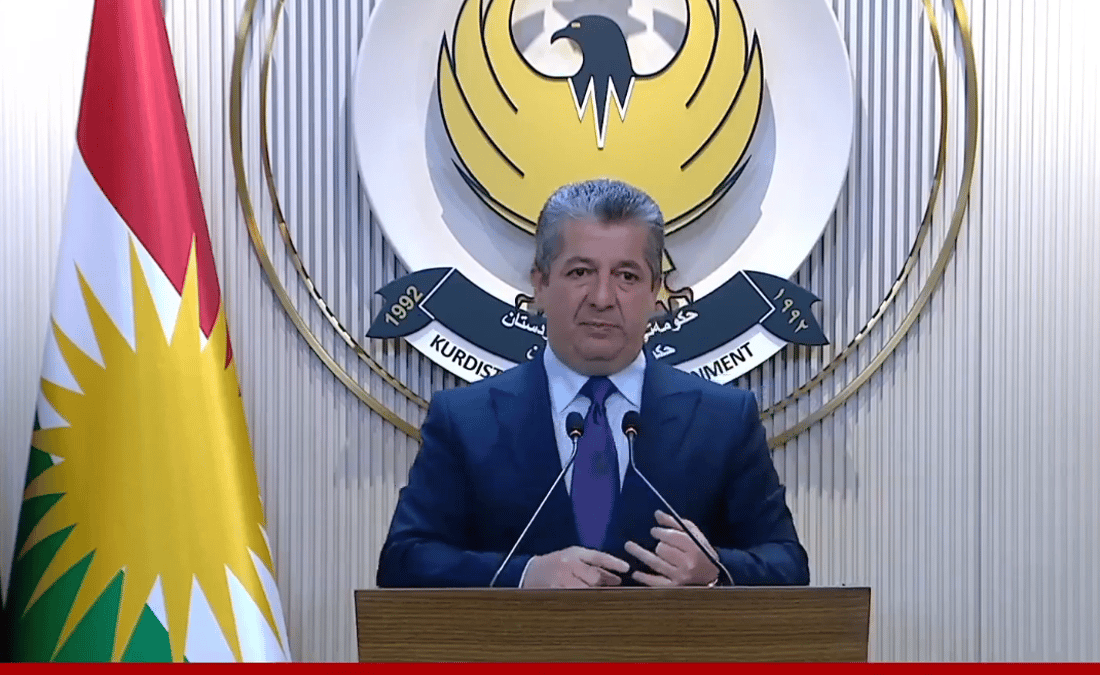
KRG Prime Minister Masrour Barzani
PM Barzani: Kurdistan Region not obstacle to oil exports
ERBIL — Kurdistan Region Prime Minister Masrour Barzani said Tuesday that the federal government bears responsibility for stopping attacks targeting the Kurdistan Region, while pushing back on Baghdad’s characterization of the KRG as an obstacle to oil exports.
“The government will do whatever is necessary to protect the people of Kurdistan,” Barzani said at a press conference, thanking security and international forces for intercepting drones and missiles. “We reassure the people of Kurdistan, we will live and die together.”
He said the Kurdistan Region has not been a party to the regional war but has suffered its consequences. “Unfortunately, Kurdistan has been attacked with drones and missiles. The attacks on the region have no justification, because the region has not posed a threat or danger to any side.” Iran’s IRGC and allied Iraqi militias have carried out 307 attacks on the Kurdistan Region since the war began Feb. 28, killing eight people and wounding 51, according to Community Peacemaker Teams – Iraqi Kurdistan.
Barzani called on Baghdad to act against what he described as “outlaw groups” carrying out the attacks, saying some “receive salaries from the Iraqi government and are provided with weapons and funding” — an allegation the KRG’s Ministry of Natural Resources also leveled earlier this week in the context of the oil dispute.
On that dispute, Barzani was direct: “The Kurdistan Region is not an obstacle to oil exports.” His remarks were a response to Baghdad’s escalating accusations — Iraq’s Oil Ministry said Tuesday the KRG’s position was “purely political” and threatened legal action, while accusing Erbil of violating the constitution by refusing to resume shipments through the Kirkuk-Ceyhan pipeline. The KRG has rejected those claims, saying the federal government distorted the issue and pointing to the dollar embargo Baghdad imposed on Kurdistan Region traders since January and militia attacks on energy infrastructure that have brought production to a standstill.
Barzani said production currently stands at around 250,000 barrels per day, with pipeline exports ranging between 250,000 and 300,000 barrels per day — volumes he noted fall well short of compensating for the loss of southern exports. “This does not reach half a million barrels and cannot compensate for the oil Iraq was exporting,” he said, attributing the production shortfall directly to attacks on oil and gas fields. He called on the federal government to halt those attacks so that Kurdistan Region fields could resume contributing alongside Kirkuk crude.
Barzani also called for salary transfers to Kurdistan Region employees to be sent on time and “not be turned into a pressure card” — a reference to Baghdad’s chronic delays in payroll transfers, which the KRG says have been used as leverage in the broader dispute.
On the internal political situation, Barzani called for unity among political parties, saying “we must all get through this crisis together.”