
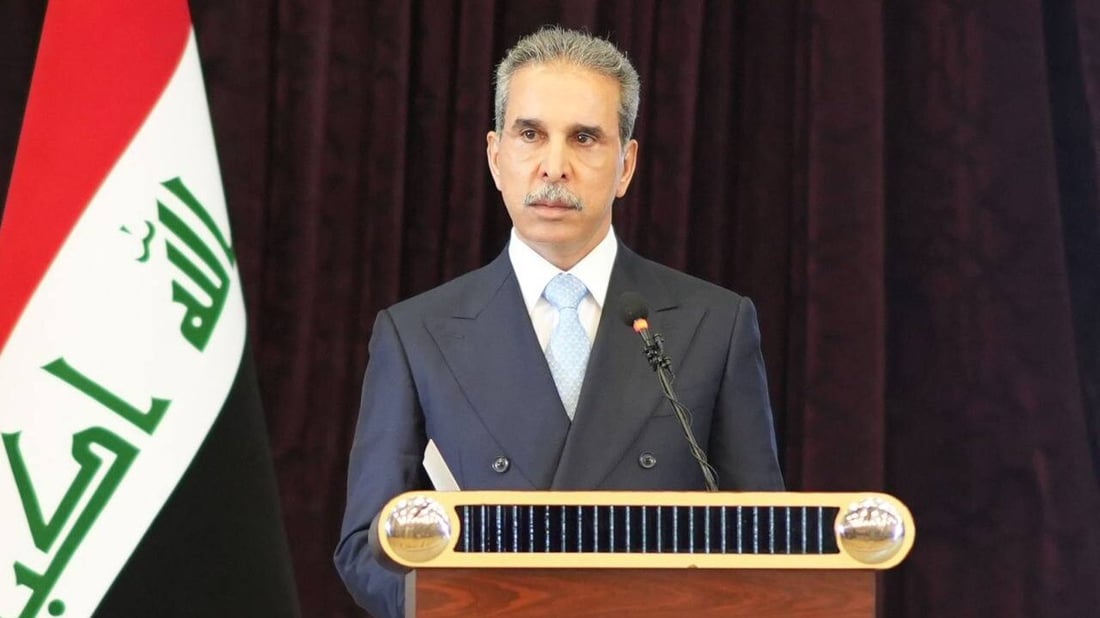
Iraq’s Supreme Judicial Council head Faiq Zaidan
Iraq’s top judge proposes revisiting Iraq’s ‘largest bloc’ ruling amid political deadlock
BAGHDAD — Iraq’s Supreme Judicial Council President Faiq Zaidan has proposed revisiting the Federal Supreme Court’s landmark 2010 interpretation of which parliamentary bloc has the right to form a government — the same ruling that originally delivered the premiership to Nouri al-Maliki, and whose reversal could now prevent his return.
In an article published Tuesday in Asharq Al-Awsat titled “The Sin of the Incorrect Interpretation of the Constitution,” Zaidan argued that the court’s 2010 ruling on Article 76 of the constitution “contained several constitutional flaws” and “contradicted the clear text of the constitution.” The ruling allowed blocs to form post-election alliances to claim the largest parliamentary coalition, even if they did not win the most seats individually.
In the 2010 elections, Iyad Allawi’s Iraqiya list won 91 seats against Maliki’s State of Law coalition’s 89. After the ruling, Maliki’s bloc joined other Shiite parties to form a larger post-election coalition and claim the right to nominate a prime minister — launching his first full term in office. Zaidan wrote that the interpretation “affects the will of the voter” because it allows political forces to alter election results through post-vote negotiations, a dynamic he said has driven prolonged government formation crises after every election since.
The concept of the largest bloc has become “a permanent axis of political conflict due to an interpretation whose effect is political more than legal,” Zaidan wrote.
Zaidan outlined three possible remedies: a constitutional amendment by parliament, an amendment to the law governing the Council of Representatives, or a new Federal Supreme Court interpretation replacing the 2010 ruling — noting that more than 15 years have passed and the court now operates under different leadership and composition.
If the court were to reinterpret Article 76 and grant the right to form the government to the election-winning list rather than the largest post-election coalition, Prime Minister Mohammed Shia al-Sudani’s Reconstruction and Development Coalition — which won 46 seats in the November 2025 elections, the most of any single list — would receive the mandate to form the next cabinet. Maliki’s State of Law Coalition won 29 seats.
The Coordination Framework, the broader Shiite coalition that includes Maliki’s bloc, has declared itself the largest parliamentary coalition and nominated Maliki as its prime ministerial candidate. The nomination has fueled internal divisions, drawn Sunni opposition and prompted U.S. criticism, with President Trump warning Washington would not continue support for Iraq if Maliki returned to office. Maliki has declined for weeks to attend Framework meetings or engage with withdrawal scenarios.
A reinterpretation would not resolve the separate constitutional requirement to elect a president, which requires a two-thirds quorum of 220 of 329 lawmakers — a threshold political parties have so far been unable to assemble.